





1. 서 론
한국은 6·25 전쟁 이후 1960~70년대 수출 주도형 산업화를 적극 추진하면서 국제 무역량이 급격히 증가하였다. 1962년 450만 톤에 불과하던 무역량은 1979년 9,080만 톤으로 약 20배 성장하였으며, 2015년에는 12억 2,030만 톤에 달하여 1962년 대비 271배의 성장을 기록하였다(MOLIT, 2017). 이러한 급격한 물동량 증가는 한국이 세계 주요 해운 국가로 부상하는 기반이 되었으며, 항만 인프라의 역할이 국가 경제 전반에서 차지하는 비중을 더욱 높이는 계기가 되었다. 이에 대응하기 위해 정부는 항만 시설 확충에 대규모 투자를 시행하였으며, 1976년 3,400만 톤에 불과하던 항만 처리 능력은 2016년 11억 4,000만 톤으로 약 34배 증가하였다(MOF, 2016). 2018년 기준 한국에는 60개의 항만이 운영 중이며, 우리나라의 국제 무역 물동량의 97%가 이들 항만을 통해 처리되고 있어(MOLIT, 2017), 항만은 국가 물류체계의 핵심 인프라로서 기능하고 있다.
그러나 양적 성장에 치중한 항만 투자는 유지관리 측면에서의 구조적 불균형을 초래하였다. 2000년대 이후 항만 건설 투자는 지속되는 반면, 유지관리 예산은 연간 1,000억 원 내외에 머물러 있다. 정부의 사회간접자본(SOC) 중장기 예산 계획(2017~2021)에 따르면, SOC 예산은 2017년 14.7조 원에서 2021년 10.8조 원으로 연평균 7.5% 감소할 예정으로 (MOSF, 2017), 항만 인프라 유지관리에 투입될 수 있는 재원은 더욱 제한될 것으로 전망된다. 이처럼 축소되는 예산 환경 속에서 지속적으로 노후화되는 항만 인프라를 효율적으로 유지·관리하기 위해서는 시설물의 열화(deterioration) 과정을 과학적으로 예측하고, 그 결과를 생애주기 유지관리(Life Cycle Management, LCM) 예산 계획에 체계적으로 반영하는 접근이 필수적이다.
항만은 안벽(quay wall), 크레인, 하역 장비, 창고 등 다양한 시설로 구성되며, 이 중 안벽은 토목 인프라로 분류된다. 항만 토목 인프라는 기계·전기 설비에 비해 유지관리가 상대적으로 소홀히 이루어져 왔으며, 법정 내용 연한에 관한 규정도 부재하여 100년 이상 운용되는 시설도 존재한다(PIANC, 1998). 이러한 제도적·인식적 한계로 인해 항만 토목 인프라의 열화 모델에 관한 연구는 국내외적으로 활발히 수행되지 않았다(Zhang et al., 2016). 현행 유지관리 비용 추정 방식 또한 건설비 대비 일정 비율을 적용하는 경험적 접근에 의존하고 있어, 실제 시설물의 열화 상태를 반영하지 못하는 구조적 한계를 지닌다(Cha, 2008; PIANC, 2008). 이는 예산의 비효율적 배분과 긴급 보수 소요의 증가로 이어질 수 있으며, 장기적으로는 항만 안전성 저하라는 심각한 결과를 초래할 위험성을 내포한다.
기존의 인프라 열화 모델 연구는 주로 도로 포장, 교량, 상하수도 등 육상 인프라를 중심으로 발전해 왔으며(Butt et al., 1987; Carnahan et al., 1987; Jiang et al., 1988; Madanat et al., 1995; Frangopol et al., 2001; Morcous et al., 2002), 항만 토목 인프라에 대한 적용은 상대적으로 미진한 상태이다. 특히 마르코프 연쇄 기반 열화 모델은 시설물의 상태 전이를 확률적으로 기술하는 방법론으로 널리 활용되어 왔으나(Golabi et al., 1997; Thompson et al., 1998), 항만 안전 등급 데이터에 적용할 경우 두 가지 핵심적 제약에 직면한다. 첫째, 국내 항만 안전진단 자료는 시설물 종류·위치·진단 주기의 비균등성으로 인해 표본 수가 제한적이다. 둘째, 정밀안전진단이 4~6년 주기로 실시됨에 따라 중간 시점의 안전 등급 데이터가 구조적으로 결측되어 있다. 이러한 소규모·결측 자료 문제는 전이확률행렬(Transition Probability Matrix, TPM)의 안정적 추정을 저해하며, 기존의 단순 최적화 기반 접근으로는 추정 불확실성을 충분히 반영하기 어렵다.
이에 본 연구는 이러한 방법론적 공백을 메우기 위해 MCMI(Bayesian Markov Chain Monte Carlo with Multiple Imputation) 기반 통합 추정 프레임워크를 제안한다. MCMI 는 Bayesian 추론 체계인 MCMC와 다중 대체법(Multiple Imputation, MI)을 유기적으로 결합한 통합 캘리브레이션 프레임워크로, 기존 기법들이 개별적으로만 적용되어 왔던 두 방법론을 항만 열화 분석에 처음으로 통합 적용한다는 점에서 독창성을 지닌다. MCMC는 복잡한 사후분포에서 직접 표본을 생성하여 전이확률의 불확실성을 정량화할 수 있는 반면, 결측 자료 문제를 독립적으로 해결하기 어렵다. MI는 결측값을 복수의 가능한 값으로 대체하여 결측 불확실성을 추정에 반영할 수 있으나, 단독으로 적용될 경우 모수 추정의 사후 불확실성을 충분히 포착하지 못한다. MCMI는 이 두 방법론의 상호 보완적 강점을 결합함으로써, 소규모 자료와 결측 자료가 동시에 존재하는 항만 안전진단 데이터 환경에서 TPM을 더욱 안정적이고 신뢰성 있게 추정할 수 있는 방법론적 기반을 제공한다.
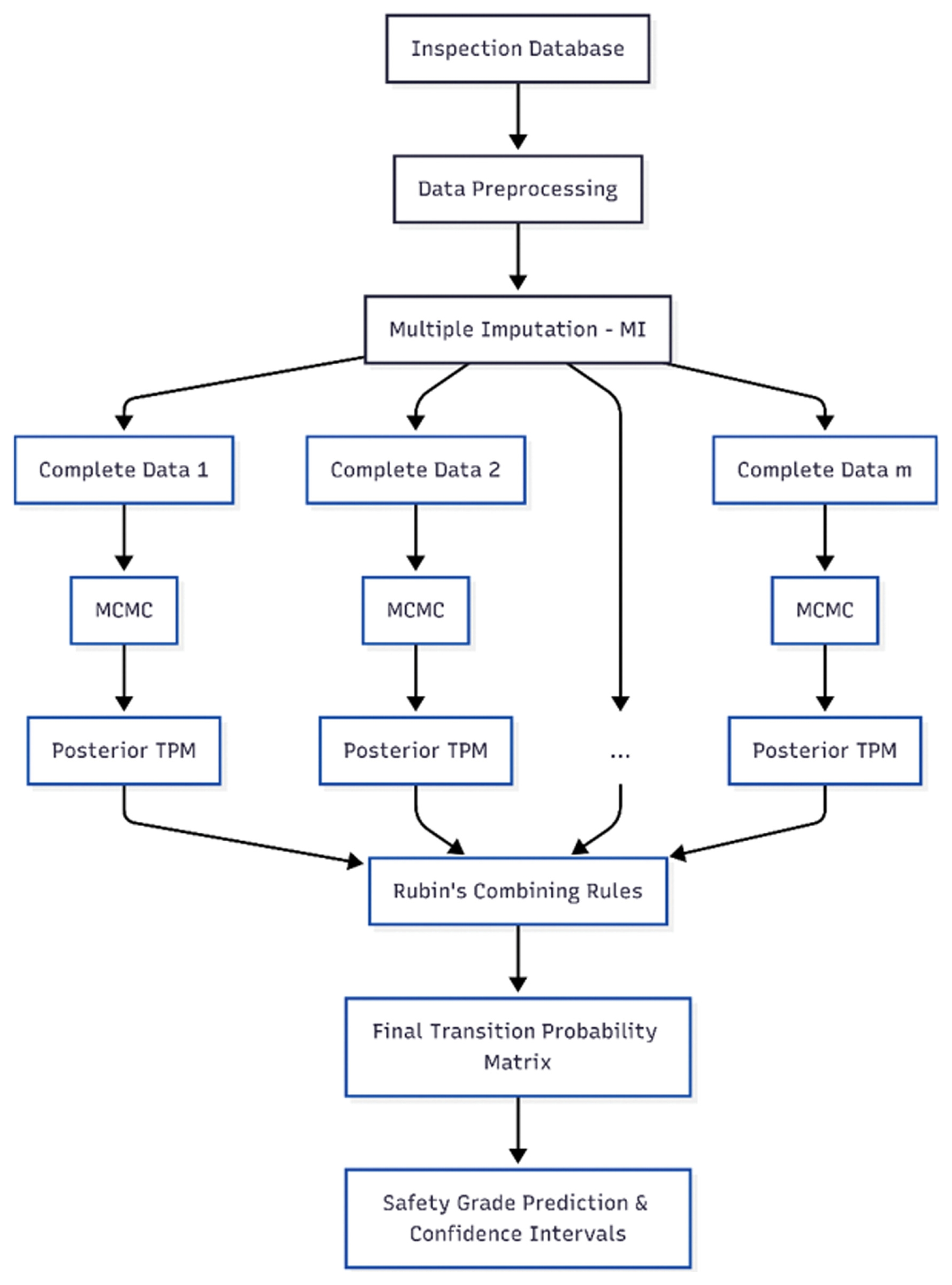
구체적으로 MCMI의 작동 원리는 다음과 같다. 먼저 MI 단계에서는 결측 메커니즘을 임의 결측(Missing At Random, MAR)으로 가정하고, 관측된 안전 등급 자료의 분포 구조를 반영하여 복수의 완전 데이터셋을 생성한다(Rubin, 1987). 이어서 MCMC 단계에서는 각 완전 데이터셋에 대해 Metropolis-Hastings 또는 Gibbs sampling 절차를 적용하여 TPM의 사후분포를 추정한다. 마지막으로 결합 단계에서는 Rubin의 결합 규칙(Rubin's combining rules)에 따라 복수의 사후분포 추정 결과를 통합함으로써, 결측 불확실성과 모수 불확실성을 동시에 반영한 최종 전이확률 추정치를 산출한다. 이 과정은 단일 추정치에 의존하는 최적화 기법이나 결측 처리 없이 적용되는 MCMC 단독 기법과 구별되며, 불완전한 자료에서도 편향과 분산을 보다 현실적으로 통제할 수 있다는 방법론적 우위를 갖는다.
본 연구의 구체적인 연구 목표는 다음과 같이 설정된다.
첫째, 마르코프 모델의 TPM 추정을 위한 네 가지 캘리브레이션 기법(Optimization, OWBB, MCMC, MCMI)을 실제 항만 안전진단 자료에 적용하고, 예측 정확도 및 불확실성 정량화 측면에서 체계적으로 비교 분석한다.
둘째, 소규모 자료 및 구조적 결측 문제를 동시에 처리하기 위한 통합 프레임워크로서 MCMI 기법을 제안하고, 그 방법론적 타당성과 추정 성능을 검증한다.
셋째, MCMI 모델의 장기 예측 결과를 바탕으로 한국 항만의 안전 등급 변화 궤적을 분석하고, 이를 생애주기 유지 관리 예산 계획 수립에 활용하는 실무적 방안을 도출한다.
본 연구의 학술적 기여는 크게 두 측면에서 찾을 수 있다. 방법론적으로는 Bayesian 추론과 다중 대체법의 통합이라는 새로운 캘리브레이션 체계를 항만 토목 인프라 분야에 최초로 적용함으로써, 기존 연구에서 충분히 다루어지지 않았던 소규모·결측 자료 문제를 통계적으로 엄밀하게 처리하는 방안을 제시한다. 실무적으로는 예측 결과를 생애주기 유지관리 비용 추정과 연계하여, 제한된 예산 환경에서 항만 인프라의 유지관리 우선순위를 탐색하기 위한 스크리닝 수준의 우선순위 결정(screening-level prioritization)을 지원하는 기초 체계로서 기여한다. 이는 노후 인프라 관리 문제가 심화되고 있는 국내외 항만 관리 기관에 실질적인 정책적 함의를 제공할 것으로 기대된다.
2. 이론적 배경
2.1 한국 항만의 안전 등급 체계
시설물의 안전등급은 「시설물의 안전관리에 관한 특별법」에 의거하여 공공 인프라의 성능 지표로 안전 등급(A~E)이 강제 적용된다. 안전 등급은 상태 조사(state analysis)와 구조 안전성 분석(structural safety analysis)을 바탕으로 산출되는 상태 지수(Condition Index, CI)와 연계되며, CI 값에 따라 A(최우수)부터 E(불량)까지 5단계로 구분된다(MOLIT, 1997). CI는 시설물의 물리적 열화 상태를 정량적으로 표현하기 위한 수치 지표로, 1.0~5.0의 범위를 가지며 값이 높을수록 시설물의 상태가 양호함을 의미한다. CI 산출은 두 단계로 구성된다. 먼저 상태 조사 단계에서는 시설물의 균열, 부식, 변형, 박리 등 외관상 결함을 조사하여 부재별 상태 점수를 산정하고, 구조 안전성 분석 단계에서는 주요 부재의 내하력·내구성 등 구조적 성능을 분석하여 안전성 점수를 산정한다. 이 두 결과를 가중 평균하여 최종 CI를 산출하며, 해당 CI 값에 따라 Table 1과 같이 안전 등급이 결정된다.
항만에 대한 정밀점검은 현행 안전 등급에 따라 1~3년 주기로, 정밀안전진단은 4~6년 주기로 실시된다. 이러한 점검 주기의 비균등성으로 인해 안전 등급 데이터는 시설물별·시기별로 관측 빈도가 상이하며, 중간 시점의 데이터가 구조적으로 결측되는 특성을 지닌다. 이는 마르코프 기반 열화 모형의 전이확률 추정 시 소규모·결측 자료 문제를 야기하며, 본 연구에서 MCMI 기법을 제안하게 된 방법론적 배경이 된다.
2.2 마르코프 연쇄 기반 열화 모델
2.2.1 마르코프 연쇄 모델의 기본 구조
마르코프 연쇄 기반 열화 모델은 시설물의 상태 전이를 확률적으로 기술하는 모형으로, 전이확률행렬(Transition Probability Matrix, TPM)의 추정을 통해 시설물의 장기 열화 과정을 예측한다. 본 연구의 마르코프 열화 모형은 항만의 안전 등급을 A, B, C, D, E의 5단계 상태공간으로 정의하며, 각 상태는 연령 증가에 따라 상위 상태로는 이동하지 않고 동일 상태를 유지하거나 한 단계 더 열화되는 단방향 전이 구조를 갖는다고 가정한다. 또한 각 안전 등급에 지표값을 할당하여 연산 처리가 가능하도록 A, B, C, D, E를 각각 5, 4, 3, 2, 1의 값으로 매핑하여 상태지수(Condition Index, CI)와 연계하였다. 본 연구는 보수 또는 복구가 반영되지 않은 자연 상태의 열화 과정을 대상으로 하므로, 한 연도 내 안전 등급의 변화는 한 단계 이내로 제한된다고 가정한다. 이러한 가정에 따라 항만 안전 등급의 TPM PP는 다음과 같이 표현된다.
여기서, pAA, pBB, pCC, pDD는 각각 A, B, C, D등급에서 다음 연도에도 동일 등급을 유지할 확률을 의미하며, 마지막 등급인 E는 최하위 상태이므로 전이 후에도 E 상태를 유지한다고 본다. 건설 시점(t = 0)의 초기 상태벡터를 C0 = (1,0,0,0,0)으로 설정하면, 연령 t년 후의 상태벡터 Ct 는 다음과 같이 산출된다.
계수벡터 R = {5, 4, 3, 2, 1}을 도입하면, 연령 t에서의 상태지수는 다음과 같이 계산된다.
2.2.2 TPM 캘리브레이션 기법
마르코프 기반 열화 모형에서 TPM의 추정은 모델의 예측 성능을 좌우하는 핵심 단계이다. 본 연구에서는 TPM을 추정하기 위하여 최적화법, OWBB(Optimization with Bayesian Bootstrap), MCMC, MCMI(MCMC with Multiple Imputation)의 네 가지 캘리브레이션 기법을 적용하였다. 각 기법은 동일한 안전 등급 자료를 대상으로 하되, 추정의 관점과 불확실성의 처리 방식에서 차이를 가진다.
(1) 최적화법
최적화법은 관측자료와 모형 예측치 사이의 차이가 최소가 되도록 TPM 파라미터를 결정하는 방법이다. 본 연구에서는 각 안전등급의 관측값을 수치화한 후, 연령별 예측 상태지수와의 제곱오차 합을 목적함수로 설정하였다. 목적함수는 다음과 같이 정의할 수 있다.
여기서, C R i o b s
(2) OWBB 기법
OWBB(Optimization with Bayesian Bootstrap)는 최적화법의 단일 추정치 한계를 보완하기 위하여 Bayesian Bootstrap 을 결합한 방법이다. Bayesian Bootstrap은 관측치에 Dirichlet 기반 가중치를 부여하여 재표집을 수행하는 방식으로, 표본의 불확실성을 확률적으로 반영할 수 있다(Rubin, 1981). 본 연구에서 OWBB는 다음의 절차로 수행하였다. 먼저 원자료로부터 Bayesian Bootstrap을 이용하여 재표집 자료를 생성하였다. 이후 각 재표집 자료에 대하여 최적화법을 적용하여 TPM을 추정하였다. 이 과정을 충분한 횟수만큼 반복하여 TPM 파라미터의 경험적 분포를 구하였으며, 분포의 중위값을 대표값으로, 2.5퍼센타일과 97.5퍼센타일을 95% 신뢰구간으로 제시하였다. 재표집을 위해서 Python의 numpy.random.choice 를 이용하였으며, 최적화를 위해서 scipy.optimize.minimize가 사용되었으며, 각 반복에서 얻어진 재표집 자료에 대해 동일한 최적화 절차를 적용하였다. 즉, OWBB는 별도의 독립적인 최적화 알고리즘이라기보다, Bayesian Bootstrap과 최적화법을 결합한 반복 추정 절차로 이해하는 것이 적절하다. OWBB는 최적화법과 비교하여 불확실성을 정량화할 수 있고, 재표집을 통해 결과의 변동성을 확인할 수 있다는 장점이 있다. 다만 기본 구조가 최적화법에 기반하므로 초기값 의존성은 완전히 제거되지 않는다. 따라서 본 연구에서는 반복 재표집을 통해 이러한 민감성을 완화하고자 하였다.
(3) MCMC 기법
베이지안 마르코프 연쇄 몬테카를로(Bayesian Markov Chain Monte Carlo, MCMC)는 복잡한 사후분포로부터 직접 표본을 생성하여 모수의 불확실성을 정량화하는 베이지안 계산 기법이다(Micevski et al., 2002; Tran, 2007). 최적화법이 TPM의 단일 점추정값만을 제공하는 것과 달리, MCMC는 각 전이확률의 사후분포를 제공함으로써 추정의 불확실성을 신뢰 구간으로 표현할 수 있다는 장점이 있다(Jeon, 2019). MCMC 의 이론적 기반은 사후분포(posterior)는 사전분포(prior)와 우도(likelihood)의 곱에 비례한다는 베이즈 정리(Bayes’ theorem)이다.
여기서, p(θ|D)는 관측 자료 D가 주어졌을 때 모수 θ에 대한 사후분포이며, p(D|θ)는 우도, p(θ)는 사전분포이다. 즉, 사전정보와 관측자료를 결합하여 모수의 분포를 갱신하는 과정이 베이지안 추론의 핵심이다. 사후분포를 해석적으로 계산하기 어려운 경우, MCMC 시뮬레이션을 통해 사후분포로부터 표본을 추출하는 방식으로 근사한다. 본 연구에서는 MCMC 알고리즘으로 Metropolis-Hastings Algorithm(MHA)을 채택하였다(Chib and Greenberg, 1995). MHA는 현재 위치 θ (i)에서 제안분포 θ (θ *|θ (i))를 이용하여 후보 표본 θ *를 생성하고, 다음의 수용확률 α에 따라 후보를 채택하거나 기각한다.
균일분포 U(0,1)에서 추출한 난수 u와 α를 비교하여, u < α 이면 θ(i+1) = θ *로, 그렇지 않으면 θ(i+1) = θ i로 설정한다. 이 과정을 반복하면 마르코프 연쇄의 정류분포(stationary distribution)가 목표 사후분포로 수렴하게 된다. 본 연구에서 TPM의 미지 모수는 pAA, pBB, pCC, pDD 의 4개이며, 이들은 모두 0과 1 사이의 값을 가져야 한다. 모수에 대한 사전 정보가 없으므로 사전분포는 U(0,1)로 설정하였으며, 이 경우 위 식은 수용확률은 우도와 제안분포만으로 단순화된다. 우도함수는 연령 t에서 안전등급 i에 속하는 시설물 수 ni(t)와 마르코프 모델에 의해 계산된 해당 등급의 존재확률 p ^ i ( t )
본 연구에서는 제안분포로 가우시안 분포를 사용하였으며, Python의 emcee 라이브러리에 구현된 Metropolis-Hastings sampler(emcee.MHSampler)를 통해 알고리즘을 실행하였다. 사후분포의 안정적인 추정을 위해 단일 체인(Single chain) 기반으로 총 13,000회의 반복 추출을 수행하였으며, 소각기간(Burn-in) 3,000회를 제외한 최종 10,000회의 표본을 매개변수 추정에 활용하였다. 아울러 궤적 그림(Trace plot)에 대한 시각적 검토를 통해 체인의 정상 상태 도달과 양호한 혼합(Good mixing)을 확인하여 수렴을 진단하였다. 대표값은 사후분포의 중위값(median)으로 산정하였고, 2.5퍼센타일과 97.5 퍼센타일을 95% 신뢰구간의 하한 및 상한으로 제시하였다.
MCMC는 초기값 의존성이 없고 파라미터의 불확실성을 신뢰구간으로 자연스럽게 표현할 수 있다는 장점이 있으나, 특정 안전등급의 관측자료가 매우 부족한 경우 사후분포가 수렴하지 않고 넓게 퍼지는 불안정성이 발생할 수 있다. 본 연구에서는 이러한 한계를 극복하기 위해 다중 대체법(Multiple Imputation)을 결합한 MCMI 기법을 추가로 적용하였다. 또한 베이지안 추정은 제한된 자료 환경에서도 단일 점추정(point estimate)이 아닌 사후분포(posterior distribution)를 기반으로 모수를 추정하므로, 전통적인 최적화 기반 추정보다 추정의 불확실성을 보다 합리적으로 반영할 수 있다. 이러한 특성은 특정 안전등급의 관측치가 매우 적은 항만 안전진단 자료와 같이 희소한 데이터(sparse data) 환경에서 특히 유리한 것으로 알려져 있다.
(4) MCMI 기법
본 연구에서는 결측자료의 불확실성과 모수 추정의 불확실성을 모형 내에 동시에 반영하기 위해, 다중 대체(Multiple Imputation)와 마르코프 체인 몬테카를로(MCMC) 알고리즘을 유기적으로 결합한 MCMI(Multiple Imputation and MCMC) 통합 캘리브레이션 프레임워크를 제안한다. 제안된 방법론은 두 기법을 단순히 순차적으로 나열하여 적용하는 기존의 한계를 넘어, 다중 대체를 통해 생성된 개별 완전자료(Complete Data)로부터 전이확률행렬(Transition Probability Matrix, 이하 TPM)의 사후분포를 독립적으로 추정하고, 이를 Rubin의 결합 규칙(Rubin's Combination Rules)에 따라 통계적으로 결합하는 통합적 구조를 취한다. 이러한 방법론적 접근은 기존의 최적화 기반 추정이나 MCMC 단독 적용 방식에 비해 모수 추정의 안정성(Stability)과 신뢰성(Reliability)을 유의미하게 향상시킨다. 특히 표본의 크기가 제한적이고 구조적 결측이 공존하는 항만 시설물 안전진단 데이터의 특성을 효과적으로 다룰 수 있다는 점에서 차별성을 지닌다.
MCMI 프레임워크의 첫 단계인 다중 대체는 수집된 데이터의 결측 메커니즘이 임의결측(Missing At Random, MAR) 이라는 가정하에 Rubin(1987)의 다중 대체 이론을 기반으로 수행된다. 항만 시설물의 안전등급 데이터에 결측이 발생하는 원인은 시설물의 물리적 열화 상태 자체에 기인하기보다, 관련 법령인 「시설물안전법」에 명시된 정기적·행정적 점검 주기와 진단 시점에 의해 제도적으로 결정되기 때문에 MAR 가정을 합리적으로 충족하는 것으로 판단할 수 있다. 구체적인 대체 절차를 위해 우선 시설별 연령에 따른 안전등급을 종단형 패널 데이터(시설-연령별 안전등급 행렬) 형태로 재구성한다. 이후 동일 시설의 미관측(결측)된 안전등급은 베이지안 부트스트랩(Bayesian Bootstrap)을 활용하여, 해당 연령(열)에서 관측된 타 시설들의 안전등급 분포로부터 확률적으로 재표집(Resampling)하여 대체한다. 이때 대체의 불확실성을 충분히 확보하기 위해 대체 횟수를 m = 100회로 설정함으로써 총 100개의 완전자료 패널을 생성한다.
최종 모수 추정 및 결합 단계에서는 매 회 생성된 100개의 완전자료에 대해 개별적으로 MCMC 알고리즘을 적용하여 사후분포를 추정한다. 사후 시뮬레이션을 통해 반복적으로 얻어진 개별 모수 추정치들의 평균값을 본 연구의 대표 TPM으로 정의하며, 추정치의 2.5% 및 97.5% 백분위수를 산출하여 95% 신뢰구간(Confidence Interval)을 구축한다. 다만, 본 연구에서 제안한 다중 대체 절차는 시설물의 안전등급이 연령 증가에 따라 유지되거나 악화될 뿐 일시적으로 호전될 수 없다는 ‘단방향 열화 제약조건’을 대체 단계에서 직접적으로 강제하지 못한다는 방법론적 한계를 지닌다. 이로 인해 생성된 일부 대체 패널 내에 등급이 일시적으로 개선되는 역전 현상이 존재할 수 있으며, 이러한 한계점이 최종 추정 결과에 미치는 영향과 구체적인 보완 방안에 대해서는 후술하는 4.3절에서 상세히 논의하고자 한다.
관측자료를 Dobs, 결측자료를 Dmis라 하면 전체 자료는 D = (Dobs, Dmis)로 표현된다. 먼저 Multiple Imputation을 이용하여 D(1), D(2), …, D(m)의 m개의 완전자료를 생성한다. 각 완전자료는 D(k)~p(Dmis|Dobs)를 만족하도록 생성된다. 여기서, Dobs는 관측된 안전등급자료, Dmis는 미관측된 안전등급자료이다. 각 완전자료에 대하여 TPM의 모수
의 사후분포는
로 정의되며, Metropolis-Hastings 알고리즘을 이용하여 추정한다. 각 데이터셋으로부터 얻어진 추정치는 θ(1), θ(2), …, θ(m)으로 표현된다. 최종 TPM은 Rubin(1987)의 Combining Rule을 이용하여
으로 계산한다. 또한 전체 분산은
이며, U ¯ = 1 m ∑ k = 1 m U k B = 1 m − 1 ∑ k = 1 m ( θ k − θ ¯ ) 2
실제 수행 절차는 다음과 같다. 먼저 안전등급 자료를 종단형 자료로 변환하였다. 다음으로 Bayesian Bootstrap을 이용해 m개의 완전자료를 생성하였다. 각 완전자료에 대해 MCMC를 적용하여 TPM을 추정한 후, 이를 결합하여 최종 파라미터를 도출하였다. 본 연구에서는 이 과정을 반복 수행하여 파라미터 분포의 안정성을 검토하였다. 파이썬 구현 측면에서 MCMI는 numpy를 이용한 부트스트랩 샘플 생성, scipy.optimize 및 emcee 기반 추정 절차를 결합한 방식으로 구성된다. 따라서 MCMI는 단일 라이브러리로 구현되는 것이 아니라, Bayesian Bootstrap용 샘플링과 MCMC 추정을 조합한 복합 절차로 이해하는 것이 정확하다. 전체 흐름은 Fig. 1과 같다.
2.2.3 모델 성능 평가 지표
열화모형의 성능은 Root Mean Square Error(RMSE)와 Index of Agreement(IA)를 이용하여 평가하였다. RMSE는 관측값과 예측값 사이의 차이를 제곱한 후 평균하여 다시 제곱근을 취한 지표로서, RMSE 값이 작을수록 모형의 예측 성능이 우수함을 의미한다. 동일한 데이터를 활용한 기법간의 상대비교에 널리 사용된다(Hyndman et al., 2006). RMSE는 다음과 같이 정의된다.
여기서, Oi는 관측값, Ei는 예측값, N은 자료의 수를 의미한다. IA는 Willmott(1985)이 제안한 지표로서, 관측값과 예측값 간의 일치 정도를 종합적으로 평가하는 데 사용된다. IA는 다음과 같이 정의된다.
여기서, Pi는 예측값, Oi는 관측값, O ¯
3. 항만 열화모델
3.1 데이터 전처리
본 연구에 사용된 데이터는 해양수산부(MOF, 2012)의 항만 유지관리 연구 보고서에 포함된 정밀안전진단 결과로서, 87개 항만의 총 417건의 안전 등급 기록으로 구성되어 있다. 해당 데이터는 1999년부터 2011년까지의 점검 결과를 포함한다. 데이터 전처리 과정에서는 다음의 가정을 적용하였다.
가정 1: 모든 항만의 안전 등급 데이터는 동일 모집단에서 추출된 것으로 간주한다. 이는 소규모 데이터 문제를 완화하기 위한 불가피한 가정이며, 향후 위치별·구조 유형별 세분화된 모델 개발의 기초가 된다.
가정 2: 점검 기록이 존재하는 연도에는 해당 안전 등급이 적용되며, 연속된 두 점검 사이의 중간 연도에는 이전 점검의 안전 등급을 유지하는 것으로 처리한다. 이는 최적화법 적용을 위한 가정이다. 이와 별도로, 2.2.2(4)절의 MCMC 및 MCMI 추정에서는 위 자료를 시설별 종단형 패널로 재구성하며, 이 패널에는 동일 시설의 관측 구간 내에서도 채워지지 않은 개별 연령 셀이 남아 있다.
가정 3: 각 항만의 연령은 건설 완료 시점을 기준(0년)으로 계산한다.
가정 4: 점검 기간 동안 보수 공사가 없었음을 전제로 열화는 단방향으로만 진행된다 가정한다.
위 가정을 적용한 전처리 결과, 최종 분석용 안전등급 데이터는 103건이며, 이를 이력 레코드 단위로 무작위 분할(record-level random split)하여 모델 구축용 78건과 검증용 25건으로 Table 2와 같이 분류하였다. 본 분할 방식의 특성 상 동일 시설의 서로 다른 시점 점검 기록이 모델 구축용과 검증용 데이터셋에 각각 나누어 포함될 수 있으며, 이는 소규모 데이터 환경에 따른 제한점 중 하나이다. 모델 구축용 자료는 TPM 추정에만 사용하였으며, 검증용 자료는 모델 구축 과정에 포함하지 않고 예측 성능 평가를 위한 독립 자료로 사용하였다. 전처리된 103건의 안전 등급 분포는 B등급이 79건(76.7%)으로 지배적이며, A등급 5건(4.9%), C등급 18건(17.5%), D등급 1건(1.0%)으로 구성되어 있다. 이처럼 특정 등급(B)에 데이터가 편중된 불균형 분포는 열화 모델의 안정성에 영향을 미칠 수 있으며, 이를 극복하기 위한 방법론적 접근이 요구된다. 특히 D등급 데이터가 1건에 불과한 점은 D등급의 변화 추정의 불확실성을 높이는 주요 요인이다. 이러한 자료의 희소성과 등급 불균형은 전통적인 최적화 기반 추정에서 불안정한 모수 추정을 초래할 수 있다. 반면 베이지안 추정은 사후분포를 기반으로 추정의 불확실성을 직접 반영하므로 제한된 표본 환경에서도 보다 안정적인 모수 추정을 제공하는 것으로 알려져 있다 (Gelman et al., 2013). 또한 다중대체는 결측자료의 불확실성을 적절히 반영하여 편향을 감소시키고 추정의 효율성을 향상시키는 방법으로 널리 활용되고 있다(Schafer and Graham, 2002). 이러한 이유로 본 연구에서는 MCMC와 MCMI 기반의 베이지안 캘리브레이션 기법을 적용하였다.
3.2 전이확률행렬(TPM) 추정
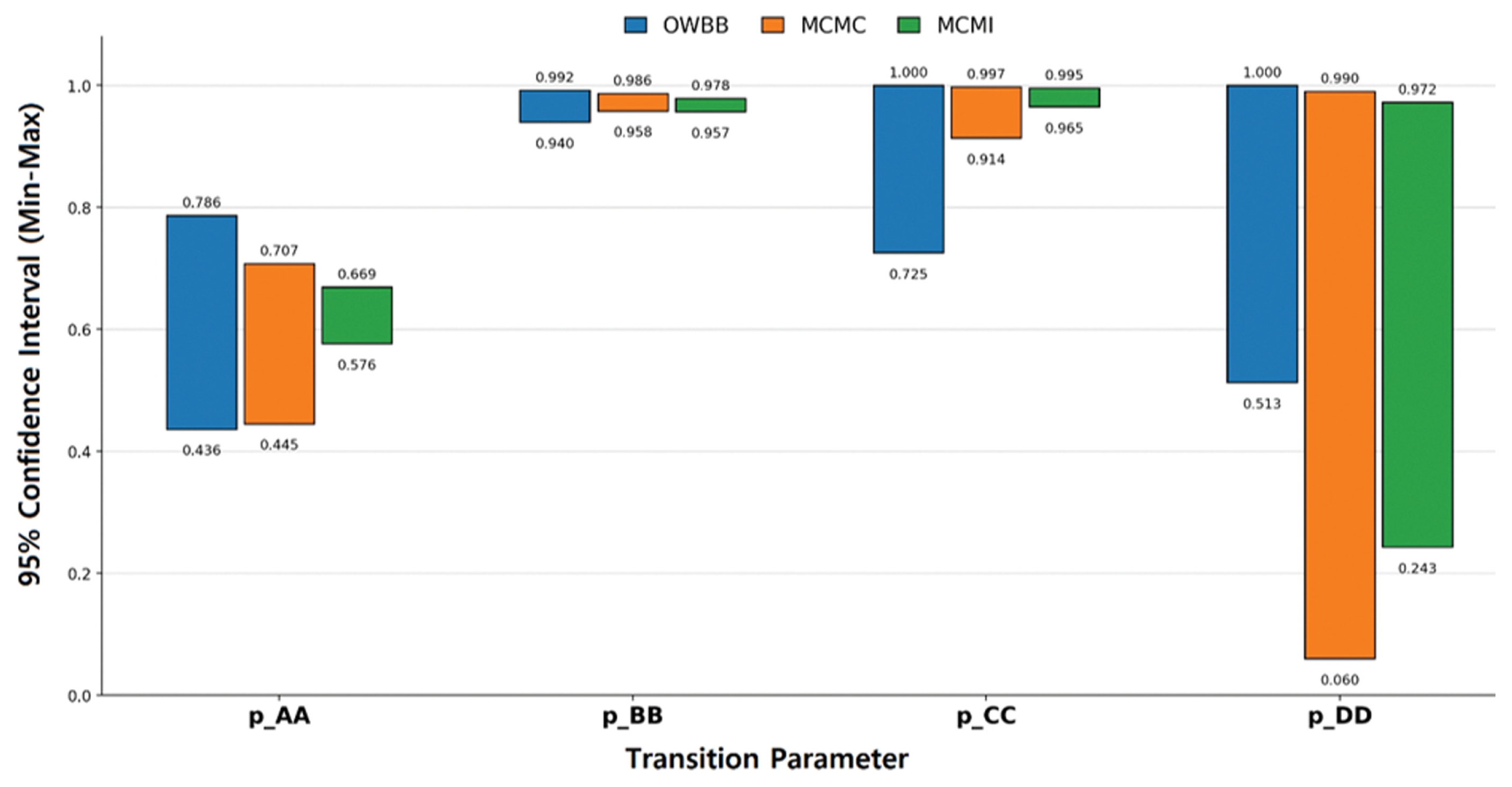
4가지 기법으로 추정된 TPM의 대표값 및 95% 신뢰구간은 Table 3과 Fig. 2와 같다. MCMC 기법의 경우 D등급 관련 파라미터 pDD의 신뢰구간이 0.060~0.990으로 매우 넓게 분포하며 불안정한 것을 확인할 수 있다. 이는 모델 구축용 데이터에 D등급 기록이 1건에 불과하여 베이지안 사전 분포를 충분히 갱신하지 못하기 때문이다. 반면 MCMI 기법은 다중 대체를 통해 데이터를 보완함으로써 pDD의 신뢰구간이 상대적으로 좁아졌으며(0.243~0.972), 이는 모델 안정성이 향상되었음을 나타낸다.
MCMI로 추정된 TPM은 아래와 같다.
3.3 모델 성능 평가 결과
4가지 기법에 대한 RMSE 및 IA 비교 결과는 Table 4와 같다. 대표값 기준으로는 Optimization, OWBB, MCMI 세 기법이 동일한 IA 값(0.722)과 RMSE 값(0.447)을 나타냈으나, 95% 신뢰구간을 고려하면 MCMI 기법의 IA 상한값(0.848)이 가장 높고 RMSE 하한값(0.346)이 낮게 나타났다. 이는 대표값 기준의 예측 성능은 세 기법이 유사하나, MCMI 기법이 신뢰구간의 범위를 통해 장기 예측의 불확실성을 가장 명시적으로 제시할 수 있음을 보여준다. Table 5에 모델별 주요 특성을 비교하였다.
3.4 안전 등급 예측 결과와 활용
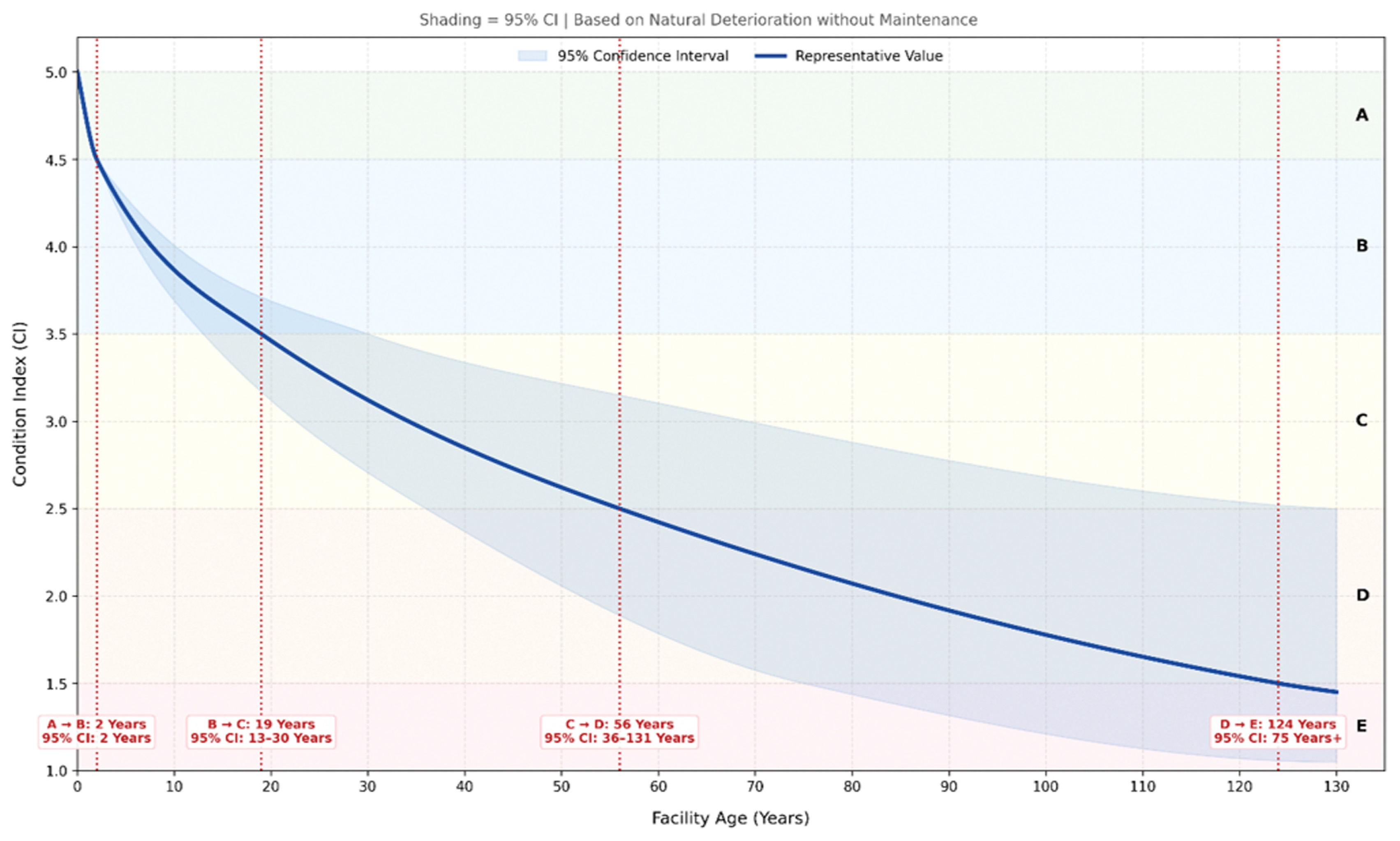
MCMI 모델의 대표 TPM을 이용하여 120년간의 상태지수(CI) 및 안전 등급 변화를 예측한 결과는 Table 6과 같다.
MCMI 모델의 예측 결과에 따르면, 국내 항만 시설은 보수 개입이 없는 자연 열화 시나리오를 기준으로 평균적으로 연령 1년까지 안전 등급 A를 유지하다가 2년에 등급 B로 전환되는 것으로 나타났다. 이후 별도의 보수 공사 없이 방치될 경우 19년(95% 신뢰구간: 13~30년)에 등급 C, 56년(95% 신뢰구간: 36~131년)에 D등급, 124년(95% 신뢰구간: 75~300년)에 E등급에 도달하는 것으로 예측되었다. 안전 등급 B에서 가장 높은 확률은 연령 7년에 0.839로 나타났으며, 안전 등급 C는 44년에 가장 높은 확률 0.482를 나타냈다. 4가지 모델 중 MCMC와 MCMI 기법이 C등급 확률을 보다 현실적으로 반영하는 것으로 평가되었으며, 전체적인 연령별 안전등급 예측 추세는 식(3)과 식(14)를 이용하여 Fig. 3과 같이 추정할 수 있다.
이러한 열화 예측 결과는 항만 유지관리 예산 계획 수립시 초기 예산 검토의 참고 기준으로 활용될 수 있다. 현행 유지 관리 비용 추정 방식은 건설비 대비 일정 비율을 적용하는 경험적 방식으로, 실제 열화 상태를 반영하지 못해 과대 또는 과소 추정의 우려가 있다(Cha, 2008). 시설물 보수가 이루어지지 않았다는 가정하에 MCMI 모델이 제공하는 안전 등급 전환 시점 및 확률 정보를 활용하면, 시설물의 실제 열화 궤적에 기반한 단계별 예산 계획의 수립이 가능하다.
• 단기 예산 계획(5~10년): B등급 유지를 위한 예방적 소규모 보수(도장, 균열 처리 등) 시기 결정
• 중기 예산 계획(10~30년): B C 등급 전환 예측 구간(13~30년)을 고려한 대규모 보수·보강 예산 반영
• 장기 예산 계획(50년 이상): 안전 등급 D 도달 시점(56년) 전후의 전면 개량 또는 대체 투자 계획 수립
특히 정부의 SOC 예산 감축 기조(2017년 14.7조 원
2021년 10.8조 원) 하에서 제한된 예산의 효율적 배분을 위해서는, 경험적 비율 방식에서 벗어나 열화 예측 기반의 우선순위 결정 체계 도입이 필요하다(MOSF, 2017). 본 연구의 MCMI 모델은 이러한 의사결정 지원 체계의 방법론적 기반으로서, 항만별 열화 속도와 등급 전환 시점의 확률적 분포를 제공함으로써 예산 배분의 합리성을 제고하는 데 기여할 수 있다.
4. 결 론
4.1 MCMI 기법의 유효성
본 연구의 분석 결과에 따르면, 국내 항만 시설은 보수 개입이 없는 자연 열화 시나리오를 전제했을 때 평균적으로 연령 2년에 B등급, 19년에 C등급, 56년에 D등급, 124년에 E등급에 도달하는 경향을 보이는 것으로 추정되었다. 네 가지 캘리브레이션 기법의 성능을 비교 분석한 결과, MCMI 기법은 대표값 기준의 예측 정확도 면에서는 최적화법 및 OWBB와 유사한 수준을 유지하면서도, 신뢰구간의 범위를 통해 장기 예측의 불확실성을 보다 명시적으로 제시할 수 있는 가능성을 보여주었다. 이는 MCMC 기법이 가지는 초기값 독립성이라는 특성을 유지하는 가운데, 다중 대체(Multiple Imputation)를 통해 데이터 프레임의 구조적 결측을 확률적으로 보완함으로써 제한된 자료 환경에서 모수 추정의 안정성을 일정 부분 향상시켰기 때문으로 사료된다. 다만, 분석에 활용된 데이터 중 D등급 관측치는 1건에 불과하고 E등급은 포함되지 않은 근본적인 자료의 제약으로 인해 pDD의 신뢰구간(0.243~0.972) 이 여전히 다소 넓게 분포하는 한계를 보였으며, 이에 따라 D E 전환 시점 추정치는 외삽(extrapolation)적 성격이 짙어 결과 해석에 유의할 필요가 있는 것으로 판명되었다. 결과적으로 MCMI 기법은 소규모 및 구조적 결측 자료가 공존하는 항만 안전진단 데이터 환경에서 전이확률을 비교적 안정적으로 추정하기 위한 대안적 방법론적 기반이 될 수 있음을 시사한다.
4.2 연구의 한계 및 향후 과제
본 연구에서 제안된 접근은 일정한 성과에도 불구하고 몇 가지 한계점을 내포하고 있어 향후 보완 연구를 통한 발전이 필요할 것으로 사료된다. 우선 자료의 희소성으로 인해 모든 항만을 동일 모집단으로 전제하여 평균적 특성만을 도출했으므로, 향후 항만 유형, 지역, 구조 형식별로 표본을 세분화한 모형으로 확장될 필요가 있다. 또한, 유지보수에 의한 상태 개선 효과가 배제된 순수 열화 경로의 기준값으로 국한될 여지가 있으므로, 실제 의사결정에는 보수 효과를 반영한 개선 모형과의 병행 적용이 고려되어야 할 것으로 판단된다. 데이터 분포 측면에서는 일부 등급(A, D)의 관측치가 제한적이고 E등급이 누락되어 추정 결과가 다소 편중되었을 가능성이 존재하므로, 장기적인 점검 데이터의 지속적인 축적이 요구된다. 아울러 임의 결측(MAR) 가정 하에 분석을 수행했으나 비임의 결측(MNAR)의 가능성을 완전히 배제하기는 어려우며, 향후 점검 이력 확보 시 이에 대한 민감도 분석이 보완될 필요가 있다. 마지막으로 대체 단계에서 단방향 열화 제약이 직접 강제되지 않아 등급의 일시적 역전 현상이 잠재되어 있을 수 있으며, 이는 향후 순서형 다중대체 기법 등의 도입을 통해 개선될 여지가 있을 것으로 보인다.



 PDF Links
 PubReader
 ePub Link
 Full text via DOI
 Download Citation
  Print
Print