





1. 서 론
항만에서는 취급 물동량의 규모와 항의 기능에 따라 수역 시설이 결정된다. 선박의 대형화 및 통항 선박 수 증가로 인해 항만의 확장이 요구되는 경우, 선박 흘수 증가에 따른 항내 수심 확보와 접안시설 보강이 수반된다. 또한 정온수역 확보를 위해 방파제의 신규 설치 또는 연장이 이루어진다. 이때 방파제의 연장 길이와 배치각도는 항내 유입 파랑의 전파 특성에 직접적인 영향을 미치며, 특히 너울과 같은 장주기성 파랑은 항내 부진동을 유발할 수 있다(Bellotti, 2007; Gao et al., 2017; Gao et al., 2020).
직립식 안벽과 접안시설은 점유 면적이 작고 시공성이 우수하여 널리 적용되고 있으나, 항내 파랑 감쇠 효과에는 한계가 있다. 이를 보완하기 위해 외곽방파제의 항내측 단면 형상은 사석 경사제 또는 유공부를 갖는 직립 소파블록 형식으로 구성될 수 있다. 직립 소파블록은 유공부를 통해 입사파 에너지의 마찰, 난류 발생을 유도하며 반사파를 저감하는 기능을 갖는다. 소파형 구조물은 일반적으로 수면을 기준으로 다층 배치되며, 반사계수에 의한 전면 파고 변화 특성이 평가된다. 직립 소파블록에 관한 기존 연구는 주로 단면실험을 기반으로 반사계수 저감 효과를 평가하는 데 초점이 맞추어져 왔다. 예를 들어, Shiraishi et al.(1976)는 콘크리트 내부에 원통형 공극과 수평 플레이트 구조를 도입하여 파랑의 수직 운동을 수평 유동으로 전환하는 구조를 제안하였으며, 공극 내부 유동에 의한 에너지 소산 효과를 실험적으로 검증하였다. 그 결과, 벽체 유효 수심과 파장비(B/L)가 0.14~0.19 범위일 때 반사계수가 최소가 됨을 확인하였다. Kim and Lee(2000)는 다양한 형상의 소파블록을 대상으로 월파량, 유속 및 수위 변화를 비교·분석하였으며, Altomare et al.(2013)은 공극 내부에 경사지게 배치된 사석층이 파랑 감쇠에 미치는 영향을 검토하였다. 또한 Theocharis et al.(2011)와 Taveira et al.(2011)은 다중형 및 개방형 챔버 구조를 적용하여 반사파 저감 효과를 수리모형실험을 통해 평가하였다. 이와 같이 직립식 소파블록에 대한 연구는 일정 수준 축적되어 있으나, 대부분 2차원 시각에서의 반사계수 해석에 국한되어 있다.
한편, 직립 소파블록은 단주기 파랑에 대해서는 효과적인 감쇠 성능을 나타내지만, 장주기 파장에 비해 공극 길이가 상대적으로 짧아 완전한 감쇠에는 구조적 한계가 존재한다(Bellotti, 2007; Gao et al., 2017). 따라서 항내 정온 확보를 위해 항 입구부 형상을 조정하거나 유입 파랑을 차단하는 방안이 함께 고려될 수 있다. 그러나 항 입구부 폭이 과도하게 축소될 경우 선박의 통항뿐 아니라 해수 교환이 제한되어 항내 수질 악화 문제가 발생할 수 있기 때문에(Falconer, 1986; Tsoukala and Moutzouris, 2009) 항 입구부 배치 형상과 방파제 설치각도는 항내 파랑 형성에 복합적인 영향을 미치는 주요 설계 인자라 할 수 있다.
항 입구를 통해 유입된 파랑은 방파제 배후면을 따라 항내로 전파되며, 이 과정에서 소파블록의 형상과 공극 구조는 파의 변형 및 에너지 재분배에 영향을 미칠 수 있다. 그러나 방파제를 따라 진행하는 파랑 특성에 관한 기존 연구는 대부분 항외측 조건에 한정되어 수행되었으며(Lee et al., 2008; Yoo et al., 2010), 방파제 배후에서 파가 전파될 때 주파수별 에너지 거동에 대한 연구는 상대적으로 부족하다. 특히 배후 영역에서는 파의 회절, 반사, 쇄파 및 중첩 효과가 복합적으로 작용하여 국부적 파고 증폭이나 특정 주파수 대역의 에너지 집중이 발생할 가능성이 있다. 단면 실험은 직각 입사 조건에서의 반사 특성 분석에는 유효하나, 평면 전파에 따른 공간적 에너지 분포 특성을 충분히 설명하기에는 한계가 있다.
따라서, 본 연구에서는 평면 수리모형실험을 통해 항만 확장 시 신규 설치되는 직립식 콘크리트 방파제를 대상으로 항내측 유공부 변화가 파고 및 주파수 대역별 에너지 분포에 미치는 영향을 분석하였다. 방파제 형상은 무공 직립 콘크리트식과 유공 직립 소파형식으로 구분하였으며, 다양한 입사 조건에 대해 파고비와 스펙트럼 기반 에너지 밀도 특성을 비교하였다. 또한 항 입구부에 날개벽을 설치하여 항폭을 축소한 조건을 고려함으로써, 입구 형상 변화가 항내 파랑 거동에 미치는 영향을 함께 검토하였다.
2. 연구방법
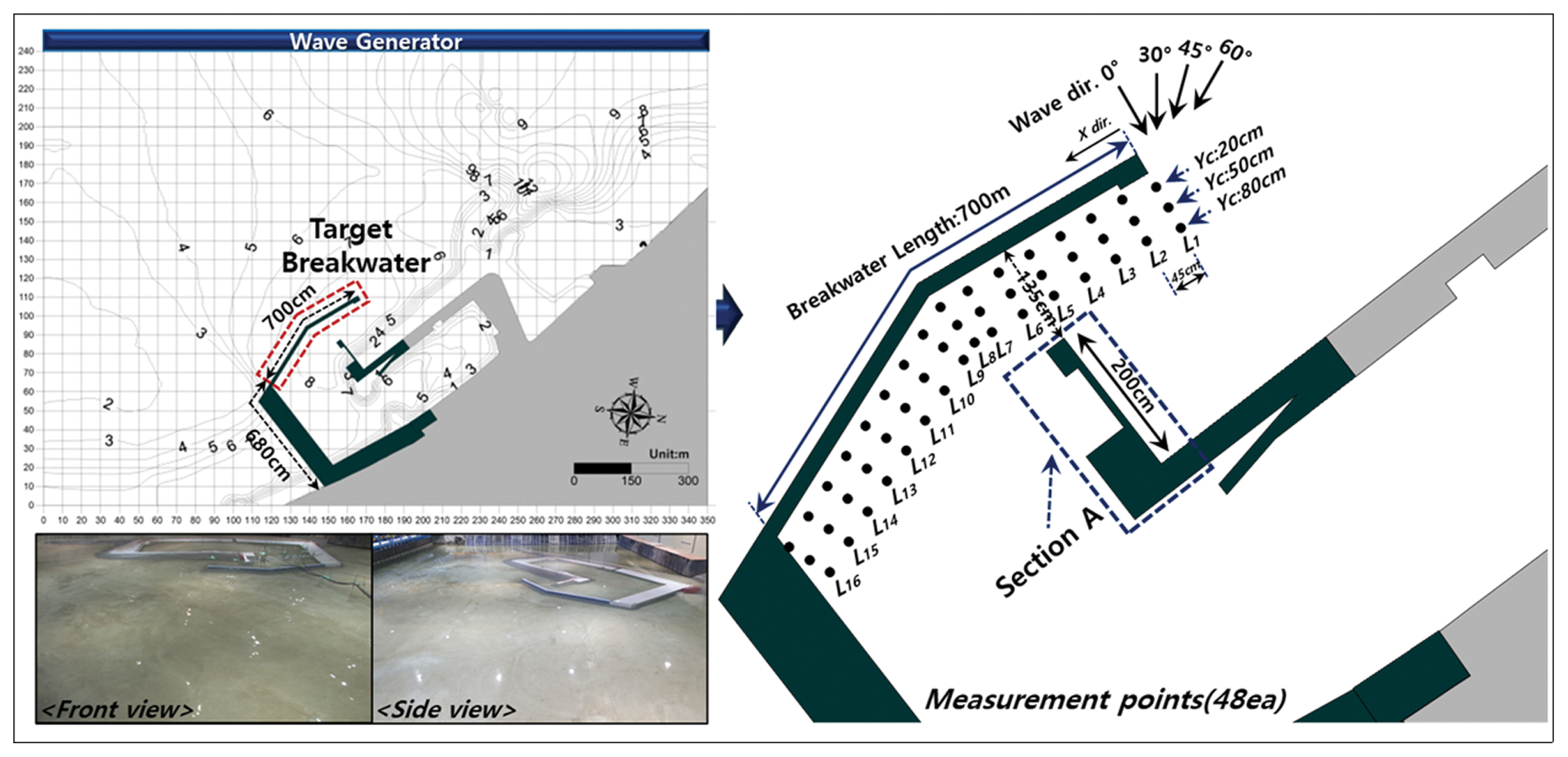
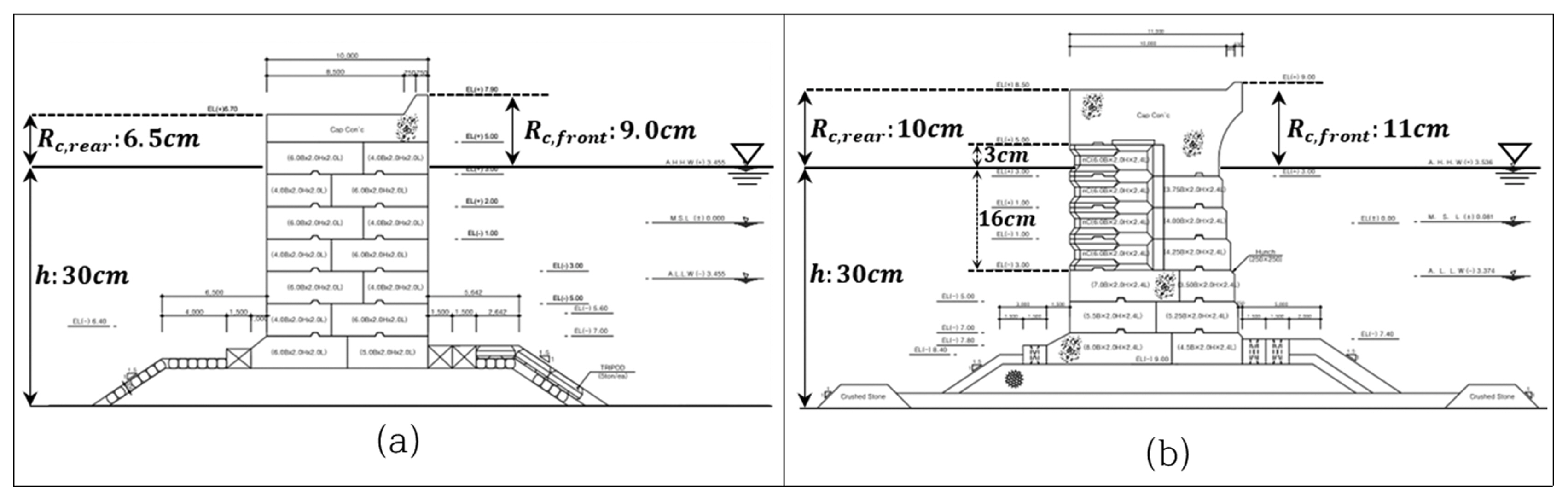
본 연구는 항내로 유입되는 파랑이 방파제 형상에 따라 변화하는 전파 특성을 분석하기 위한 목적을 가지며 평면 수리 모형실험을 통해 검토하였다. 연구 대상지는 우리나라 서해안에 위치한 G항으로, 기존 항만시설(gray color)에 외곽 호안 및 방파제(dark green color)가 추가 설치되는 조건을 모사하였으며(Fig. 1), 다양한 조건을 설정하여 해당 항만시설에서 발생되는 수리현상에 대한 실험적 연구를 수행하였다. 기존 항만시설은 무공 직립콘크리트 형식이며, 방파제를 제외한 신규 구간은 Fig. 2(a)와 같은 공극율(porosity rate, p) 40%의 유공 직립소파형식이다. 여기서 공극률(p)은 Fig. 2(a)와 같은 직립소파블록 구조물 내 공극 체적이 전체 구조물 체적에서 차지하는 비율(volumetric porosity)을 의미한다. 재현된 외곽 방파제의 길이는 L = 700 cm의 비월파 조건으로 설정하였다. 방파제 전면은 직립 무공 콘크리트식으로 구성하였으며, 배후 단면은 직립 콘크리트식(p = 0%, Fig. 2(a))과 유공 직립 소파블록식(p = 40%, Fig. 2(b))으로 구분하였다. p = 0% 단면은 블록 저면에 사석 마운드가 설치되고 수면으로부터 배면측 마루(RC,rear)까지는 6.5 cm로 설정하였다. p = 40% 단면은 수면 기준 상단 3 cm, 하단 16 cm 범위에 유공부를 배치하였으며, 4개 층을 교차 배열하여 공극률을 확보하였다. 주요 외력 조건은 수심(h) = 30 cm, 유의파고(HS) = 5 cm 및 8 cm, 주기(TS) = 1.2, 1.8, 2.2 sec이며, 이에 따른 파형경사(S)는 0.014~0.045 범위에 해당된다. 아울러, 항내 유입 파향의 영향을 검토하기 위하여 입사각은 30o, 45o, 60o로 설정하였다(Table 1). 입사파는 Modified B-M spectrum(Goda, 2010)을 적용하여 생성하였으며, 수조 경계에서 방파제 제두부까지 전파되는 파형 특성은 Smax = 25를 적용하였다.
기존 직립 소파블록 연구는 주로 안벽 단면을 대상으로 수행되었으나, 본 연구에서는 외곽 방파제 배후 전파 특성을 분석하기 위하여 방파제를 따라 등간격으로 구분하고 각 지점에서의 진행파 변화를 계측하였다. 계측 위치는 방파제 배후면으로부터 YC = 2 0 cm, 50 cm, 8 0 cm 이격된 지점으로 설정하였다. YC = 80 cm는 실해역 기준 약 350 GT급 선박의 길이(약 L = 40 m)에 해당하는 축척 거리이다. 파고 계측은 횡방향 45 cm 간격으로 총 48개 지점에서 수행하였으며, 진행파에 대한 특성을 검토하기 위해 정상상태 형성 이후 2,048개의 데이터를 취득하여 Zero-up crossing 방법으로 분석하였다. 전반적인 parameter 계산은 Froude 상사법칙(1/50)을 적용하였다.
실험결과로부터 각 지점의 파고 데이터, 방파제 기부 방향으로 이동하는 파랑의 변형 특성, 주요 지점에서의 파랑 에너지 밀도 분포 및 단면 형식 변화에 따른 파고비(%)를 분석하였다. 본 실험의 기본 개념은 Shim et al.(2024)의 실험 조건을 기반으로 하되, 파형경사(S) 및 상대여유고(RC,rear/H) 등의 조건을 추가로 변화시켜 수행하였다.
3. 연구결과
본 연구에서는 외해에서 전파된 파랑이 항 입구를 통과하여 항내로 유입되는 과정에서 방파제 배후 형상에 따라 발생하는 파랑 변형 특성을 분석하기 위해 유의파고(HS), 주기(TS), 입사각(Wave dir.), 이격거리(YC) 및 공극률(p)을 주요 변수로 설정하였다. 방파제 배후 전파 과정에서의 파고 변화는 방파제 시점부(x1 = L1)를 기준으로 입사파장(LI)에 대한 상대 이동거리(x1-16/LI)로 정리하였으며, 각 지점의 파고는 파고비(HS/HI)로 제시하였다. 또한 배후면 공극률 변화에 따른 영향을 비교하기 위하여 p = 0%와 p = 40% 조건의 파랑 분포 특성을 상호 비교하였다. 실험은 Table 1에 제시된 바와 같이 총 108개 조건에 대해 수행되었으며, 이 중 경향이 뚜렷하게 나타난 입사각 30° 및 60o 조건을 중심으로 결과를 정리하였다.
3.1 Dir.: 30o, p: 0% 조건
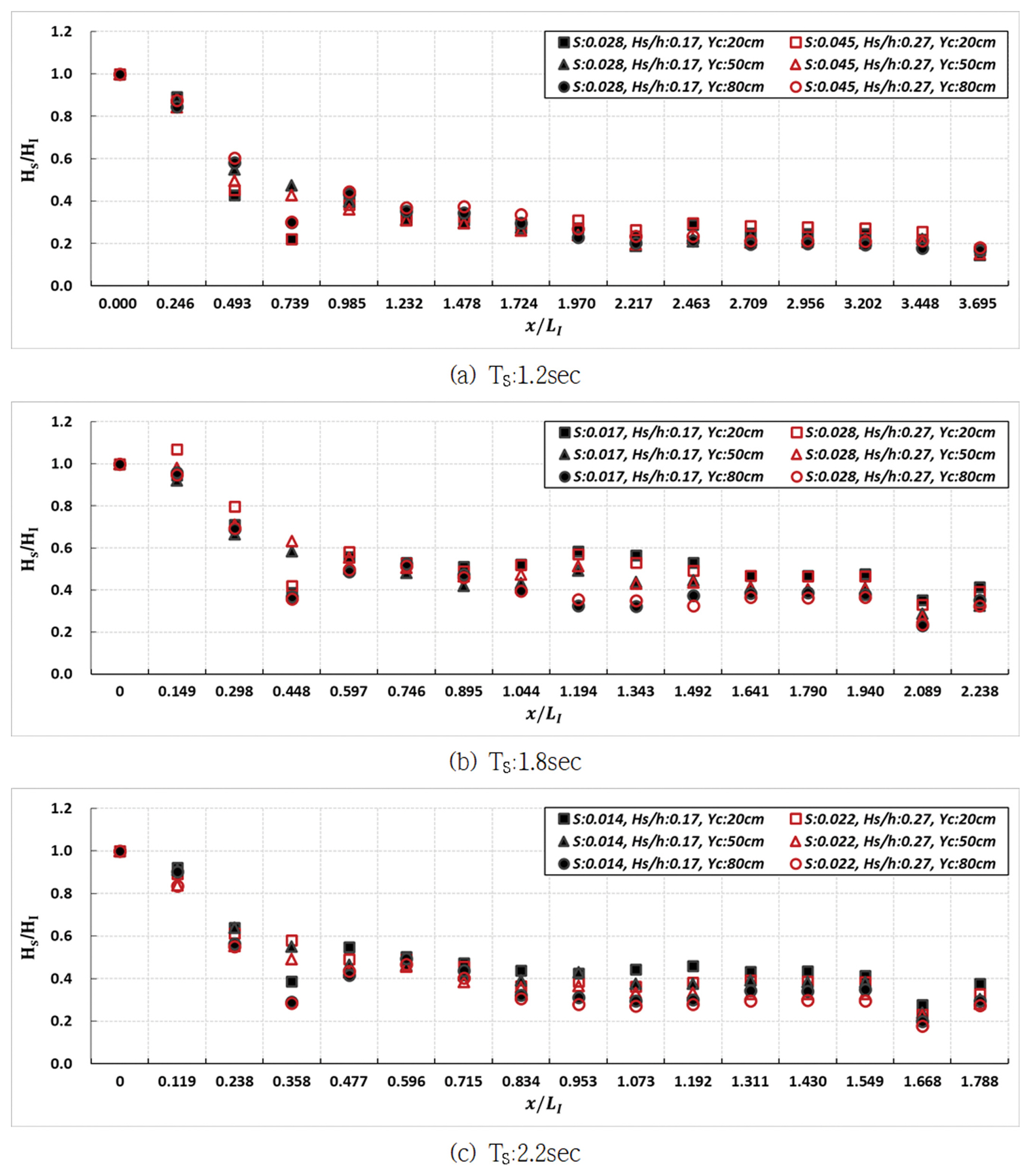
방파제 배후로 전파되는 파고는 방파제를 따라 점진적으로 감소하였으나, 방파제 배치 각도가 변화하는 지점(Fig. 1; L8)을 지나면서 국부적 상승이 나타났다. 이러한 분포는 주기와 이격거리에 따라 차이를 보였다.
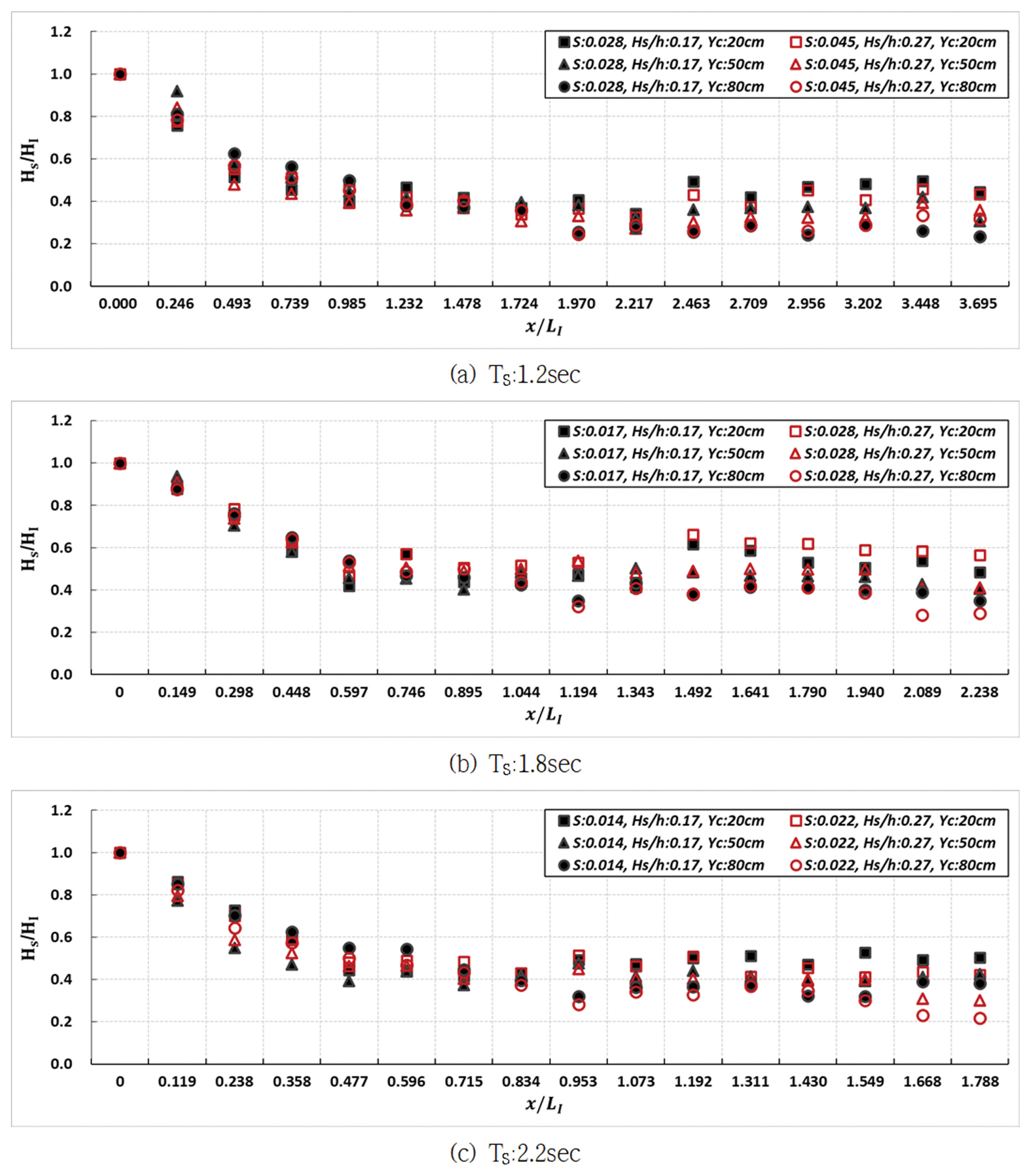
파형경사가 가장 큰 TS = 1.2 sec 파랑 내습시 방파제의 각도가 변화되는 지점 이후까지(x/LI = 2.217) 파고감쇠가 지속되었으며 가장 낮은 약 0.3의 파고비를 보였다. x/LI = 2.463에서는 평균 0.35의 값으로 최대 0.49까지 파고비가 증가하였으며 배후로 진행하면서 일정한 범위의 파고가 유지되었다(Fig. 3(a)). 주기가 1.8 sec로 증가될 경우 파고의 감쇠 구간은 항내 파랑유입을 제어하기 위해 설치된 보조방파제(Fig. 1; Section A) 전면으로 제한되었으며 이 구간을 통과한 이후 평균 0.47의 수준을 유지하였다. 파고상승은 TS = 1.2 sec의 조건과 동일한 지점에서 발생하였으며 그 이후 파랑은 점진적으로 감소되었다(Fig. 3(b)). TS: 2.2 sec에서는 방파제의 각도가 변화되는 지점(x/LI = 0.834)까지 파고는 감쇠되었으며 방파제 끝단(L16)으로 이동하면서 YC에 따라 편차는 증가하였으나 평균파고비는 일정하게 유지되었다(Fig. 3(c)).
p = 0%인 조건에 대한 실험결과 방파제와 인접한 YC = 20 cm 지점에서 파고 증폭현상은 공통적으로 나타났으며, 주기변화에 따라 파고의 감쇠구간의 위치와 재상승 범위, 이격 거리 간 편차가 변화되었다. 특히 항내로 전파되는 파랑은 평균적으로 파형경사가 큰 조건에서 가장 작은 파고비를 형성하였으며 TS: 1.8 sec에서 최대가 되었다.
3.2 Dir.: 60o, p: 0% 조건
입사각이 60o인 조건에서 방파제 내측구간의 파고상승 현상은 입사각 30o에 비하여 증가되었다. 특히, YC: 20 cm 구간에서 현저히 나타났으며 이격거리가 증가할수록 완화되는 경향을 보였다.
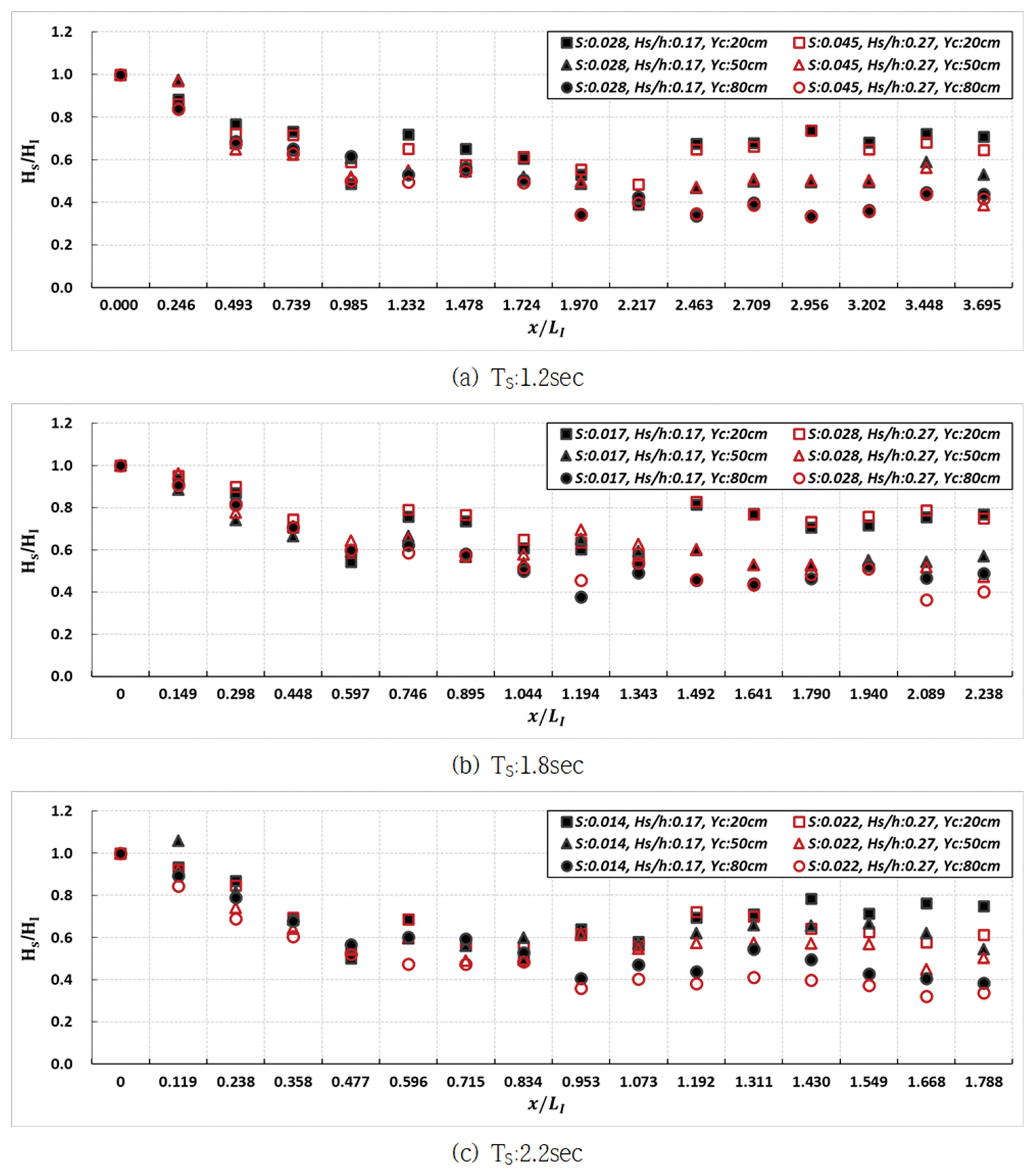
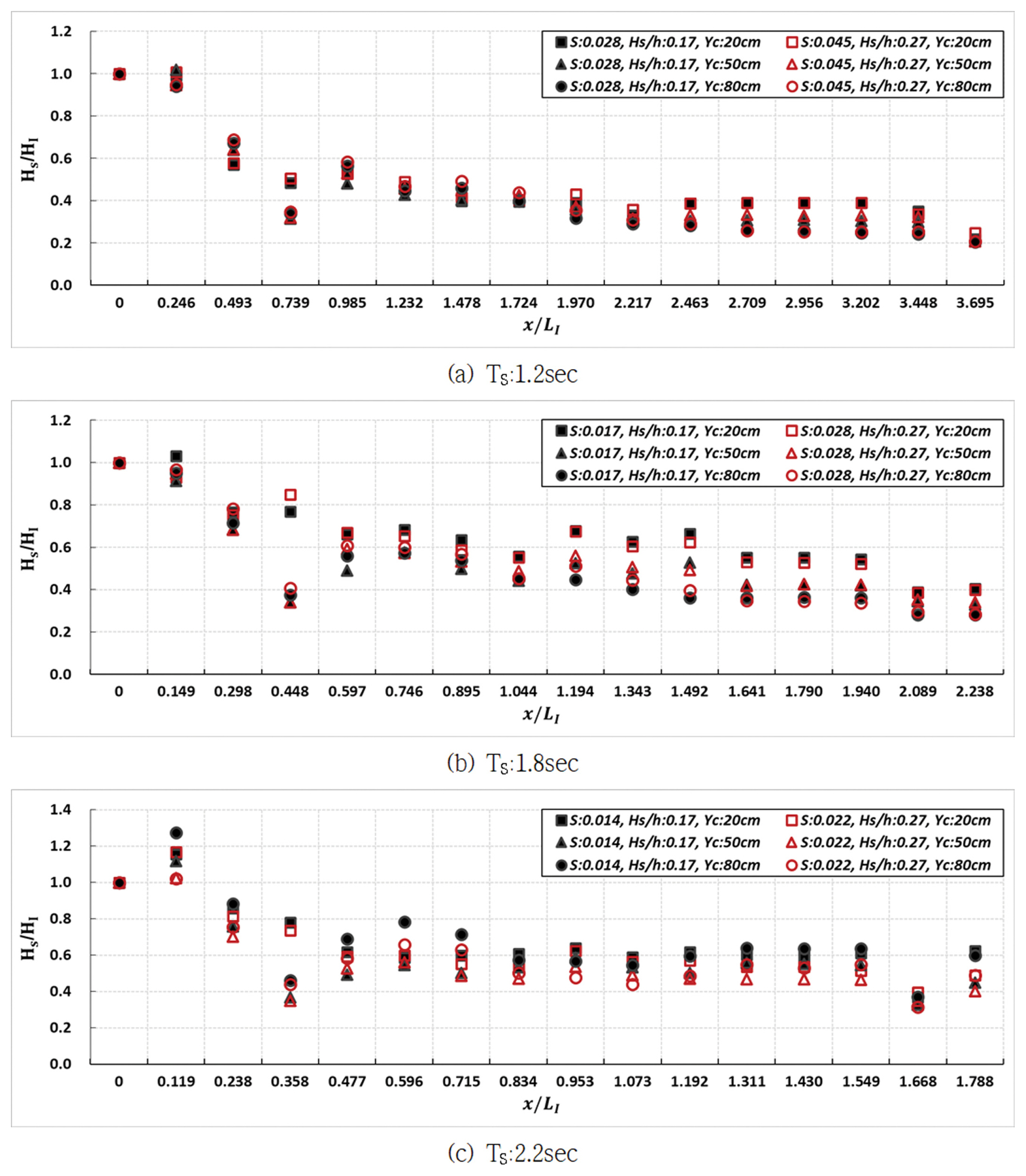
주기변화에 대한 특징으로는 TS = 1.2 sec의 파랑 내습시 파고 증가현상이 항 입구에 해당되는 x/LI = 1.232와 항 내측에 해당되는 x/LI = 2.463에서 나타났다. x/LI = 1.232에서의 파고비는 최대 0.72까지 증가한 후 평균 0.49까지 감쇠되었으며, x/LI = 2.643에서 0.68까지 재상승한 이후 일정 수준을 유지하였다(Fig. 4(a)). TS = 1.8 sec로 증가된 조건에서는 파고의 감쇠 및 상승 지점의 위치는 동일하였으나 파형경사와 이격거리간 편차는 1차 상승된 지점 이후로 TS: 1.2 sec 대비 약 14% 증가하였다(Fig. 4(b)). TS = 2.2 sec 조건에서도 파고의 감쇠 및 증가는 동일한 지점에서 발생되었으나 1차 상승 이후 2차 상승 지점까지 파고감쇠 경향은 완화되었으며 파고비는 TS: 1.2 sec 대비 7% 증가하였다(Fig. 4(c)).
공통적으로 항내측으로 전파되는 파랑은 YC: 20 cm를 제외하면 비교적 일정한 파고를 유지하였으며 평균 파고비는 TS: 1.8 sec의 조건에서 최대가 되었다.
3.3 Dir.: 30o, p: 40% 조건
방파제 배후 단면이 p = 40%인 경우, p = 0% 조건과 달리 방파제 시점부터 내측 방향으로 보다 안정적인 감쇠 패턴이 형성되었으며, 국부적 재상승은 상대적으로 완화되는 경향을 보였다. 이러한 특성은 주기 변화에 따라 차이를 나타내었다.
입사각 30o 조건에서 TS: 1.2 sec 파랑내습시 항 입구부를 통과하면서 파고의 감쇠율은 줄어들었으며 방파제의 설치각도가 변화되는 지점 이후 구간은 비교적 일정한 파고가 형성되었다(Fig. 5(a)). TS: 1.8 sec의 조건에서는 방파제의 각도 변화 지점에서 파고 상승이 관찰되었으며(YC: 20 cm, 50 cm), YC: 80 cm에서는 YC: 20 및 50 cm 구간의 파고가 감쇠되는 x/LI = 1.492 지점부터 증가하는 특성을 보였다(Fig. 5(b)). 이러한 경향은 TS = 2.2 sec 조건에서도 유사하게 나타났으나, 전체적인 파고비의 변동 폭은 p = 0% 조건에 비해 제한적인 범위 내에서 형성되었다(Fig. 5(c)).
주기변화에 대한 파고변화 분석결과 파형경사가 상대적으로 큰 TS: 1.2 sec 조건에서는 이격거리에 관계없이 유사한 파고범위가 형성되었으며 평균 파고비는 TS: 1.8 sec에서 최대가 되었다. TS: 2.2 sec에서는 방파제의 각도가 변화되는 구간부터 이격거리 간 편차가 증가하는 특성을 보였다.
3.4 Dir.: 60o, p: 40% 조건
입사각이 60o일 경우 항내로 전파되는 파의 특성은 동일 단면에 대한 30o의 파랑 내습조건과 유사한 경향을 보였으나 전체적인 파고값은 증가하는 경향을 나타냈다.
주기 변화에 따른 특성으로, TS: 1.2 sec 조건에서는 항 입구부(x/LI = 0.985) 통과 이후 파고 감쇠현상이 나타났으며, 항 입구부에서 방파제 끝 지점(x/LI = 3.695)까지 평균 파고비는 0.36으로서 30°대비 약 39% 증가하였다(Fig. 6(a)). TS: 1.8 sec의 주기조건에서는 파고변동 폭이 확대되었으며, 방파제 꺾임부(x/LI = 1.194)에서 국부적 상승이 형성되었다. 이후 항내로 전파되면서 계단식 감쇠 양상이 나타났으며, 평균 파고비는 30o 대비 약 12% 증가하였다(Fig. 6(b)). 주기 2.2 sec의 조건에서는 뚜렷한 파고의 상승 없이 방파제 꺾임부 이후 일정한 파고가 형성되었다. 그러나 30o 조건 대비 약 47% 높은 값을 보였다. x/LI = 1.668 지점에서의 파고감쇠 원인은 항내측으로 설치된 방파호안과의 인접 구간에서 형성된 중 복파의 영향으로 판단된다(Fig. 6(c)).
이상의 결과를 통해 파형경사가 큰 조건에서 파랑저감은 유리한 경향을 보였으며 항 입구부 이후의 평균 파고는 TS: 1.2 sec 대비 1.8 sec에서 34%, 2.2 sec에서 49%의 차이를 보였다. 입사각 60o 조건에서는 주기가 증가함에 따라 방파제 배후 파고가 비례하여 증가하는 것으로 확인되었다.
방파제 배후에서의 파고변화 분석결과, 입사각과 주기조건은 항내 파고의 공간적 분포 특성을 결정하는 주요 인자로 작용하였다. p = 0% 조건에서는 방파제를 따라 전반적으로 파고가 감소하는 과정에서, 방파제 꺾임부 및 인접 구간에서 국부적인 파고 상승이 관찰되어 공간적 변동성이 크게 나타났다. 반면 p = 40% 조건에서는 이러한 국부 상승의 규모가 상대적으로 완화되어 보다 안정적인 감쇠 패턴이 형성되는 경향을 보였다. 또한 YC 변화에 따른 파고 분포에서도 두 조건 간 차이가 뚜렷하게 나타나, 공극 구조가 평균 파고의 저감뿐 아니라 국부 변동성 완화에도 영향을 미치는 것으로 판단된다.
4. 연구결과분석
4.1 스펙트럼분석
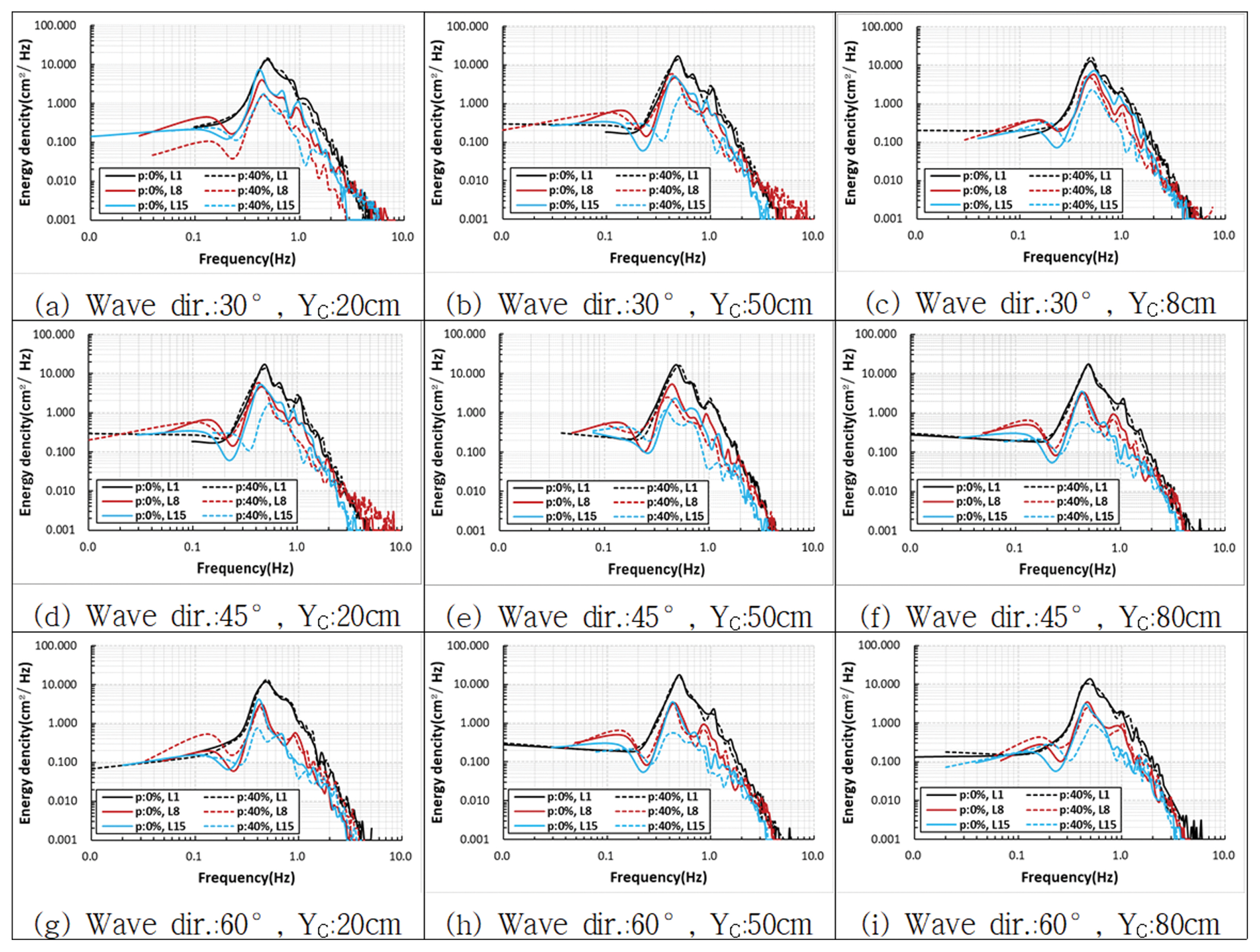
3장에서는 파랑이 항 입구에서 방파제 끝단까지 전파되는 과정에서 입사각 및 이격거리에 따른 파고변화를 분석하였다. 본 절에서는 주요 지점(L1, L8, L15)을 대상으로 스펙트럼 분석을 수행하여 주파수 대역별 에너지 변화를 정량적으로 고찰하였다. 분석 조건은 파형변화가 비교적 뚜렷하게 나타나는 HS = 8 cm, TS = 1 .8 s ec 조건을 적용하였다. 스펙트럼은 Modified B-M에 기반하여 산정하였으며, L1은 제두부 배후 첫 계측지점, L8은 방파제 꺾임 지점, L15는 방파제 끝단에 해당한다(Fig. 1). 결과의 분석은 첫 번째로 에너지 밀도의 peak 값을 기준으로 검토하였으며 각 지점에서의 peak energy 감소율은 다음과 같이 정의하였다.
여기서, R(peak)는 L1 대비 L8 및 L15에서의 peak energy 비율이며, fp는 최대 에너지 밀도를 갖는 주파수이다.
실험결과 peak 주파수는 지점별로 약간의 차이를 보였으나 (< 0.07), 본 분석에서는 동일 주파수로 간주하였다.
4.1.1 Peak energy 변화
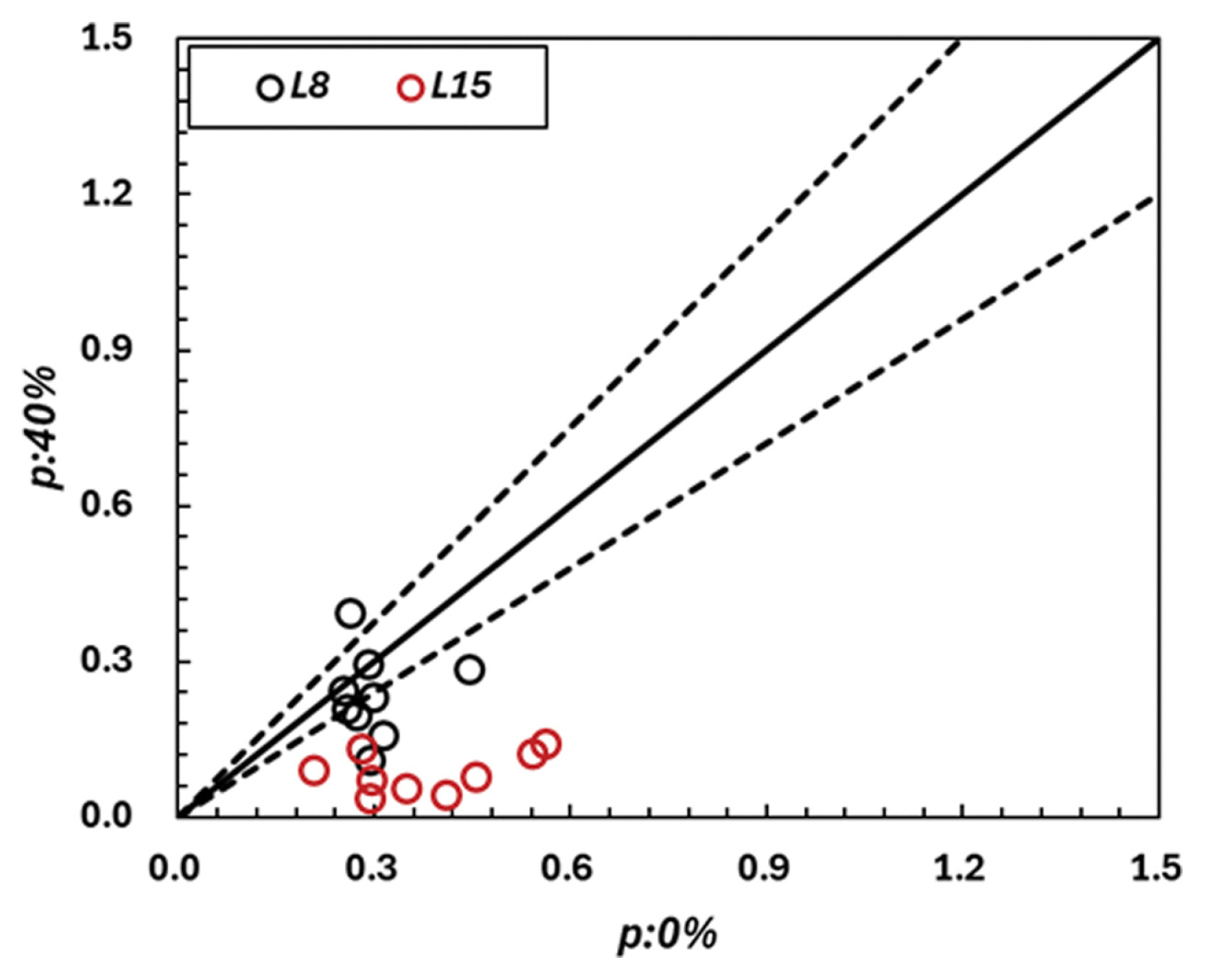
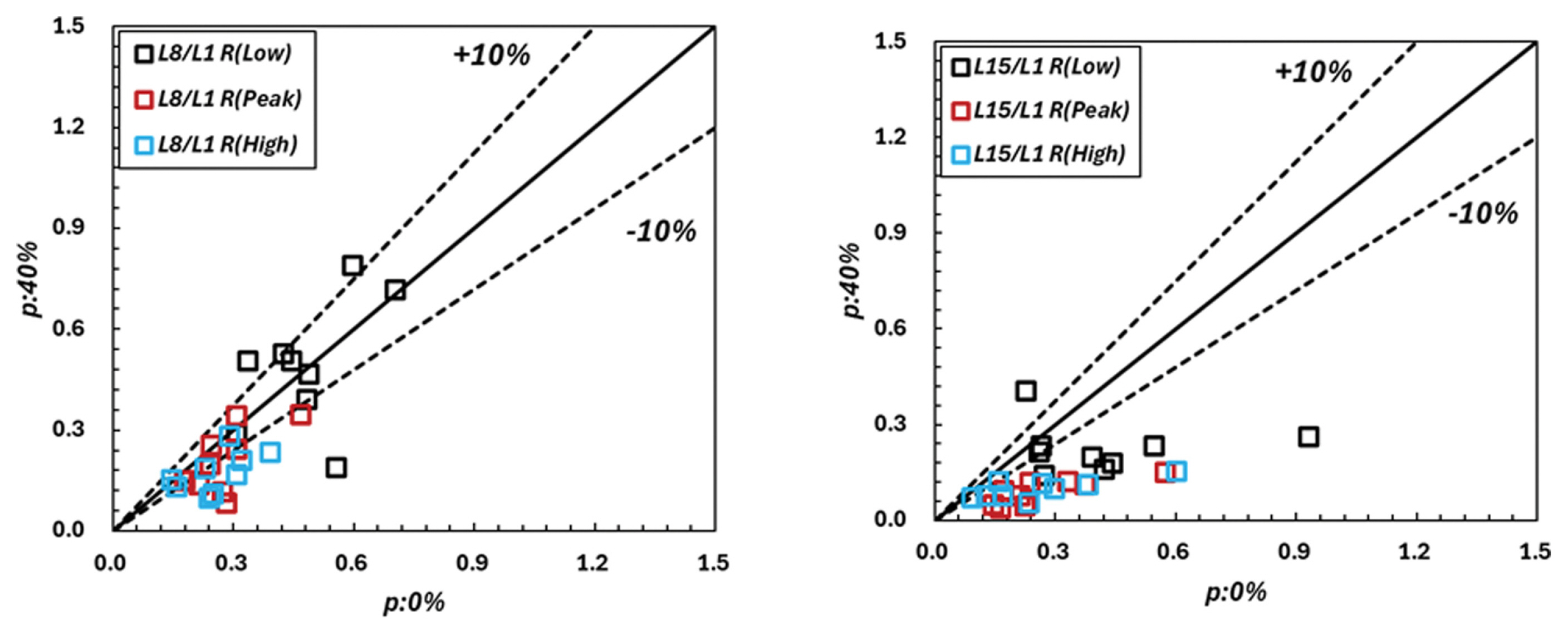
L1 지점의 peak energy는 모든 조건에서 유사하게 나타났으며(Fig. 7), 이는 방파제 영향 이전의 입사 조건이 동일함을 의미한다. p = 0% 조건에서 L8 및 L15의 평균 peak energy 비율은 각각 0.30, 0.38 수준으로 나타났다. 이를 통해 L8에서 약 70%, L15에서 약 62% 수준의 감쇠가 발생하 였음을 알 수 있다. 반면, p = 40% 조건에서는 L8 및 L15에서 각각 평균 0.23 및 0.08 수준으로 peak energy가 감소하였으며, 특히 L15에서 현저한 감쇠 현상이 나타났다. 이는 공극 구조에 의한 에너지 소산 효과가 전파 거리 증가에 따라 누적으로 작용함을 의미한다. 분석에 적용된 36개의 실험 조건 중 1개 조건을 제외하고는 p = 40%에서의 peak energy가 p = 0%보다 작게 나타났으며, 평균적으로 L8에서는 22%, L15에서는 약 77%의 감쇠 효과가 확인되었다(Figs. 7 and 8).
4.1.2 주파수 대역별 에너지 변화
Peak energy 감소뿐 아니라, 주파수 대역별 에너지 변화 특성을 분석하기 위해 다음과 같이 band energy ratio를 정의하였다.
R(band) 분석에 적용된 주파수 구간은 저주파 영역(6), 피크 영역(7), 고주파 영역(8)으로 구분하였다.
여기서, f의 좌변은 f1, 우변은 f2가 되며 모두 SL1의 값을 적용하였다. 아울러, 스펙트럼 적분값과 파고의 관계는 다음과 같이 표현된다.
(1) p = 0% 조건
L8 지점에서 저주파 영역의 평균 감쇠율은 약 52% 수준으로 나타났으며, 피크 및 고주파 영역에서는 약 74% 이상의 감쇠가 확인되었다. 즉, p = 0% 조건에서는 저주파 성분이 상대적으로 유지됨을 알 수 있다. L15 지점에서는 저주파 영역에서 58%의 감쇠율을 보였으나, 피크 및 고주파 영역에서는 L8 대비 유사한 값이 확인되었다.
(2) p = 40% 조건
p = 40% 조건에서는 저주파 영역의 감쇠율이 51%로서 p = 0%와 유사한 수준을 보였으나, 피크 및 고주파 영역에서는 각각 79%, 82%가 되어 감쇠효과가 크게 나타났다. 특히, L15 지점에서는 피크 및 고주파 성분이 현저히 감소하여 공극으로 인한 파고감쇠가 유리한 것으로 확인되었다. 이는 유공부가 상대적으로 단주기 및 고주파 성분에 대해 효과적으로 작용하며, 저주파 성분에 대해서는 제한적인 영향을 미침을 시사한다(Fig. 9).
4.2 공극률 변화에 대한 파고비 분석
앞 절에서는 스펙트럼 분석을 통해 주요 지점에서의 에너지 밀도 변화를 비교하였다. 본 절에서는 3장의 결과를 기반으로 S, TS, dir., YC 및 p 변화에 따른 각 지점의 파고비(HS/HI)를 종합적으로 비교하였다.
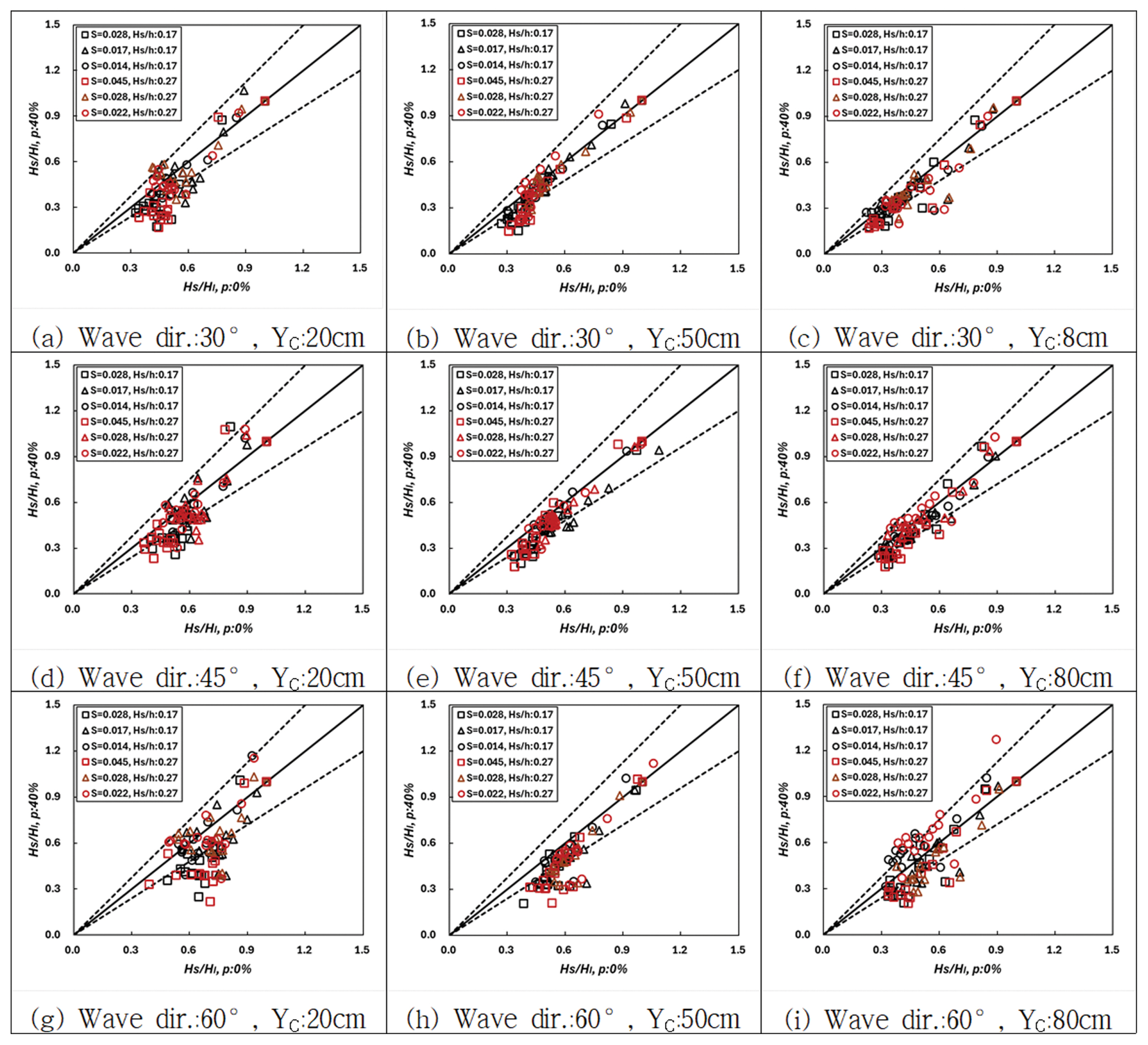
실험결과를 통해 파랑이 L1에서 L16으로 전파되는 과정에서 전반적인 감쇠 경향은 나타나지만, 방파제의 설치각도 및 형상 변화에 의해 공간적 변동성이 증가함을 확인하였다. 또한, 방파제와의 이격거리(YC)에 따라 파고 분포 특성은 상이하게 나타났다. 전체 108개의 실험 조건에 대한 평균 파고비는 p = 0%에서 0.48, p = 40%에서 0.41가 되어 공극률 변화에 따라 약 15% 내·외의 추가 감쇠 효과가 확인되었다. 항 입구에 해당하는 L6부터 방파제 끝단인 L16 구간에 한정하여 비교하면, p = 0% 조건에서 YC = 2 0 cm는 평균 0.56, YC = 50 cm 및 80 cm는 각각 0.48 및 0.41로 나타났다. 이는 방파제 인접부에서 상대적으로 높은 파고가 형성됨을 의미한다.
p = 40% 조건에서는 동일 구간에서 각각 0.45, 0.39, 0.38로 감소하였으며, 특히 YC = 20 cm 구간에서 공극 구조에 의한 감쇠 효과가 가장 크게 나타났다. 반면 YC = 80 cm에 서는 p = 0%와 유사한 수준을 보여, 공극 효과는 방파제 인접부에서 가장 지배적으로 작용함을 확인하였다. 동일 지점에서 공극률 변화에 따른 파고 분포를 비교한 결과, 입사각이 증가할수록 공간적 분산 경향이 확대되었으며, 동일 입사각 조건에서는 이격거리가 증가할수록 p에 따른 편차가 감소하였다(Fig. 10). 또한 파형경사(S)와 이격거리가 증가할수록 공극률 차이에 따른 감쇠 효과는 점진적으로 줄어드는 경향을 보였다(Fig. 10(f), (i)). 이는 공극 구조가 상대적으로 단주기 및 저이격 조건에서 더 효과적으로 작용함을 의미한다.
4.3 항내 잔여 장주기 성분 고찰
본 연구에서 수행된 파고검토 범위는 방파제로부터 최대 YC: 80 cm로 제한되어 있으므로 항내 공진을 논하기에는 한계가 있다. 하지만 파의 전파과정에서 주요 파랑저감 구간이라고 할 수 있는 방파제 배후의 에너지 감쇠 및 주파수 대역별 특성은 항내 장주기 응답과 잠재적으로 연관될 수 있으므로 제한적 범위에서 infragravity(IG)대역 변화를 고찰하였다. 일반적으로 항내 공진은 입사파 스펙트럼 내 특정 주파수 성분이 항의 고유주기에 근접하거나 장주기 성분과 항의 고유모드가 결합할 때 발생하며(Mei and Agnon, 1989; Bellotti, 2007), 특히 소규모 항에서는 IG 대역 성분이 주요 요소로 작용할 수 있다. 본 연구는 실험 축척 1/50을 적용하여, 실해역 IG 대역(0.003~0.04 Hz)은 모형 기준 약 0.02~0.28 Hz로 환산하였다. 공진에 대한 많은 연구 중 Gao et al.(2016)은 항내 IG wave amplitude가 증폭되는 현상을 수치적으로 제시하였으며, 본 연구에서는 이러한 저주파 증폭 현상을 정량적으로 비교하기 위하여 특정 단일 주파수 대신 IG 대역 전체의 스펙트럼 에너지 비를 식(10), 식(11)과 같이 정의하였다.
여기서, R(IG)는 방파제 시점(L1)대비 항내(L8, L15)에서의 IG 대역 에너지 상대비를 의미한다. 한편, R(IG) > 1은 해당 저주파 대역에서 입사파 대비 상대적 증가 또는 잔류되는 현상을 의미하지만 본 지표만으로 공진 발생을 판단하기보다는, 항내 고유주기 추정값과의 근접성 및 공간적 변화(L1->L8→L15)를 함께 고려하여 공진 기여 가능성을 고찰하였다.
4.3.1 p = 0% 조건
p = 0% 조건에서 L8 지점은 일부 조건(예: 45o, YC = 20 cm)에서 R(IG)의 최대값이 1.28로 나타나 저주파 성분이 상대적으로 증가되었다. 반면 L15 지점에서는 대부분 1 이하의 0.55 범위로 나타나 IG 대역(0.02~0.28 Hz, 모형 기준)의 공간적 증폭은 확인되지 않았다. 하지만, 4.1절의 대역별 분석결과와 같이 피크 및 고주파 성분에 비해 저주파 성분의 감쇠가 상대적으로 작게 나타났기 때문에, 저주파 에너지가 일정 수준 잔류하는 경향은 확인되었다.
4.3.2 p = 40% 조건
p = 40% 조건에서도 L8 지점의 일부 조건(30o, YC = 80 cm; 45o, YC = 20 cm; 4 5o, YC = 80 cm; 60o, YC = 80 cm)에서 에너지비가 1을 초과하여 저주파 성분의 상대적 증폭이 관찰되었다. 이는 공극 구조가 고주파 및 피크 성분을 선택적으로 감쇠시키는 과정에서 저주파 성분의 상대적 비중이 증가할 수 있음을 의미한다. 그러나 L15 지점에서는 평균 약 0.54 수준으로 나타나 IG 대역의 공간적 증폭은 확인되지 않았다. 즉, 저주파 성분이 상대적으로 잔류하는 경향은 존재하나, 항내 깊숙한 영역까지 지속적으로 강화되는 증폭 현상은 발생되지 않았다. 이러한 결과는 공극 구조가 단주기 및 고주파 성분 감쇠에는 효과적이나, 장주기 성분 제어에는 구조적 한계를 가질 수 있음을 시사한다.
4.3.3 항내 잔여 장주기성분 분석
항내 공진 가능성을 정량적으로 검토하기 위해 반폐쇄형 수역에 대한 근사식을 적용하여 고유진동주기를 추정하였다(Mei and Agnon, 1989; Bellotti, 2007).
여기서, L은 유효수역의 길이, g는 중력가속도, h는 수심이다. 위의 식에서 항의 길이는 항 입구부(Fig. 1, Section A)부터 방파제 끝단까지 425 cm가 된다. 이때 고유진동주기는 약 10 sec이며 대응하는 주파수는 0.10 Hz가 된다. 이는 본 연구에서 설정한 IG 대역(0.02~0.28 Hz) 내에 포함되기 때문에 식(10) 및 식(11)에서 정의한 R(IG)는 고유주기 인접 대역의 저주파 응답을 포괄적으로 검토하기 위한 지표로 활용 가능하다. 하지만, 공진은 단일 지점에서의 에너지 증가만으로 판단하기 어렵고, 공간적 증폭 경향(L1 → L8 → L15)과 고유주기 근접성의 동시 충족이 필요하다. 실험결과 L8 지점에서는 일부 조건에서 R(IG) > 1이 나타나 저주파 성분의 상대적 증폭 가능성이 관찰되었으나, L15 지점에서는 대부분 R(IG) < 1에 해당되어 지속적 공간 증폭은 확인되지 않았다. 이는 본 연구 조건 범위 내에서는 고유모드에 근접한 저주파 잔류 또는 국부적 강화 현상은 존재할 수 있으나, 항 전체에 걸친 명확한 장주기 공진 상태로 발전되었다고 보기는 어려움을 시사한다. 따라서 R(IG) > 1이 공진을 판단하는데 주요한 항목이라고 하기 보다는 고유주기 대역에서의 저주파 에너지의 상대 증가를 나타내는 보조 지표로 해석하는 것이 적절하다. 아울러, 항의 형상, 입구 폭 및 장시간 내습하는 외력 조건이 결합될 경우 공진 응답으로 발전될 가능성이 존재한다.
5. 결 론
본 연구에서는 항만시설 확장 시 신규 설치되는 직립식 방파제를 대상으로, 배후면 공극률(p = 0%, 40%), 입사각(θ = 30o, 45o, 60o), 파형경사(S = 0.014~0.045), 이격거리(YC = 20 cm, 50 cm, 80 cm)에 따른 항내 전파 특성을 평면 수리모형실험을 통해 분석하였다. 특히 파고비(HS/HI), 스펙트럼 기반 peak 및 band energy ratio, 그리고 IG 대역 에너지비를 통해 주파수별 에너지 재분배 특성을 정량적으로 검토하였으며, 주요 결론은 다음과 같다.
1) 공극률 변화에 따른 전반적 파고 감쇠 특성
항내로 전파되는 파랑은 방파제 배후 공극 구조에 의해 유의한 감쇠가 발생하였다. 총 108개 조건에 대한 평균 파고비는 p = 0%에서 0.48, p = 40%에서 0.41로 나타나 약 15%의 추가 감쇠 효과가 확인되었다. 특히 방파제 인접부(YC = 20 cm)에서는 평균 약 24%의 차이가 발생한 반면, YC = 80 cm에서는 약 8% 수준으로 감소하여 공극 효과는 방파제 인접 구간에서 가장 지배적으로 작용함을 확인하였다.
2) 공간 전파 특성과 국부적 파고 재증가 현상
파랑은 항 입구 통과 직후 전반적으로 감쇠되는 경향을 보였으나, 방파제 꺾임부(L8) 이후 일부 조건에서 국부적 재증가가 관찰되었다. 이러한 현상은 입사각에 따른 법선 성분 집중, 방파제 형상 변화, 회절 및 반사파 중첩 효과가 복합적으로 작용한 결과로 판단된다. 특히 고각 입사(60o) 조건에서 공간적 분산과 인접부 증폭이 더욱 뚜렷하게 나타났다.
3) Peak 및 주파수 대역별 에너지 재분배 특성
스펙트럼 분석 결과, p = 40% 조건에서 peak 및 고주파 영역의 에너지는 p = 0% 대비 평균 30~70% 추가 감쇠되었으며, L15 지점에서는 최대 80~90% 수준의 감쇠가 확인되었다. 반면 저주파 영역(0 ≤ f < 0.8fp)에서는 상대적으로 감쇠율이 작게 나타났다. 이는 공극 구조가 단주기 및 고주파 성분에 대해 선택적으로 작용하며, 저주파 성분에 대해서는 구조적 제어 한계를 가질 수 있음을 시사한다.
4) IG 대역 에너지 거동 및 항내 공진 가능성
Froude 축척(1/50)을 적용하여 실해역 IG 대역(0.003~0.04 Hz)을 모형 기준 0.02~0.28 Hz로 환산하여 분석한 결과, L8 지점에서는 일부 조건에서 R(IG) > 1이 나타나 저주파 성분의 상대적 증폭이 관찰되었다. 그러나 항 내측 L15 지점에서는 대부분 R(IG) < 1로 나타나 본 실험 조건 내에서 명확한 장주기 증폭은 확인되지 않았다. 다만, peak 및 고주파 성분이 현저히 감쇠됨에 따라 저주파 성분의 상대적 비중이 증가하는 경향이 확인되었으며, 항 형상 및 고유주기 조건에 따라 IG 성분과의 결합 가능성은 배제할 수 없다.
5) 구조물 배치 및 형상 변화에 대한 고찰
공극 구조는 단주기 파랑 감쇠에는 효과적이나, 장주기 성분 제어에는 구조적 한계를 가질 수 있다. 따라서 항내 정온 확보를 위한 설계 시 단순한 전체 파고 감쇠 효과뿐 아니라, 주파수 대역별 에너지 재분배 특성을 함께 고려할 필요가 있다. 특히 방파제 꺾임부와 항 입구 형상 변화는 저주파 성분의 공간적 집중에 영향을 줄 수 있으므로, 항 형상 설계와 연계한 검토가 필요하다.
본 연구는 특정 형상 및 조건을 대상으로 한 실험적 연구이므로, 모든 항에 일반적으로 적용하기에는 한계가 있다. 따라서 다양한 항의 형상, 입구 폭 변화 및 고유주기 조건 등을 고려한 추가 연구가 수행될 필요가 있다.



 PDF Links
 PubReader
 ePub Link
 Full text via DOI
 Download Citation
  Print
Print