





1. 서 론
연안 및 항만구조물의 설계에서 가장 중요한 환경 하중은 구조물의 기대 내구연한, 즉 재현기간에 대한 설계파 정보이다. 주어진 재현기간에 상응하는 설계파는 장기간의 관측자료 또는 기상자료에 의해 추산한 값을 기초로 하여 적절한 극치통계해석기법을 적용하여 결정한다.
설계파는 장기간의 파랑관측자료를 이용하여 추산하는 것이 바람직하나, 파랑관측자료가 충분하지 않은 국내의 경우, 바람장(해상풍)을 추정하고 이로부터 설계파를 추산하고 있다(MOF, 2019, 2025). 최근 국내에서도 기상청, 국립해양조사원, 해양수산부 등 다양한 기관에서 파랑 관측망을 구성하여 파랑 관측자료를 제공하고 있다.
Coles(2001)는 통상적인 통계 분석이 다루기 어려운 매우 큰 값이나 매우 작은 값과 같은 극단값(extremes)을 자료의 전반적인 분포가 아닌 분포의 양 극단에서 발생하는 현상으로 간주하고, 이들을 효과적으로 분석하기 위해 극치 해석(Extreme Value Analysis, EVA)을 제안했다. 파고의 극치분석에 의한 설계파고 추정은 해양 및 연안 구조물의 설계에 필수적이고, 다양한 해역에서 수행되었다.
Mazas et al.(2014)은 POT 기반으로 극치분석을 할 때, 임계값 설정 방식과 위치 모수 정의의 구분이 중요함을 강조하고, 다양한 후보 분포함수와 모수 추정법을 비교하였다. Solari et al.(2017)은 임계값을 객관적이고 자동적으로 설정하는 방법으로 Anderson-Darling 적합도 검정을 수행하여 최적의 임계값(Threshold)을 자동으로 결정하는 방법론을 제안하였다. 이러한 접근법은 분석가의 주관이 개입될 수 있는 시각적 방법인 평균 초과 함수 그래프 대신 통계적 검정을 기반으로 임계값을 객관적으로 결정하는 이점을 제공한다.
Bakali et al.(2021)은 모로코 대서양 북부 연안 세 지점을 대상으로 연최대법과 임계값 초과법을 병행해서 100년 재현 주기의 극치파고를 추정하고, 두 기법의 차이를 비교함으로써 상호보완적 활용을 제안했다. Alsaaq and Shamji(2023)는 홍해 Jeddah 연안을 대상으로, GPA, GEV 분포함수를 활용한 재현주기에 대한 극치파고 추정을 수행하였다. Wang et al.(2021)은 71년간의 파랑 분석자료를 활용해서, 남중국해(South China Sea, SCS)에서의 유의파고의 시간-공간적인 추세 및 극치분포를 분석하였으며, Theil-Sen 및 Mann-Kendall 기법을 활용한 경향 분석과 함께 GPA 분포함수 – POT 극치자료를 이용하여, 100년 재현주기 극치파고를 추정하였다.
Jeong et al.(2004)는 한국 연안 67개 지점의 추산 파랑자료를 활용하여 Gumbel, Weibull, Lognormal 분포함수 등의 분포를 비교하고, 확률가중모멘트법을 포함한 여러 매개변수 추정법을 적용해 설계파고와 분포 적합성을 검정했다. Jeong et al.(2009)는 부산항 신항에서 관측된 14년간의 파랑자료를 바탕으로 Gumbel, Weibull, Kernel 분포함수를 이용한 극치 분석을 수행하였고, Bootstrap 기법을 통해 설계파고의 신뢰 구간을 추정하였다. 한편 MOF(2019, 2025)에서는 우리나라 모든 연안 해역을 대상으로 후측 파랑자료를 이용하여, GEV, Weibull 분포함수 등을 이용하여 극치해석을 수행한 바 있으며, 매개변수는 선형변환 환산 변수(reduced variate)를 이용하는 안정적인 선형회귀 분석 기법으로 추정을 수행하였다. Jeong et al.(2018)은 POT 방법을 이용하여 부산지점의 극치 해수위의 비정상성 빈도해석을 수행하였으며, Ko et al.(2020)은 장죽수도 인근의 장기 파랑 후측 자료를 극치분석한 결과 Weibull 확률분포이 가장 적합한 것으로 추정하였다.
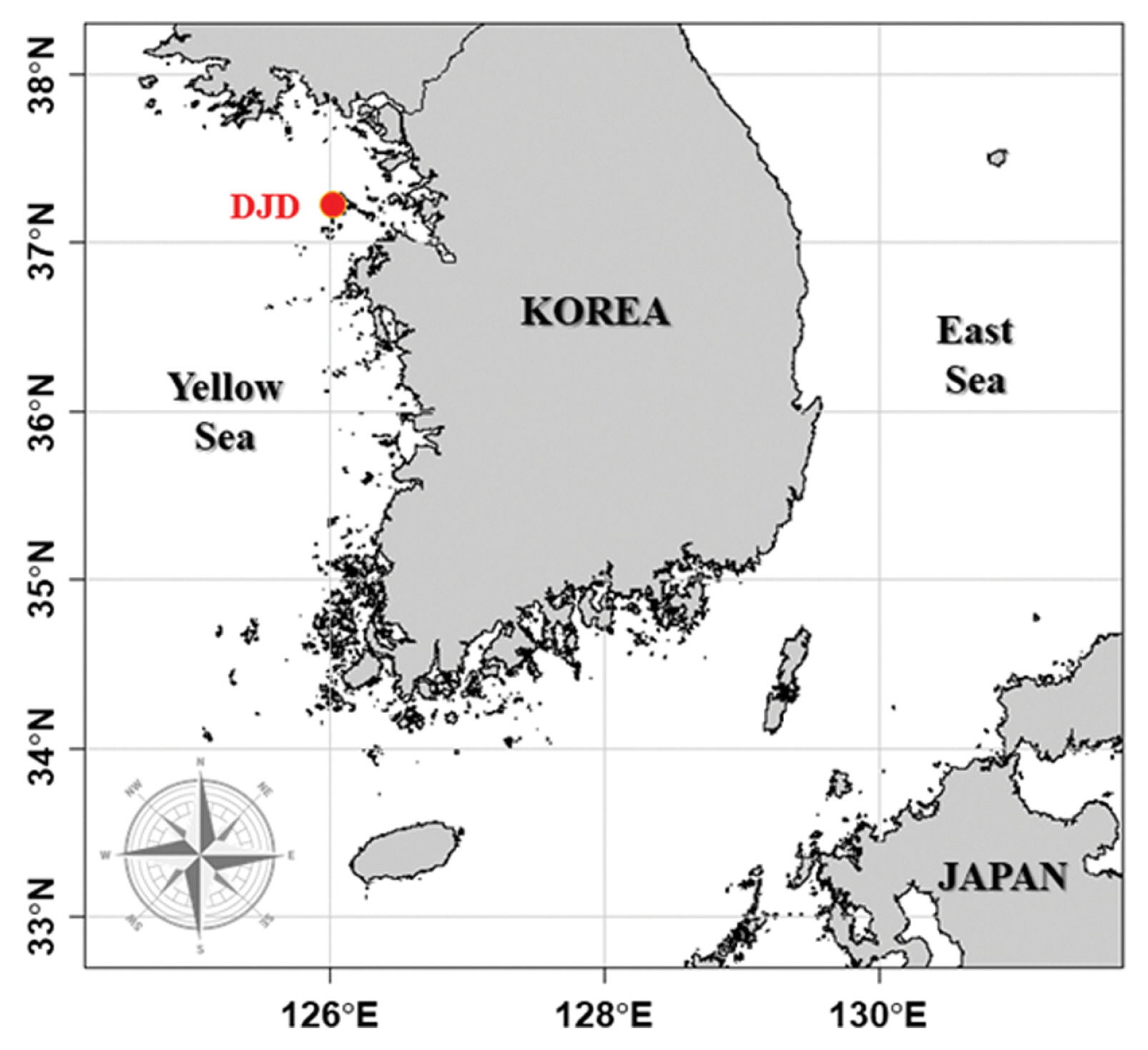
본 연구에서는 최근 구축된 전국파랑관측자료 제공시스템(WINK: Wave Information Network of Korea)에서 제공하는 파랑 관측자료 중 가장 장기간에 해당하는 덕적도 인근 해역의 매 1시간 파랑 관측 자료를 수집하였으며, 연최대치(AM) 계열과 임계치 초과(POT) 계열 자료를 이용하여 극치 설계파고를 산정하였다. 또한 극치파고의 분포함수로는 4종류를 대상으로 L-모멘트를 사용하여 매개변수를 추정한 뒤, 다양한 방법으로 적합도 검정을 수행하여 최적분포형을 채택하였으며, 이 결과를 이용하여 재현기간별 설계파고의 점추정 및 구간추정을 수행하였다.
2. 분석 방법
2.1 프로그램 구성 요소 및 절차
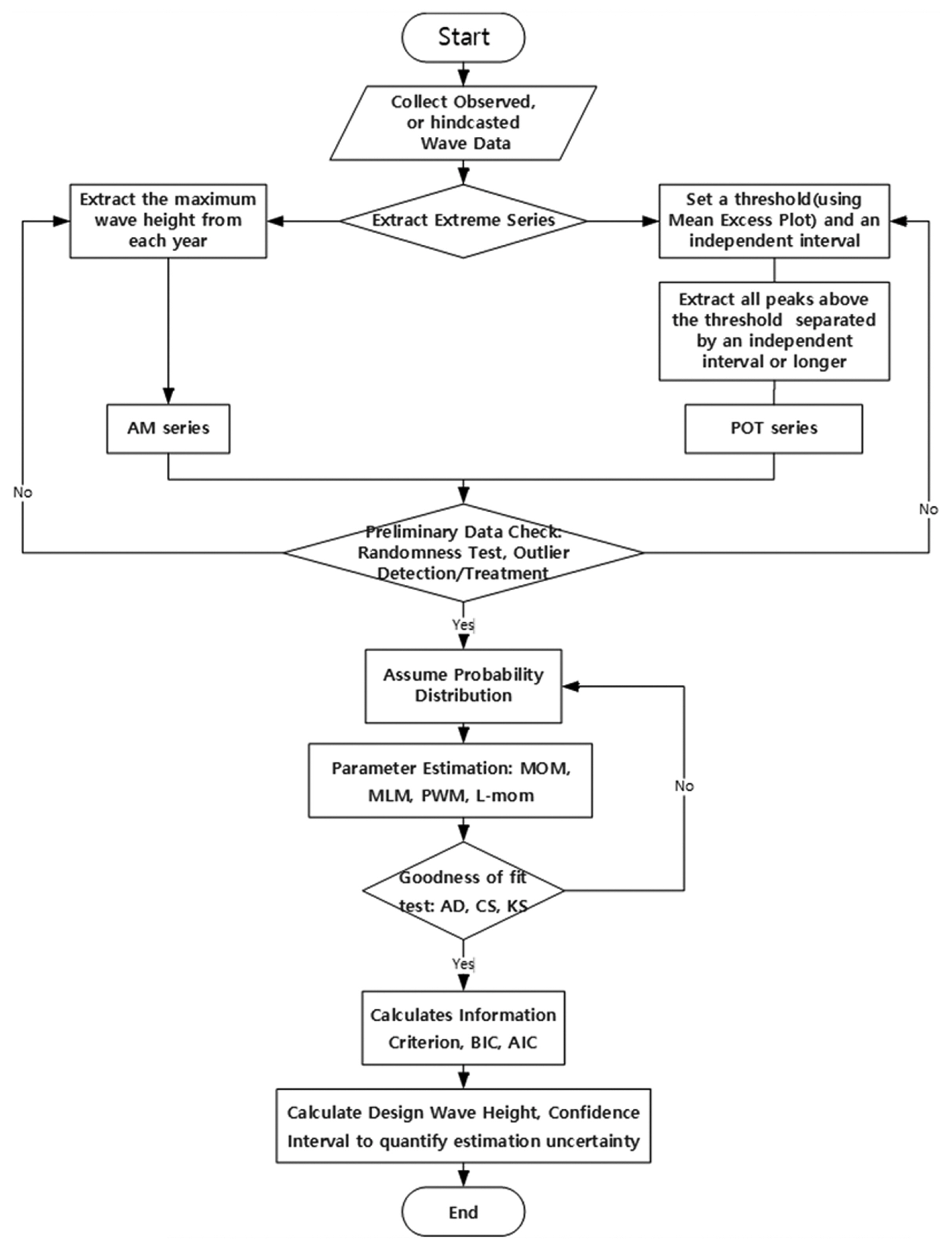
극치 분석은 극치 자료를 이용하여 재현기간에 따른 재현 변량을 추정하는 핵심 절차를 포함하는 표준화된 절차로 구성된다. 파고 자료를 대상으로 그 전반적인 구성 요소 및 연결 단계는 Fig. 1의 흐름도로 표현할 수 있다.
2.2 극치자료 추출 방법
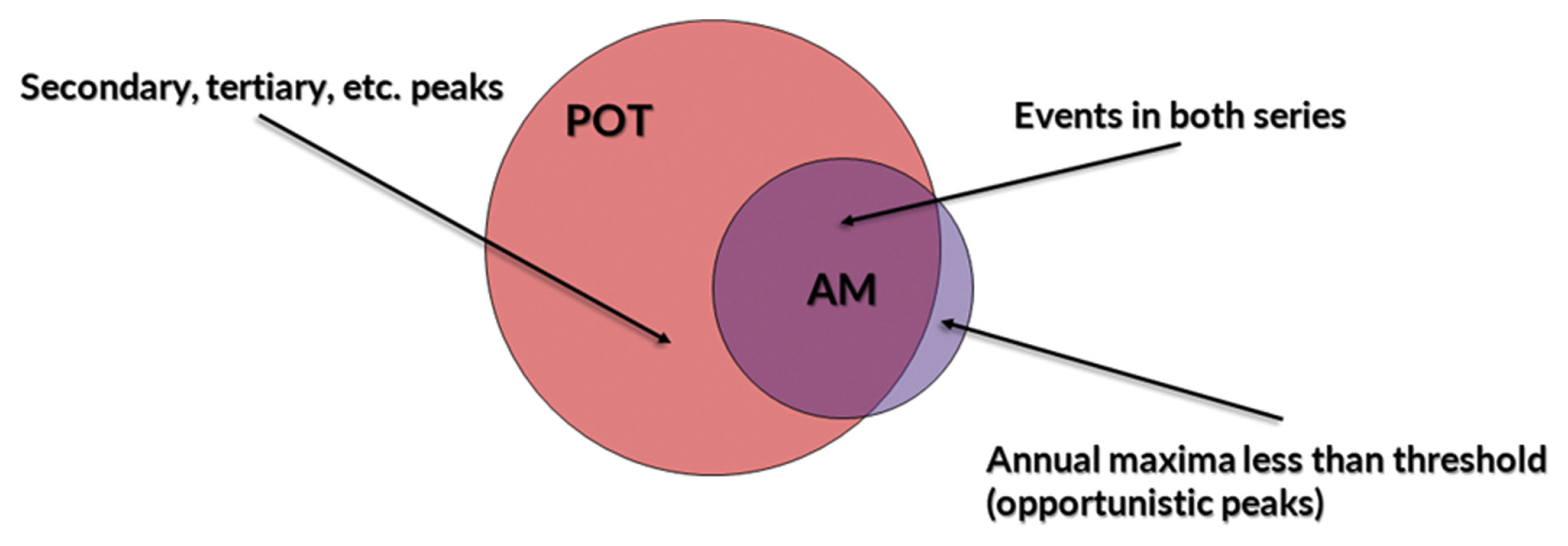
극치 분석에 이용되는 극치(extreme values)를 추출하는 방법은 매우 다양하지만, 본 연구에서는 다음과 같은 대표적인 2가지 방법, Annual Maxima(AM, 또는 Block Maxima, Block = 1년), Peak Over Threshold(POT) 방법을 사용하였다. 추출되는 극치의 개수는 AM 방법은 자료의 연도 단위 기간으로 고정되지만, POT 방법의 경우 Threshold 설정, 시간 구간에서 추출하는 극치의 개수 설정 조건에 따라 크게 달라진다. 이 경우 이론적인 기준은 없지만 AM 자료 개수의 1.5~3배 정도가 일반적으로 이용되며, 자료의 개수 증가로 인하여 불확실성이 감소하는 장점을 가진다. AM, POT 자료의 관계는 Fig. 2와 같다.
3. 자료 취득 및 예비적 해석
3.1 파랑 자료 취득
전국파랑관측자료 제공시스템(WINK: Wave Information Network of Korea)은 기상청, 국립해양조사원, 해양수산부에서 관측하고 있는 우리나라 주변해역의 파랑자료를 수집하고, 품질관리를 거쳐 신뢰할 수 있는 파랑자료를 제공하고 있다.
3.2 극치 파랑 자료 추출
적절한 임계값을 선택하기 위한 대표적인 시각적 및 정량적 방법들은 평균 초과 함수 그래프(Mean Excess Function Plot), 모수 안정성 그래프(Parameter Stability Plot) 방법 등을 사용한다(Coles, 2001). 본 연구에서는 취득한 자료를 AM 기준 극치자료를 기준으로 POT 극치자료 개수를 1.5~3배 이내로 유지하여 극치자료를 추출하였다.
Cunnane(1973)은 POT 자료 개수가 AM보다 약 1.65배 이상 많을 때 통계적으로 더 효율적이라는 기준을 제시하였고, Madsen et al.(1997)은 두꺼운 꼬리 분포를 갖는 자료의 현장 분위수 추정에는 POT 모델을 추천하였다.
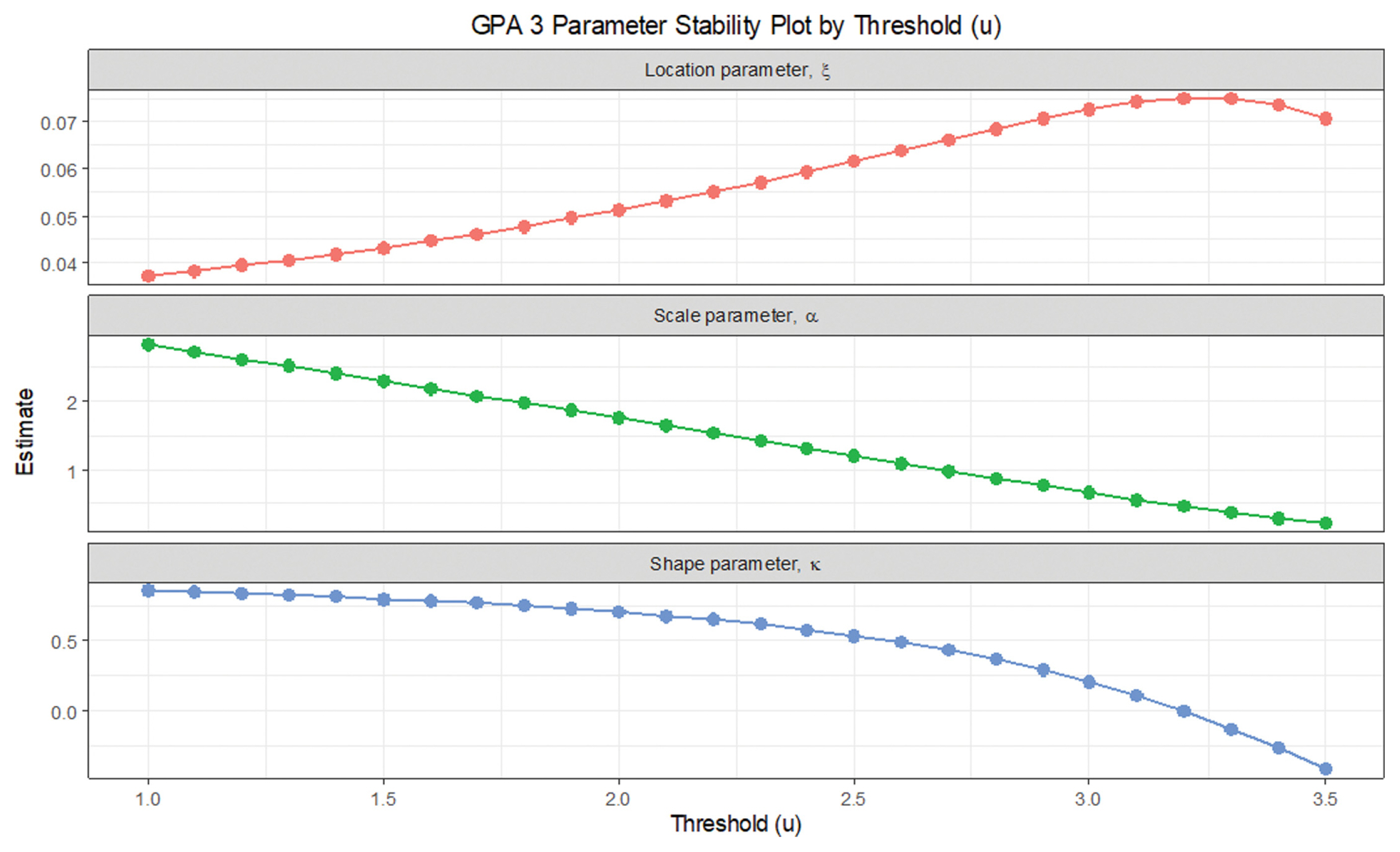
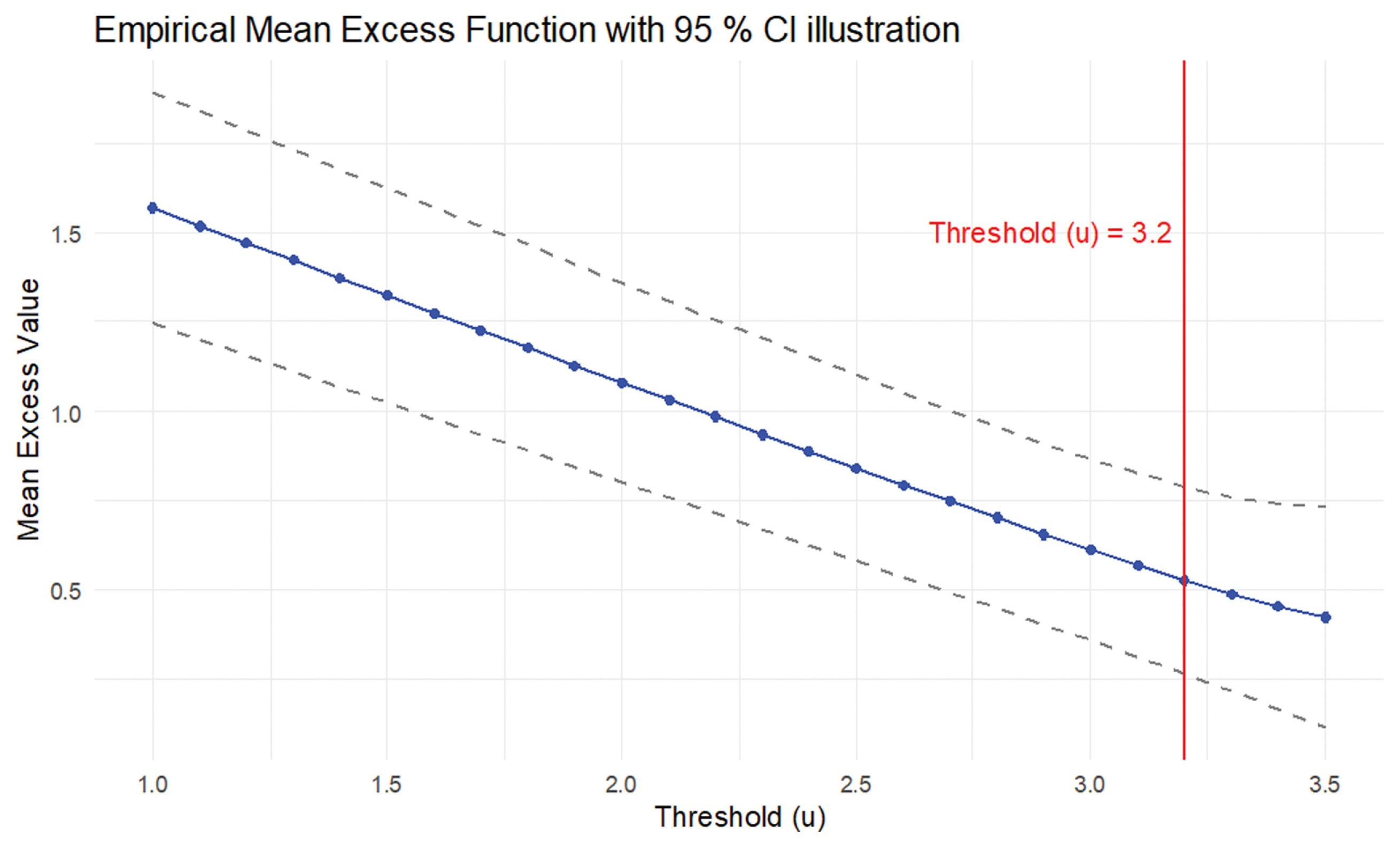
1시간 자료 평균초과치에 대한 Generalized Pareto(GPA) 분포의 매개변수를 L-모멘트를 이용하여 산정한 결과는 Fig. 4에, 평균 초과 함수와 95% 신뢰구간을 Fig. 5에 도시하였다. 평균 초과 함수 그래프의 선형성을 고려할 때 임계값(u) = 3.2 m가 적절한 후보로 검토되었다(Fig. 5 참조). 그러나, 이 경우 추출된 자료수가 22개에 불과하여 연최대치(AM) 자료 수(30개)보다 작아지는 현상이 발생한다. 본 분석에서는 통계적 유의성 확보를 위해 임계값을 2.8 m로 하향 설정하여 충분한 표본 크기를 확보하였다. 추출된 자료 간의 독립성을 보장하고자 파랑의 군집 특성을 고려한 72시간(3일)의 시간 간격을 적용하였으며, 이를 통해 최종 62개의 POT 극치 자료를 산출하였다. 특히 덕적도 지점의 경우, 시간 간격을 48시간으로 완화하더라도 72시간 적용시와 동일한 결과가 도출됨을 확인하여 분석 기준의 안정성을 검증하였다.
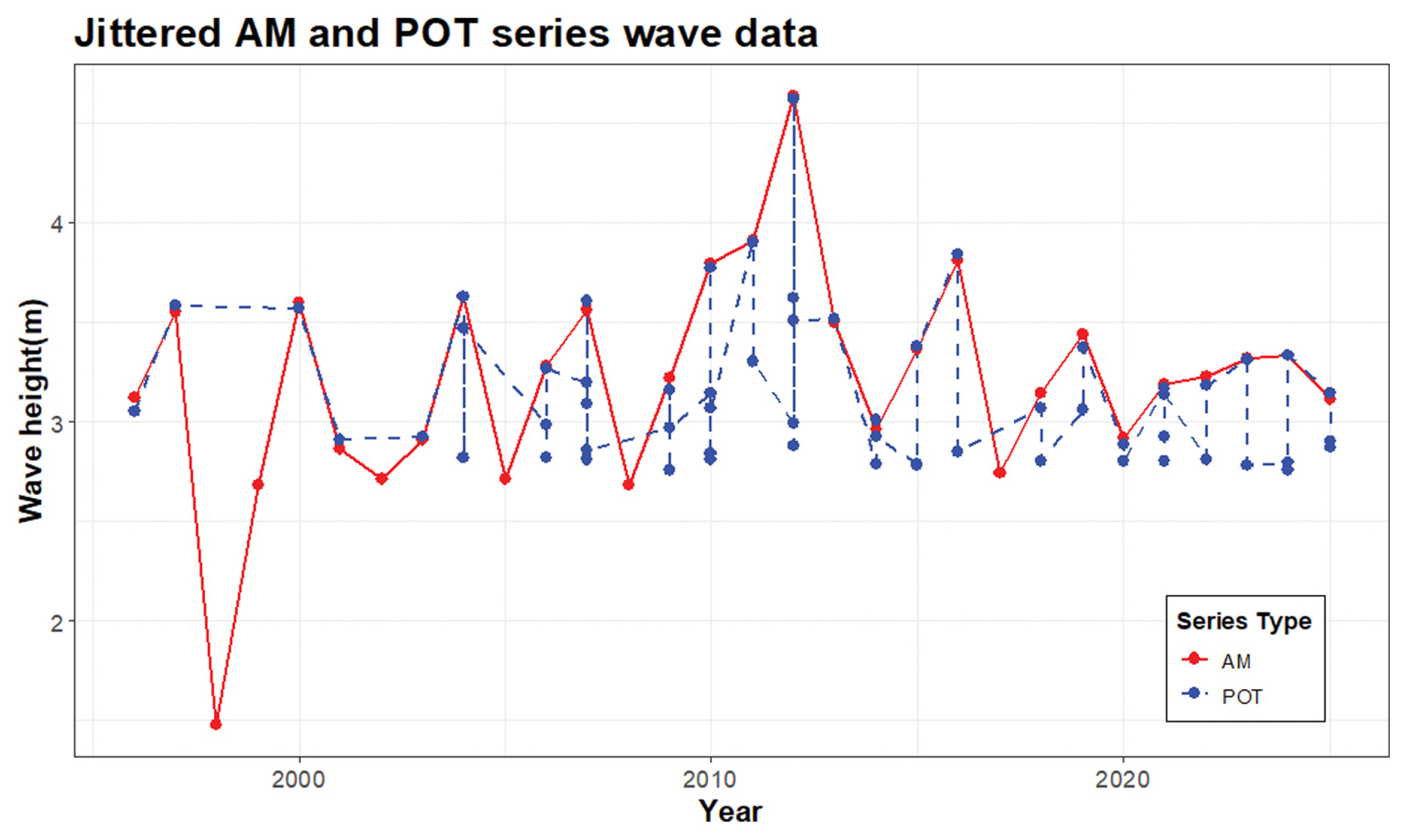
추출된 AM(30개) 및 POT(62개) 자료는 관측 기기의 해상도 한계 및 기록 과정에서의 반올림으로 인해 수치적 중복성이 높게 나타났다. 즉, 실제 고유한 파고값은 AM 자료에서 13종류, POT 자료에서 12종류에 불과하였다.
이를 해소하기 위하여 데이터 포인트의 위치에 작은 양의 무작위 노이즈를 추가하는 기법인 지터링(Chambers et al., 1983; Chambers and Hastie, 1992)을 AM 및 POT 자료에 적용하였다. 지터링은 관측 데이터가 중복되어 있는 경우, 데이터의 잠재적인 분포 구조를 명확히 하고 수치적 불안정성을 해소하기 위하여 관측 기기의 해상도 오차 범위 내에서 지터링 폭을 제한하여 자료의 연속성을 확보하기 위하여 수행한다(Chambers et al., 1983). 관계식은 다음과 같다.
여기서, Xobs는 관측된 파고 데이터, Xjittered는 지터링이 적용된 데이터, ε는 노이즈 성분이며 균등분포를 따른다.
지터링을 적용한 AM 및 POT 파고값을 Fig. 6에 도시하였다.
3.3 자료의 도시
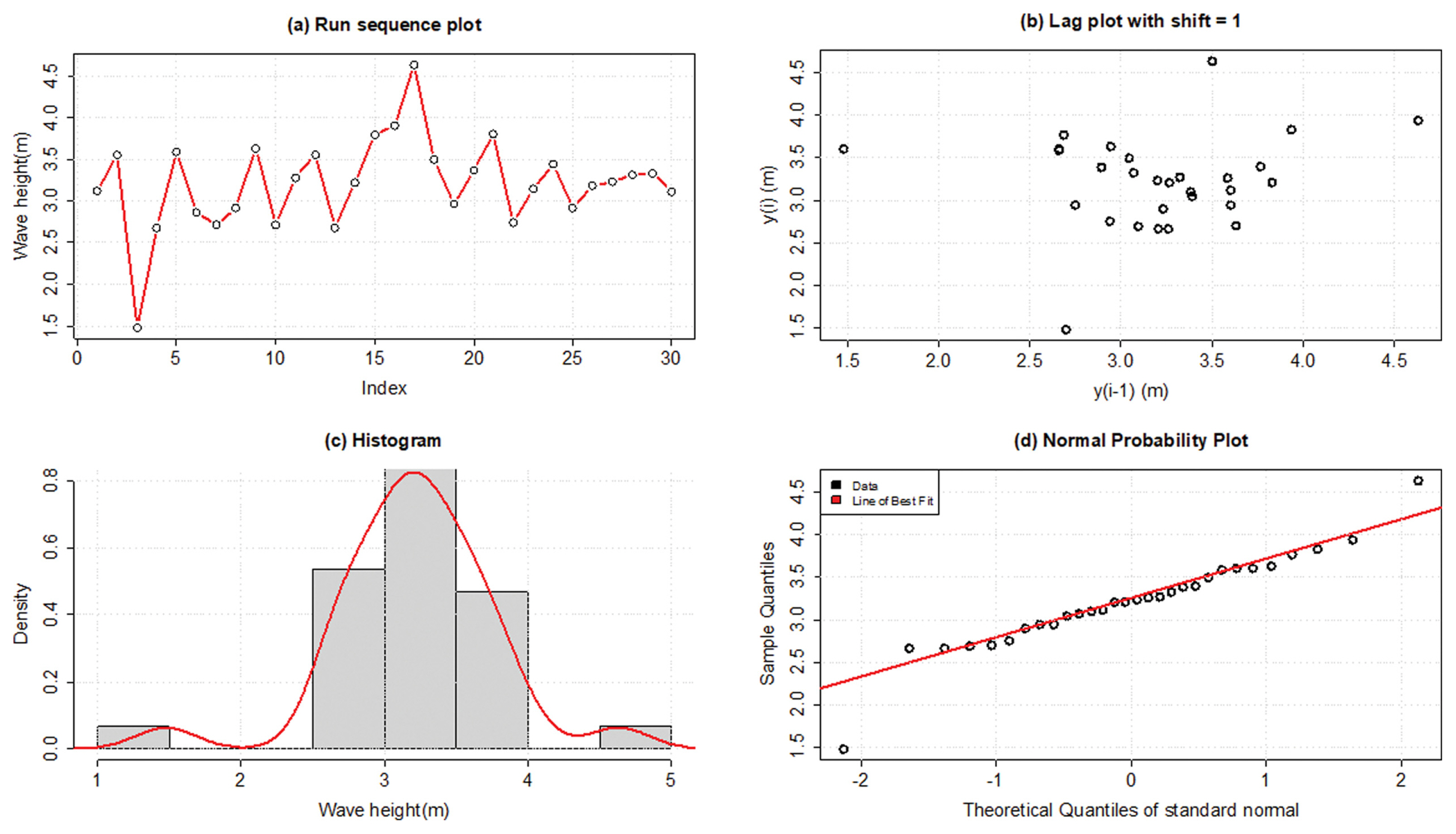
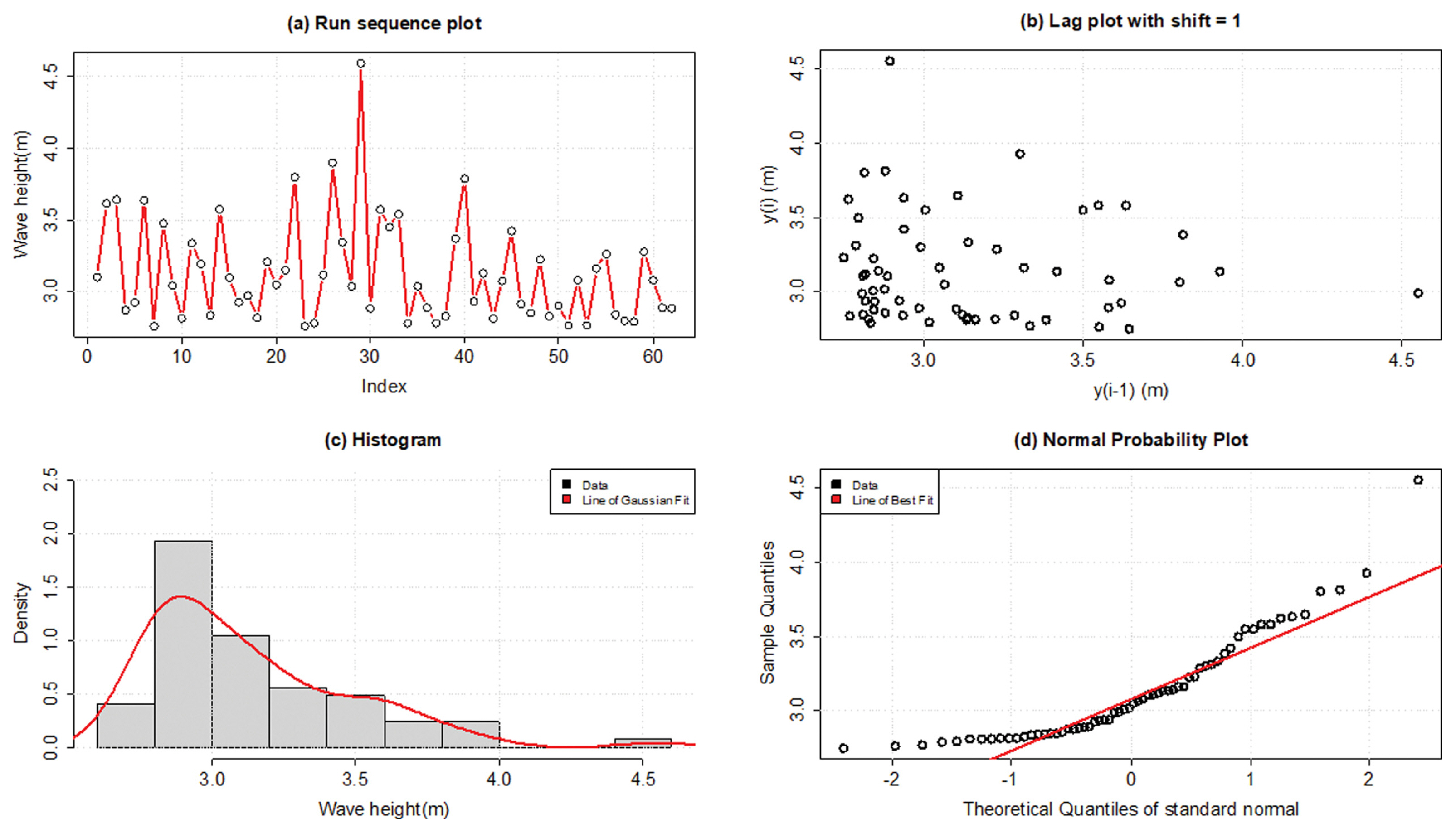
통계적 기법 적용에 앞서 자료의 특성을 예비적으로 파악하기 위해 NIST(미국 국립표준기술연구소)에서 권장하는 4종류의 그래픽 데이터 분석(4-Plot)을 수행하였다. Fig. 7과 8은 덕적도 지점 AM 및 POT 자료에 대한 4-Plot 분석 결과를 보여준다. Run sequence plot과 Lag plot에서 확인된 위치·변동 폭의 일정성과 무작위성은 자료가 통계적으로 안정적임을 입증한다. 반면, Histogram과 Normal probability plot을 통해 정규분포와 상이한 특성이 확인된바, 본 자료는 극치 통계 분석에 적합하며 이를 위해서는 자료의 특성을 반영한 적절한 확률분포형 적용이 필수적이다.
3.4 무작위성 검정
덕적도 지점 파고자료의 독립성 여부를 판단하기 위해 지체계수에 따른 자기상관함수를 검토하였다. 자료의 무작위성 검증을 위해 유의수준 0.05를 기준으로 신뢰구간을 설정하여 분석한 결과, AM 및 POT 자료 모두 대부분의 지체구간에서 0을 중심으로 신뢰구간 내에 분포하는 것으로 나타났다. 이를 통해 추출된 자료들 사이에는 유의미한 상관관계가 없음을 확인하였으며, 극치 분석을 위한 전제 조건인 자료의 상호 독립성과 무작위성을 통계적으로 입증하였다.
자료의 무작위성을 정량적으로 평가하고자 R의 ‘lawstat’ 패키지와 자체 개발 코드를 이용하여 Bradley(1960)의 Runs 검정을 실시하였다. Table 2의 검정 결과를 살펴보면, 덕적도 지점의 AM 및 POT 자료 모두 유의수준 0.05와 0.01에서 귀무가설이 기각되지 않아 자료의 무작위성이 확인되었다.
3.5 이상치 분석
이상자료 여부에 대한 검토를 위하여 다음과 같은 다양한 분석을 수행하였다.
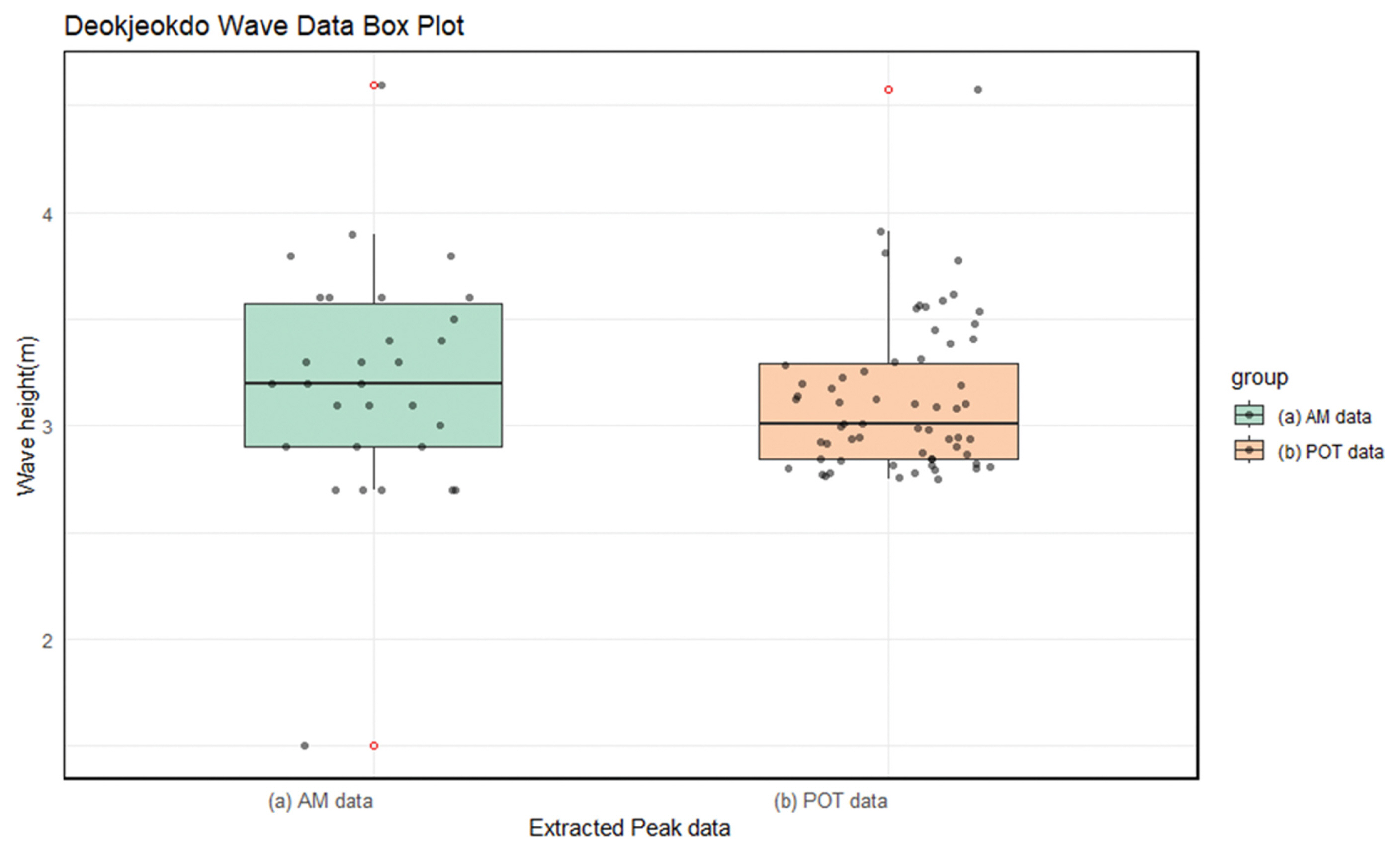
상자 그림(Chambers et al., 1983)은 자료의 분포와 산포 정보를 시각화하며, 특히 데이터 그룹 간의 구조적 차이를 비교하고 분석하는 데 매우 효과적인 도구이다. Fig. 9는 덕적도 지점의 파고자료를 상자 그림(box plot)으로 나타낸 것이다.
AM 자료의 경우 상하위 각 1개 파고자료(1.5 m, 4.6 m)는 이상자료로 분류할 수 있고, POT 자료의 경우에는 상위 1개(4.6 m)는 이상자료로 분류할 수 있다.
한편, 이상치 분석을 위하여 Grubbs 검정(Grubbs, 1969)을 수행하였다.
• AM 자료: 검정 통계량 G = 3.16, p-value = 0.007이므로, Grubbs 검정은 유의수준 α로 귀무가설은 기각하여야 한다. 따라서, 파고 1.5 m는 이상자료이다.
• POT 자료: 검정 통계량 G = 4.11, p-value = 0.0003이므로, Grubbs 검정은 유의수준 α로 귀무가설은 기각하여야 한다. 따라서, 파고 4.6 m는 이상자료이다.
자료 분석시 통계적 유의성과 실질적 유의성을 구분하는 것이 중요하다. 통계적 유의성은 단순히 귀무가설을 기각한다는 것을 의미한다. 검정이 귀무가설을 기각하는 차이를 감지하는 능력은 표본 크기에 따라 달라진다. 예를 들어, 특히 큰 표본의 경우, 검정은 두 공정 평균이 동일하다는 귀무가설을 기각할 수 있다. 그러나 실제로 두 평균 간의 차이는 실제 공학적 유의성이 없을 정도로 상대적으로 작을 수 있다. 본 연구에서는 자료의 무작위성은 확보되어 있으므로, 이상자료를 제거하지 않고 전체 자료를 대상으로 극치분석을 수행하였다. 이들 최고 및 최저치가 극치분석에 미치는 영향이 크기 때문이다.
4. 극치 해석 및 결과 분석
4.1 매개변수 추정
확률분포형의 매개변수를 추정하는 방법은 모멘트법(Method of Moments), 최우도법(Method of Maximum likelihood), 확률가중모멘트법(Method of Probability Weighted Moments) 그리고 L-모멘트법 등이 있다.
L-모멘트는 기존 모멘트보다 데이터의 이상치에 덜 민감하고, 적은 표본에서도 매개변수 추정이 편향이 적으며, 최우도 추정치보다 더 효율적인 모수 추정치를 제공하는 경우도 있다(Hosking, 1990). 또한 극치 해석에 많이 사용하는 파레토 분포를 대상으로 최우도법, 확률가중모멘트법을 이용하여 매개변수를 추정한 결과 표본 크기가 500 이상이 아닌 경우에는 확률가중모멘트법으로 도출된 추정량이 최우도법에 의한 결과보다 더 신뢰할 만하다는 것을 보여주고 있다(Hosking and Wallis, 1987).
본 연구에서는 확률가중모멘트(PWM)의 선형 조합인 L-모멘트법(Karvanen, 2006; Hosking, 2007; Asquith, 2011; Ahmad et al., 2011)을 적용하여 매개변수를 산정하였으며, 계산 과정에는 R 패키지 ‘lmomco’의 ‘lmoms’ 및 ‘lmom2par’ 함수를 활용하였다. 대상 확률분포형으로는 극치 해석에 널리 사용되는 Generalized Pareto(GPA), Generalized Extreme Value(GEV), Weibull(WEI), Pearson Type III(PE3) 분포 등 총 4종을 선정하였다. 덕적도 지점의 파고 자료를 대상으로 산정한 각 분포별 매개변수는 Table 3과 같다.
4.2 적합도 검정 및 정보 기준
임의의 확률분포에 대한 적합도의 검정은 그 확률분포의 상대도수함수(relative frequency function)와 누가도수함수(cumulative frequency function)의 이론값과 표본값을 비교하여 그 정도를 판별하게 된다. 본 연구에서는 Kolmogorov-Smirnov 검정, χ2 검정, 그리고 Anderson-Darling 검정(Stephens, 1974)을 수행하였다. 통계 모델의 상대적인 품질을 평가하는 지표인 정보 기준(Information Criterion, IC)은 가장 널리 사용되는 BIC, AIC, AICc(Burnham and Anderson, 1998; Burnham and Anderson, 2004)를 산정하였다.
여기서,
k: 확률 모형에 의해 추정된 매개변수의 개수
N: 매개변수 추정에 사용한 자료의 개수
4.3 설계파고 산정
전술한 적정 확률분포형을 구하게 되면, 다양한 목적에 따라 재현기간별 설계파고를 구하게 된다. 본 연구에서는 1, 2, 3, 5, 10, 30, 50, 100년 재현기간에 따른 설계파고를 누가분포함수의 역함수를 이용하여 산정하였다. Table 7에 4종류의 분포형을 이용하여 덕적도 POT자료를 대상으로 산정한 설계 파고를 정리하였다. 재현기간이 30년 이상인 경우, 최적분포형인 GPA 분포로 추정한 설계파고가 다른 분포형으로 추정한 값에 비하여 작게 나타났다.
4.4 설계파의 신뢰 구간
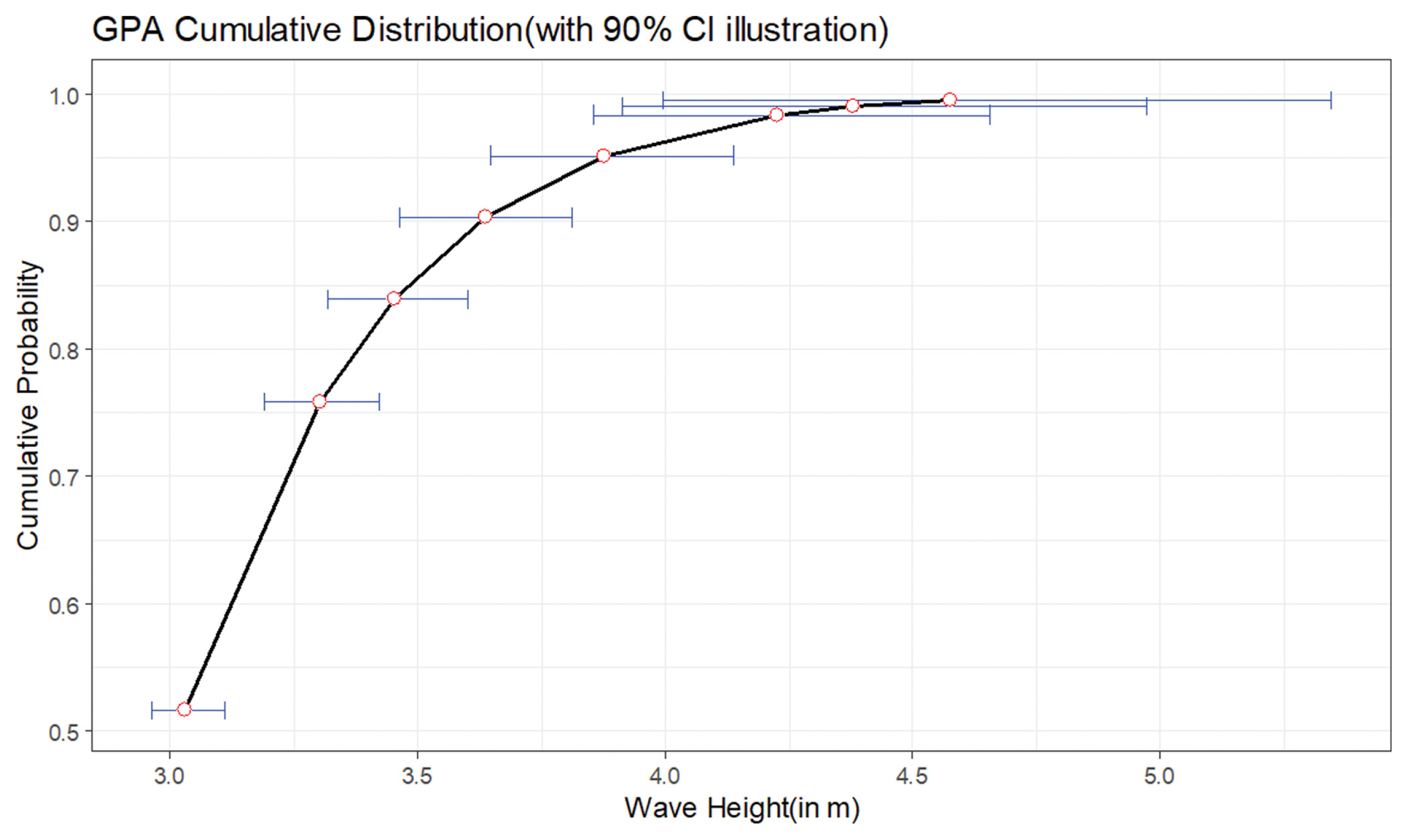
최적 분포형으로 선정한 Generalized Pareto 분포형(POT 자료 대상)을 이용하여 신뢰구간 분석을 수행하였다. 본 연구에서는 R package ‘lmomco’의 ‘genci.simple’ 함수를 이용하였다. 신뢰구간을 형성하는 과정은 2000번, 그리고 90% 신뢰수준으로 산정한 재현기간별 설계파고의 값은 Table 8에 제시하였으며, 그 결과는 Fig. 10에 도시하였다.
이러한 신뢰구간 평가결과가 의미하는 것은 반복적으로 설계파고에 대한 구간추정을 행한다면, 이들 중 대략 90%에 해당하는 신뢰구간들이 참값을 포함한다는 뜻이다. 즉 설계파고가 이 구간에 속할 확률이 90%라는 것이 아니고, 사용된 구간추정방법이 참값을 포함하는 신뢰구간을 형성하는 것이 100번중 90번 정도이므로 산정한 신뢰구간들도 이 중의 하나일 것으로 기대할 수 있다.
5. 결론 및 제언
통계적 기법을 통한 설계파고 산정을 위해서는 장기간 파랑자료가 요구된다. 그러나 열악한 해상상태에서 장기 파랑 관측 자료의 확보는 쉽지 않으며, 최근 한반도 주변 파랑 관측시스템의 설치가 증가하고 있으나 장기 파랑 정보가 누적되기 위해서는 더 많은 시간이 지나야 한다. 이에 따라 현존하는 파랑 관측 자료중 최장 관측 기간(1996/07/23~2025/11/29)의 덕적도 파고를 대상으로 극치해석을 수행하여 다음과 같은 결과를 도출하였다.
(1) Coles(2001)가 제시한 Mean Excess Plot 방식은 2매개 변수 GPA 분포와 최우도법에 기반한 시각적 진단에 의존하기 때문에 임계값 설정의 주관성이 배제되기 어렵다. 본 연구에서는 이를 개선하기 위해 Mazas et al.(2014)이 제안한 위치 매개변수를 포함한 3매개변수 GPA 분포를 L-모멘트법으로 추정하였다. 이는 임계값 설정 과정에 통계적 객관성을 부여하며, 향후 적합도 검정을 통한 정량적 판단을 가능하게 한다.
(2) Mean Excess Plot을 통한 시각적 진단 결과, 선형성이 확보되는 임계값은 3.2 m로 나타났다(Fig. 5 참조). 그러나 해당 임계값을 적용할 경우 추출된 임계치 초과(POT) 자료는 총 22개(0.73회/년)에 불과하여, 재현빈도가 지극히 낮은 최상위 극치에만 국한됨으로써 분포의 매개변수 추정에 불확실성을 높일 우려가 있다. 이에 본 연구에서는 표본의 통계적 대표성 기준(Cunnane, 1973)을 충족하기 위하여 임계값을 2.8 m로 조정하였다. 이를 통해 확보된 POT 자료는 30년간 총 62개(2.1회/년)로, 이는 서해안의 주요 고파랑 원인인 태풍 및 동계 계절풍의 연간 발생 빈도와 기상학적으로 부합한다. 또한 적합도 검정 결과(Table 5 참조)에서도 해당 자료가 GPA 분포를 통계적으로 유의하게 따르고 있음을 확인하여, 2.8 m가 물리적·통계적으로 타당한 극치 임계값임을 입증하였다.
(3) 덕적도 1시간 파고자료에서 추출한 연최대치(AM) 계열과 임계치 초과(POT) 계열 자료는 각각 30, 62개이나 관측 기기의 해상도 한계 및 데이터 처리 과정의 특성으로 인해 다수의 중복된 수치가 포함되어 있다. 분석 결과, 고유한 값(Unique values)의 개수는 AM 계열 13개, POT 계열 12개에 불과한 것으로 나타났다. 이러한 계단식 데이터 구조는 연속 확률 분포 모델의 핵심 전제인 데이터의 연속성 가정을 충족하지 못한다. 이는 통계 분석시 모델의 수렴 오류를 유발하거나 매개변수 추정 결과를 왜곡하는 직접적인 원인이 된다. 실제로 지터링(Jittering)을 수행하지 않은 원시 자료에 대해 적합도 검정을 수행한 결과 대부분의 모델이 기각되었으며, 이는 연속 확률 분포 기반의 극치 분석 모델을 원시 자료에 직접 적용하는 데 한계가 있음을 의미한다. 따라서 본 연구에서는 자료의 연속성을 회복하고 통계적 수렴성을 확보하기 위하여 지터링을 수행하였다(Chambers et al., 1983). 이때 지터링 폭을 관측 기기의 해상도 오차 범위 내인 0.05 m로 제한함으로써, 자료의 물리적 정보 왜곡을 방지하는 동시에 통계적 유의성을 확보하였다.
(4) 본 연구에서는 AM 및 POT 계열 자료의 적합성을 평가하기 위해 무작위성, 이상치, 정규성에 대한 예비적 해석을 수행하였다. 분석 결과, 모든 자료 계열에서 통계적 무작위성이 확보된 것으로 나타났다. 한편, 자료 내에 일부 이상치가 포함되어 있는 것을 확인하였으나, 본 연구에서는 이를 제거하지 않고 전체 자료를 대상으로 극치분석을 수행하였다. 그 이유는 극치분석의 특성상 최고 및 최저값에 해당하는 파고 자료는 분석 결과에 결정적인 영향을 미치며, 이는 실제 발생 가능한 물리적 현상을 반영하기 때문이다. 또한 해당 이상치들이 관측 기기의 해상도 한계나 일시적 오차를 포함할 가능성이 있으나, 이를 인위적으로 배제할 경우 오히려 설계 파고 산정시 과소 혹은 과다 산정의 원인이 될 수 있기 때문이다. 따라서 통계적 수치에만 의존하지 않고 공학적 판단을 결합하여, 자료의 연속성과 보수적인 설계를 위해 이상치를 포함한 전체 자료를 분석에 활용하였다.
(5) L-모멘트법은 기존의 매개변수 산정법에 비하여 자료내에 존재하는 이상치에 의한 왜곡에 덜 민감하여 보다 안정적인 매개변수 산정이 가능하고, 표본 크기가 작은 경우에도 매개변수 추정 편향이 적어, 극치분석에서 높은 신뢰도를 제공한다. 본 연구에서는 극치분석에 주로 사용하는 4종류의 확률분포형에 대한 매개변수를 L-모멘트법을 사용하여 산정하였다. 덕적도 AM 자료에 대한 적합도 검정 결과, PE3 분포만이 해당 자료에 적합하다는 결론을 얻었다(Table 4 참조). 이와 달리 POT 자료의 경우, 4종류의 분포형 모두 적합 기준을 만족하는 것으로 나타나, AM 자료에 비해 통계적 유연성이 높은 것으로 확인되었다. 적합성이 인정된 후보 모형 중 최적의 모형을 선정하기 위하여 통계적 정보 기준인 AIC, AICc, BIC를 검토하였으며, 모든 정보 기준 값에서 GPA 분포가 가장 낮은 수치를 기록하여 모델의 적합도와 효율성이 가장 우수한 것으로 평가되었다(Table 6 참조). 덕적도 파고 자료의 경우, 자료의 개수가 상대적으로 많은 POT 계열을 활용하는 것이 AM 계열 대비 모델의 불확실성을 줄이고 분석 품질을 유의미하게 향상시키는 것으로 분석되었다.
(6) 최종적으로 선정된 POT-GPA 모형의 매개변수를 활용하여 90% 신뢰구간 내의 재현기간별 덕적도 설계파고를 산정하였다. 이를 통해 설계치에 내재된 불확실성을 정량적으로 분석하고 추정치의 정확도를 평가함으로써, 향후 해안 구조물 설계시 안전성과 신뢰성을 확보하기 위한 객관적인 기초 자료를 제시하였다.
(7) 본 연구의 성과를 바탕으로 향후에는 Coles(2001)가 제안한 평균 초과 함수 그래프 방법의 개선, Mazas et al.(2014)이 제안한 GPA 분포의 매개변수 산정방법에 대한 개선 및 Solari et al.(2017)이 제안한 최적의 임계 (Threshold)을 자동으로 결정하는 방법에 대한 검토로 이어지는 극치해석 전 과정의 정밀도를 보완함으로써, 실제 해안 구조물 설계에 더욱 신뢰성 있는 기초 자료를 제공할 수 있을 것으로 기대된다.
(8) 본 연구는 기상청 관측 자료중 최장기 기록을 보유한 덕적도 지점을 대상으로 수행되었으나, 향후 관측 데이터의 점진적인 축적에 따라 거문도, 거제도 등 주요 지점을 포함하여 해양수산부(WINK)에서 제공하는 전 파랑 관측망으로 분석 대상을 확대할 필요가 있다. 이를 통해 우리나라 전 해역의 지역적 특성이 반영된 극치파고 특성을 규명하여야 한다. 또한, 파랑은 개별 파고가 독립적으로 발생하기보다 군집을 이루어 나타나는 물리적 특성이 있으므로, 각 지점별 파랑 자료에 대한 파군 효과 및 연속 기간(Run length)의 면밀한 검토가 선행되어야 한다. 이러한 검토를 바탕으로 추출된 개별 극치 사상 간의 통계적 독립성을 엄격히 확보함으로써, 더욱 신뢰도 높은 POT 계열 자료 구축과 설계파고 산정을 도모할 수 있을 것으로 기대된다.



 PDF Links
 PubReader
 ePub Link
 Full text via DOI
 Download Citation
  Print
Print