





1. 서 론
기후변화의 영향으로 기존의 행동 패턴과는 다른 전 세계적인 기상 이변이 발생하고 있으며, 해양으로부터 발생하는 열대저기압은 가장 위험한 재해를 발생시킬 수 있는 대표적인 자연현상이다. 열대저기압은 발생 지역에 따라 태풍, 허리케인, 사이클론 등으로 다르게 불리는 기상현상의 일반적인 명칭이며, 북서태평양에서 발생한 중심 최대 풍속이 17 m/s 이상인 열대저기압을 태풍으로 정의한다(WMO, 2025). 이후 본 연구에서는 용어로 인한 혼동을 최소화하기 위해 열대저기압을 통일된 명칭으로 사용하였다. KMA(2025)의 태풍 발생 통계에 따르면, 한반도는 연평균 3~4회의 열대저기압의 영향을 받고 있으며, 최근 최대 풍속 또한 증가하는 추세이다. 이처럼 강해진 열대저기압으로 인해 해양에서 발생하는 고파랑은 해안 및 육상 구조물에 심각한 위협이 되고 있다.
이에 따라 과거부터 열대저기압에 관한 많은 연구가 다양하게 수행되었으며, 예보를 위해 열대저기압의 물리적 특성에 근거해 개발된 수치 모델링이 핵심 연구 분야이다. 최고 등급의 위력으로 2005년 미국을 강타한 허리케인 카트리나는 재난 역사상 가장 큰 피해를 주었으며, 이후 기상 분야 선진국인 미국, 일본, 유럽 등을 중심으로 수치해석이 급속히 발전하였다(Sallenger et al., 2005). 과거에는 기술적인 한계로 대기 변화만 고려되었으나, 현재는 대기와 해양이 결합한 모델을 운영 중이다(Xue et al., 2020). 이러한 수치모델의 발전과 더불어 고성능 슈퍼컴퓨터의 도입으로 예보 능력이 과거에는 상상할 수 없을 정도로 향상되었으며, 열대저기압의 경로 및 강도의 예측 정확도 향상을 위한 연구도 지속적으로 진행되고 있다. 열대저기압을 포함한 기상현상은 매우 복잡하여 현재도 그 물리 특성에 관한 연구가 진행되고 있으며, 예측 정확도를 높이기 위해 앙상블 및 인공지능 모델과의 결합을 통한 다양한 시도가 수행되고 있다(Gupta and Arthur, 2025). 이를 위해 수년 전부터는 전통 물리 기반의 수치모델과 최근 급격히 발전하고 있는 인공지능 연구를 융합하는 하이브리드 접근 방법에 관한 연구가 수행되고 있다(Chen et al., 2023; Liu et al., 2024).
Wu et al.(2005)는 1965년부터 2003년까지의 태풍 경로를 분석한 결과, 북서태평양에서 두 개의 주요 태풍 경로가 서쪽으로 현저히 이동했음을 확인하였으며, 이러한 변화의 주요 원인으로 기후변화에 따른 상층 제트기류의 이동을 제시하였다. Choi et al.(2012)는 과거 열대저기압 발생 자료를 분석하여, 열대저기압 발생 빈도의 증가가 1981년경부터 시작되었음을 밝혔다. Mei et al.(2015)와 Mei and Xie(2016)는 북서태평양 상층 해수온의 상승이 해당 지역에서 발생하는 열대저기압의 강도 증가와 밀접하게 관련되어 있음을 제시하였다. 반면 Lin and Chan(2015)은 최근 10년간의 분석을 통해, 해양의 온난화가 열대저기압 발생에 유리한 조건을 제공했음에도 불구하고, 대기 조건의 악화로 인해 전체 열대저기압 발생 빈도는 오히려 감소하는 경향을 보였다고 보고하였다.
Choi et al.(2009)은 열대저기압의 강도와 진로를 예측하는 인공신경망 모델을 개발하였으며, 다중 선형 회귀 모형보다 우수한 예측 성능을 보여주었다. 개발된 모델의 예측 성능을 분석한 결과, 진로 예측 오차는 태풍 발생 위치가 서태평양 북서쪽일수록 커졌으며 강도 예측 오차는 태풍 위치가 남동쪽일수록 오차가 증가하는 것으로 나타났다. Choi and Kim (2011)은 1984~2004년에 발생한 열대저기압을 통계적으로 분석한 결과, 1983~1984년에 유의미한 변화가 발생했음을 확인하였으며 그 이전 시기에 비해 더 많은 열대저기압이 서쪽으로 이동했음을 보여주었다. Wu et al.(2021)은 북서태평양의 열대저기압을 여름과 가을 시기로 구분하여 분석한 결과, 계절적 요인이 열대저기압의 발생 특성과 변동에 뚜렷한 영향을 미친다는 점을 보여주었다. 수년 전부터 기후변화로 인해 전 세계에서 이전의 발생 양상과는 다른 극한 가뭄, 강우, 폭염이 이어지고 있으며, 이러한 영향으로 열대저기압에도 강도 변화와 이상 기후 패턴이 발견되고 있다. 특히 한반도를 포함한 동아시아 지역에서는 열대저기압의 최대 강도 상승 추세와 발생 빈도의 변화도 발견되고 있어, 이에 대한 대응이 필요한 상황이다(Song et al., 2024; Wang et al., 2024; Xu et al., 2024).
최근 과거와 다른 양상의 기상 변화는 미래 예측을 더욱 어렵게 하고 있으며, 이에 따라 장기적인 열대저기압의 특성을 이해하는 것은 해양 및 연안 구조물의 안전 설계에 있어 매우 중요한 부분을 차지하고 있다. Na and Jung(2020)은 한반도에 영향을 미친 가을철 열대저기압을 1954~2003년, 2002~2010년, 2011~2019년의 세 시기로 구분하여 분석한 결과, 가을철 열대저기압의 발생 빈도가 2002년 이후 급격히 증가하였으며, 강풍 영역 또한 2011년 이후 지속적으로 확장된 경향을 확인하였다. 기존 연구들은 관측된 열대저기압 자료의 발생 빈도와 강도의 변화 추세를 통계적으로 분석해 왔으나, 최근 기후변화로 단기간 변동성이 커진 상황에서 장기간 변동 추이를 정확히 파악하기는 매우 어렵다.
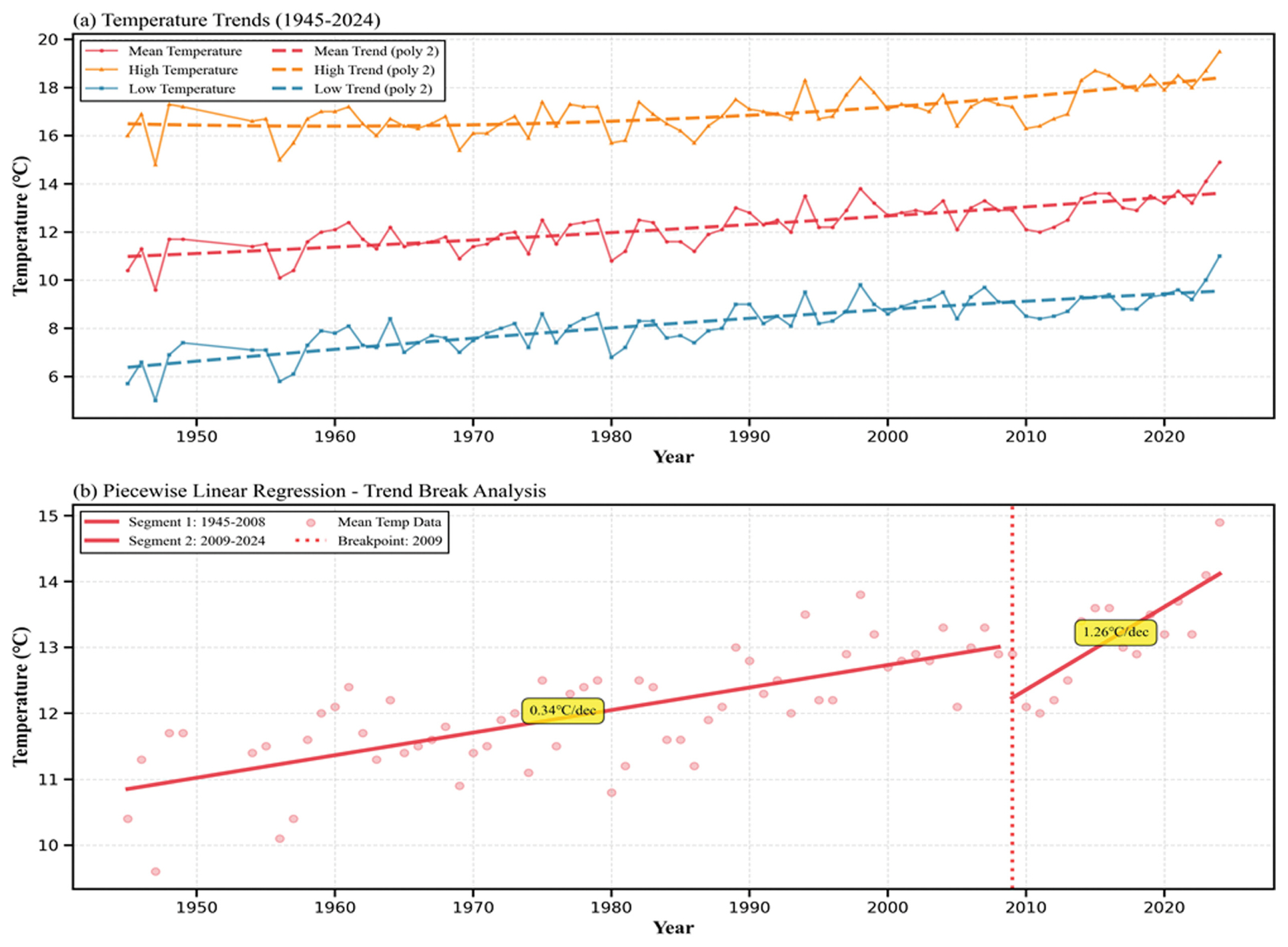
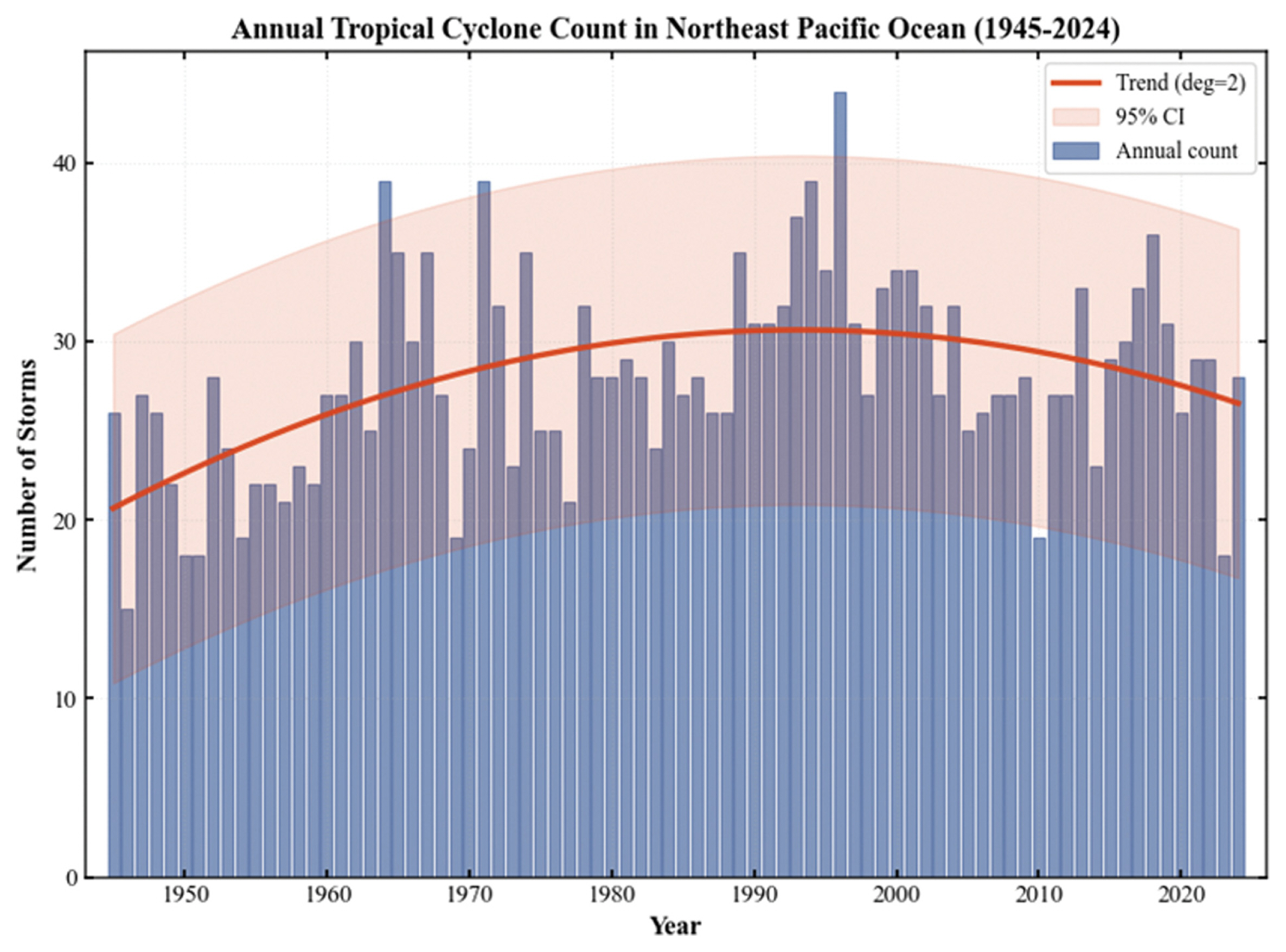
열대저기압과 동일 연구 기간의 서울 일평균 기온 변화를 Fig. 1에 제시하였다. 기온은 시간 경과에 따라 꾸준한 상승 추세를 보였으며, Piecewise linear regression 분석 결과 2009년 이후에는 기온 상승률이 더욱 증가하는 것으로 나타났다. 동일 기간 북서태평양의 연간 열대저기압 발생 빈도를 Fig. 2에 도시하였으며, 이 시계열 자료는 1990년까지 명확한 증가 추세를 나타내지만, 이후 시점부터 현재까지 감소하는 경향을 보여줌으로써 일평균 기온 양상과는 다른 것을 확인할 수 있다. 이러한 양상이 기후변화 영향과 어떻게 연관되는지는 아직 명확하지 않다. 해수면 온도(Sea Surface Temperature, SST) 상승이 열대저기압 특성 변화에 미치는 영향은 여러 연구를 통해 확고히 입증되었으나(He, 2024), 기온과 같은 대기 변수와 열대저기압 발생 개수 사이의 직접적인 정량적 연관성을 도출하는 과정은 여전히 복잡한 문제로 남아있다.
이러한 열대저기압의 장기 변동성(long-term variability)에 대한 이해는 재현 주기(return period) 산정을 통한 해안 구조물 설계 및 재해 위험 평가에 필수적이다. 일반적으로 change point(변화 시점)가 시계열 분석에서 순간적이고 가역적인 변화를 의미하지만, regime shift(장기 추세 전환)는 기존 시스템의 변화로 인해 지속적이고 장기적인 시스템 변화를 나타낸다. 본 연구에서는 change point보다 regime shift에 주목하여 기후변화에 따른 열대저기압의 추세 전환을 탐지하고자 한다. 기존의 접근 방법은 단변량 데이터에 최적화되어 있어서, 열대저기압과 같이 다수의 feature가 복합적으로 상호작용을 하는 고차원 다변량의 시계열 분석에는 제약이 있다. 또한 단기 기법 사용시 단기 이상치와 장기 구조적 변화를 구분하기 어려운 이유로 다중 아키텍처를 적용하여 이러한 문제를 해결하였다. 따라서 본 연구에서는 기존 전통적인 통계적 분석 방법에 딥러닝 모델을 보완하여 다중 아키텍처 기반의 새로운 분석 방법론을 적용하여 북서태평양 열대저기압의 장기 추세 전환을 탐지하고자 한다.
2. 연구 방법
2.1 연구 대상 지역 및 연구 자료
연구 대상 지역은 한반도를 중심으로 북서태평양에 발생했던 열대저기압 모두를 대상으로 하였다. 이 지역에는 매해 평균 28개 정도의 열대저기압이 발생하고 있으며, 이중 평균적으로 3~4개가 한반도에 영향을 미치고 있다. 본 연구에서는 1945년부터 2024년까지 80년 동안 발생한 약 2,200개의 열대저기압을 대상으로 하였으며, 미국의 공군과 해군의 합동 부대에서 운영 중인 JTWC(Joint Typhoon Warning Center, 2025)의 베스트 트랙(Best track) 자료를 분석에 사용하였다. JTWC 베스트 트랙 자료는 2000년 초반까지 개별 열대저기압에 대해 위도, 경도, 최대 풍속 세 가지 정보만 시계열로 제공되어 자료적 한계가 있었다. 이후 더욱 다양한 열대저기압의 정보가 제공됨에도 불구하고, 분석의 일관성을 유지하기 위해 이들 3가지 정보를 기반으로 다양한 feature를 구성하여 인공지능 분석에 사용하였다. 또한 본 연구에서는 80년 동안의 장기 관측 자료를 분석하기 때문에, 이 기간에 발생한 관측 자료 품질 변화를 고려할 필요가 있다. 과거 선박 및 제한적인 위성 자료에 의존했었던 것과는 달리, 1980년 이후 시기는 관측 자료 품질의 전환점으로 자주 언급되며, 이때부터 개선된 위성 관측과 표준화된 분석 기법에 따라 열대저기압의 위치 및 최대 풍속에 대한 신뢰성 높은 데이터가 확보되기 시작한 것으로 평가된다. 따라서 본 연구에서는 1945년부터 2024년까지 관측된 열대저기압의 전체 자료를 분석에 포함하고 있으나, 이러한 관측 자료 신뢰성의 급격한 향상과 가속화된 기후변화를 고려하여 1980년 이후의 자료에 좀 더 주목하여 연구를 수행하였다.
2.2 연구 방법
관측된 자료를 활용하여 열대저기압의 발생 횟수, 위치, 최대 풍속 등이 변화하는 모습을 확인할 수 있지만, 이에 대한 통계적인 패턴을 분석하고 그 요인을 분류하는 것은 매우 어렵다. 과거로부터 이를 분석하기 위해 다양한 연구 방법이 수행되었으며, 본 연구에서는 인공지능의 딥러닝 기술을 이용하여 변환점을 탐색하는 연구를 수행하였다. 시계열 자료에서 변환점을 탐지하는 대표적인 통계적인 기법은 CUSUM (Cumulative Sum Control Chart), Piecewise Linear Regression, Likelihood ratio test 등이 있다. 이러한 통계적 기법은 이론적 검증 기반이 확실하고, 결과에 대한 해석이 가능한 장점을 가지고 있다. 인공지능을 이용한 분석 방법에 비해 상대적으로 적은 데이터로도 분석이 가능하며, 과적합 위험성이 낮으며 효율적인 계산을 수행할 수 있다. 오랜 기간 축적되어 온 연구 방법으로서, 목적에 적합한 다양한 기법을 통해 높은 신뢰성과 명확한 해석 결과를 제공할 수 있다. 하지만 기상, 금융과 같은 비선형과 비정상 특성을 가진 시계열 데이터에 적용하기에는 한계가 있으며, 단변량 데이터에 최적화한 경우가 많아 본 연구에서는 인공지능을 이용하여 새로운 접근을 시도하였다.
2.3 인공지능 모델 개요
본 연구에서는 인공지능의 딥러닝 구조를 가진 LSTM(Long Short-Term Memory)과 트랜스포머(Transformer) 기반 오토인코더(autoencoder)를 결합한 프레임워크를 제시하여, 열대저기압의 행동 변화의 전환점을 탐지하였다. 사용된 오토인코더는 인공지능의 신경망 아키텍처이며 일반적으로 차원 축소를 중심으로 다양한 응용 분야에서 사용되고 있으며, 여기서는 입력된 데이터를 인코더(encoder)한 후, 다시 원본 데이터로 디코더(decoder)하는 과정에서 이상 구간의 복원 오류가 증가하는 특성을 활용하는 인공지능의 비지도 학습 방법의 한 종류이다. 인코더는 입력 시퀀스를 분석하여 주요 특징들을 추출하는 과정이며, 디코더는 인코더의 반대 개념으로 인코더를 통해 압축된 정보를 원하는 형태의 출력 시퀀스로 생성하는 과정으로 비유할 수 있다.
일반적으로 오토인코더는 인코더(encoder)-병목지점(bottle neck)-디코더(decoder)의 3가지 단계를 통해 재구성한 결과에서 발생하는 재건 오류(reconstruction error)를 최소화하도록 수행되지만, 이런 특성을 반대로 활용하여 재구성 손실이 증가는 시점을 변환점으로 추정할 수 있다. 즉 정상적인 입력은 잘 복원되지만, 비정상적인 입력은 복원 과정에서 오류가 크게 증가하는 특성을 이용하는 기법이며, 입력된 열대저기압의 시계열 자료의 연산 과정에서 오류가 크게 확대되는 지점을 시계열 데이터의 변환점으로 추정할 수 있다.
LSTM은 대표적인 딥러닝 모델이며 RNN의 최대 단점인 장기 기억 소실 문제를 보완하여 좀 더 이전 시점의 중요 정보를 유지함으로써, 과거 데이터에 기반하여 미래를 예측하는 시간의 순차적 문제 해결에 강점이 있다. RNN의 vanishing gradient 문제로 인해 장기 중요한 정보가 연산에서 소멸하는 것을 보완하여, 과거의 시계열 패턴을 통해 미래를 예측하는 기상 예측, 주가 예측, 음성 인식, 자연어 처리에 활용된다. 즉 과거의 열대저기압이 현재의 열대저기압 특성에 영향을 주는 경우, 이전보다 먼 과거의 열대저기압으로 학습 대상을 확대할 수 있음을 의미한다. 단점으로는 복잡한 연산 구조로 인해 결정 과정을 설명하기 어려우며, 데이터가 부족한 경우 과적합의 위험성을 가지고 있어 이를 해결하기 위해 드롭아웃(Dropout)과 같은 추가 알고리즘을 고려하여야 한다.
Transformer는 구글에서 2017년에 발표한 인코더-디코더 구조를 가진 딥러닝에 사용되는 신경망 모델이며, 초기에는 자연어 처리를 위해 개발되었지만, 현재는 시계열, 음성, 영상 등의 다양한 분야에서 사용되고 있다. 기존의 RNN(Recurrent Neural Network), CNN(Convolutional Neural Network)과 다르게 라벨링을 사용하지 않고, 셀프 어텐션(Self-Attention)과 자가 지도 학습(Self-Supervised Learning)을 통해 대규모의 데이터를 학습하는 구조로 되어 있다. RNN과 같이 순차적인 처리가 아니고 병렬 연산을 통해 효율적인 처리가 가능한 장점을 가지고 있어 LLM(Large Language Model)의 기반이 되고 있으며, 대규모 데이터 학습 및 추론 문제에 적합하다. 어텐션 구조 덕분에 패턴 분석에 유리하며 시계열의 장기 의존성 문제에는 전통적인 LSTM보다 우수한 성과를 보여주고 있으나, 순서가 있는 짧은 시계열 데이터 문제와 데이터가 적은 경우에는 LSTM이 더 유리한 것으로 알려져 있다(Sonata and Heryadi, 2024).
지난 80년간 북서태평양에 발생한 2,237개의 열대저기압이 가진 75,930개의 관측 시계열 자료에 대해 52개의 feature를 작성하여 추론에 사용하였으며, 오토인코더와 앙상블을 통해 정상 패턴을 학습하고 재구성 오차를 기반으로 이상 지점을 식별하였다. LSTM과 Transformer의 결과에 대해 장기 추세 변화점 탐지 분석을 위해 세 가지 방법의 탐지 알고리즘을 적용하였다. 세 가지 방법은 첫 번째 Percentile과 CUSUM 기반의 이상치 탐지, 두 번째 시계열 자료의 변화점을 찾는 Pettitt와 SNHT를 사용한 통계적 추세 변환 탐지, 마지막으로 장기적인 변동성에 장점이 있는 Time-Lagged autoencoder로 구성하였다. 최종적으로 위 세 가지 방법 모두에서 공통으로 검출된 해를 열대저기압의 장기 추세 전환점으로 판단하였으며, 결정된 시점들에 대해 SHAP 분석을 수행한 후 주요 feature들의 기여도를 해석하였다. 분석에 사용된 SHAP(SHapley Additive exPlanations)는 기존의 인공지능 모델에서는 불가능하였던, 설명 가능한 인공지능(XAI, eXplainable AI) 기법의 한 방법으로 각 feature가 해석 결과에 얼마나 기여하는지 수치로 보여줌으로써 제공된 데이터를 더욱 논리적으로 분석할 수 있게 한다. LSTM과 Transformer의 autoencoder는 단기간에 발생하는 이상 현상을 탐지하고, 장기 트랜드 분석에 장점을 가지고 있지만 단기 변화에 민감하지 못한 모델과 함께 상호 보완 함으로써, 장기 추세 변화 탐지에 대한 신뢰성과 투명성을 높이도록 하였다.
2.4 인공지능 모델 설계 및 구현
본 연구에 사용된 열대저기압의 시계열 자료는 미국의 JTWC에서 최종적으로 배포된 베스트 트랙 자료로 결측이나 전처리에 대한 문제점은 없었다. 다만 열대저기압의 시계열 자료는 최소 3시간 또는 6시간마다 관측된 자료를 사용하는 이유로 인공지능 모델에 사용하기 위해서는 이러한 데이터 간격에 관한 내용을 고려해야 할 필요가 있다. 2000년 초반까지 JTWC의 원자료는 시간, 위도, 경도, 최대 풍속의 4가지 정보가 전부이며, 이후부터 열대저기압에 대해 보다 많은 정보가 제공되지만 자료의 연속성을 위해 초기 4가지 정보만을 사용하여 Table 1과 같이 10개 분야로 구성된 총 52개의 feature를 구성하였다.
각 feature의 내용을 설명하면 Genesis Location과 Intensity는 열대저기압의 최초 발생 위치와 풍속을 의미하며, Duration은 열대저기압의 생애 기간, Time to peak은 열대저기압의 발생부터 생애 최고 풍속까지 소요된 시간을 의미한다. Wind Dynamics의 Intensification과 Weakening은 해당 연도 각각의 열대저기압의 생애 기간 중 풍속 증가율과 감소율의 최댓값들에 대한 분석이다. Genesis of Tropical storm은 열대저기압이 tropical depression 단계에서 점차 발달하여 최대 풍속이 34 kn 이상으로 Tropical s torm 단계로 그 위력이 높아진 순간의 열대저기압 정보를 다루고 있다. 마지막으로 Temporal normalization은 본 연구의 분석 대상이 시간 순서가 있는 시계열 데이터인 것을 고려하여, 전체 기간인 80년에 대해 정규화함으로써 전체 구간에서 각 자료의 시간적 위치를 보여준다. 이들 52개의 feature는 모델의 도입부에 있는 오토인코더를 이용한 분석부터, 마지막 SHAP를 이용한 해석까지 한 개도 제외하지 않고 모두 사용되었다.
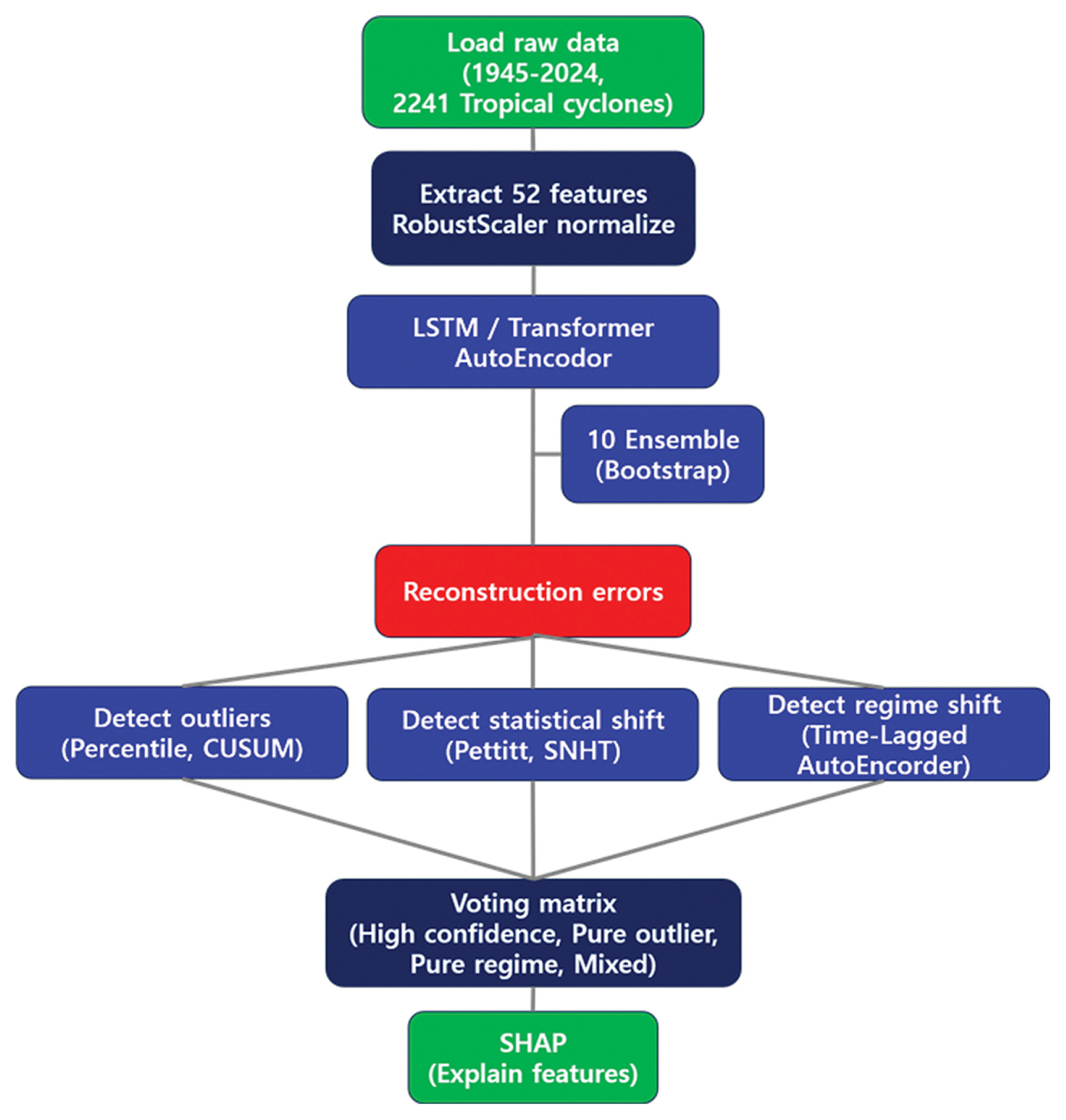
본 연구에서는 다중 아키텍처 딥러닝 구성을 위해 Fig. 3와 같이 2종류의 오토인코더, 10개의 앙상블, 3가지 독립된 결정 방법, Voting matrix, 최종적으로 SHAP 모델로 구성되어 있다. 시작부에 입력된 과거 80년 동안의 열대저기압 데이터는 RobustScaler를 통해 정규화하였다. 이후 정규화된 시계열 자료에서 outlier 탐지를 위한 reconstruction error를 획득하기 위해 두 개의 LSTM, Transformer 오토인코더를 사용하였으며, 일관적인 결과를 위해 Bootstrap을 이용하여 위 작업에 대해 10번의 앙상블을 수행하였다. Bootstrap은 일정의 통계적 기법으로 데이터 세트를 복원 추출하여 반복 연산을 수행하는 앙상블 학습(Ensemble Learning)의 한 종류로 모델 결과의 분산을 감소하고 과적합을 방지하는 장점을 가지고 있다.
다음 단계로 장기 추세 전환점을 찾기 위해 3가지 탐지 방법을 적용하였다. 세 가지 탐지 방법은 Percentile과 CUSUM 기반의 이상치 탐지 방법, Pettitt와 SNHT(Standard Normal Homogeneity Test)를 사용한 통계적 변화 탐지, 마지막으로 슬라이딩 윈도우를 이용한 Time-Lagged 오토인코더로 구성되어 있다. 세 가지 탐지 방법 중 Percentile 기반의 이상치 탐지 방법은 인공지능, 금융 위험 분야 등에서 이상치 탐지에 사용되는 기법으로, 본 연구에서는 이전 단계의 오토인코더로부터 전달받은 이상치 자료에 대해 Percentile을 사용하여 기준치 이상의 자료를 추세 전환 데이터로 분류한다. 본 연구에서는 Percentile 사용시 단일 임계값인 경우 연구자의 주관적 판단 문제가 발생할 수 있어, 4개의 다중 임계값을 적용하여 이러한 한계를 극복하고자 하였다. 높은 임계값인 경우 열대저기압의 극단적 이상치만 탐지되며 지속적인 패턴 변화를 감지하기 어려운 이유로 다수의 반복 수행을 통해 최적값을 찾도록 하였다. 본 연구에서는 70, 75, 80, 85등 4가지 값을 임계치로 사용하였다. CUSUM 기법은 Page(1954)에 의해 처음 소개되었으며, 시계열 진행 방향으로 순차적인 작은 변화를 누적하여 이상치를 찾는 기법으로 작은 변화에도 민감한 장점을 가지고 있다.
Pettitt(1979)에 의해 개발된 Pettitt 기법은 Mann-Whitney의 통계량을 기반으로 하고 있으며 오토인코더가 단기의 이상치에 민감한 것과 반대로 장기간에 걸쳐 변하는 현상을 탐지하기 위해 사용하였다. SNHT는 널리 사용되는 이상 감지 기법이며 데이터의 평균 변화와 그 위치를 탐지하는 것을 목적으로 한다(Alexandersson, 1986). Time-Lagged 오토인코더는 고정된 시계열의 윈도우를 정의하고, 시간의 흐름에 따라 윈도우를 이동하며 그 구간 내의 자료 분석을 수행하는 방식이다. 이 방법은 시계열 데이터에서 노이즈를 무시하고 느리게 변화하는 중요한 패턴을 추출하는 데 유리한 방법으로 알려져 있다. 과거 시점의 상태를 고려하여 분석이 진행되는 이유로, 일반적인 오토인코더가 단기적 변화에 민감한 이유로 시간적 맥락을 고려한 시계열 분석에 둔감한 문제점을 보완하기 위해 사용하였다.
딥러닝 기반의 오토인코더의 결과는 대부분 outlier로 분류되며 앞에서 언급한 change point 종류이지만, 다른 방법들은 지속적인 평균 변화를 탐지하기 위한 regime shift 성격의 모델이다. 따라서 change point 결과와 regime shift 결과의 중복 부분을 상호 비교 분석함으로써 참된 장기 추세 변환점을 탐지할 수 있을 것으로 기대된다. 이러한 다중 아키텍처 기반의 단기 및 장기간의 시계열 변화 검출에 유리한 여러 모델을 복합적으로 사용하여, 장기 기후변화에 따른 열대저기압의 추세 전환점을 탐지하는 연구를 수행하였다.
2.5 인공지능 모델 구성
본 연구에서 인공지능 딥러닝 모델은 크게 LSTM와 Transformer의 오토인코더로 구성되었으며, 오토인코더의 특성을 이용하여 열대저기압의 이상 탐지에 적용하였다. 일반적인 LSTM은 주로 예측이나 분류에 사용되며 지도 학습인 반면, LSTM 오토인코더는 이상치 발견에 사용되는 비지도 학습이다. 오토인코더는 특성을 압축하는 인코더 부분과 다시 복원하는 디코더 부분으로 구성되어 있으며, 거울과같이 동일한 구성의 레이어가 양쪽에 반복되는 구조로 되어 있으며 그 중간에 Latent space(bottleneck)를 포함한다.
LSTM 오토인코더의 경우 시계열과 같이 순차적 정보 처리에 장점이 보이지만, 반대로 vanishing gradient 문제로 인해 장거리 의존성 학습에서는 정보를 손실하는 문제점이 있다. Transformer 오토인코더는 self-attention 메커니즘을 통한 장거리 의존성 포착에 유리하지만, 작은 데이터 세트에서 많은 파라미터 수로 인한 과적합의 위험성을 가지고 있다. 따라서 이러한 특성을 충분히 고려하여 두 모델에 대해 하이퍼파라미터를 설정해야 한다. 일반적으로 해결하고자 하는 문제가 복잡하면 더 많은 레이어를 요구하지만, 너무 많은 레이어는 오히려 과적합을 유발하기 때문에 적절한 레이어 개수의 결정이 필요하다. 인공지능 기술개발이 활발한 현재까지도 이러한 모델의 구조적인 결정에 명확하고 일반적인 공식은 없으며 해결하는 문제마다 다르게 결정되어야 하는 이유로, 가이드로 주어지는 초깃값으로부터 시작하여 hyperparameter의 변화를 관찰하며 시행착오를 통한 경험적 접근 방법으로 결정된다.
본 연구에서는 다수의 실행을 통해 4개의 레이어 층을 구성한 경우 과적합 문제를 해결할 수 없어 최종적으로 3개의 레이어 층으로 결정하였다. 본 연구에서 사용된 LSTM 오토인코더는 인코더와 디코더에 각각 3개의 레이어를 구성하였으며, Transformer 오토인코더도 공정한 비교를 위해 각각 3개의 블록으로 구성하였다. Transformer 오토인코더는 구조가 더 복잡하여, 블록은 여러 레이어의 묶음으로 이루어져 있으며 각각의 블록 내부에 4개의 head가 배치되도록 설계되었다. 모델의 head가 너무 많은 경우 과적합의 위험이 있으며, 부족한 경우는 feature를 충분히 분석할 수 없다. 본 연구에서는 52개의 feature를 사용하므로, 각 head에 13차원씩 할당되어 균형을 이루었다고 판단된다. 본 연구에서는 모델 학습을 위한 데이터가 비교적 풍부하여 training과 validation을 80%와 20%로 배분하였으며, 다수의 반복 연산을 통해 Table 2와 같이 결정된 하이퍼파라미터를 적용하여 최적의 결과를 도출하도록 하였다. Time-Lagged 오토인코더는 LSTM, Transformer 오토인코더의 구조에 입력 데이터 처리를 sliding window를 적용하는 부분만 다르다. 북서태평양 열대저기압의 장기 변화에 영향을 줄 수 있는 ENSO(El Niño-Southern Oscillation)와 PDO(Pacific Decadal Oscillation)를 고려하여 Sequence length를 15로 지정하여 연산을 수행하였다.
2.6 Voting을 이용한 해석 방법
입력된 열대저기압 자료는 LSTM 및 Transformer의 autoencoder를 통해 outlier를 탐지하는 reconstruction error를 산출한다. 이후 앞서 설명한 3가지 탐색 기법을 거쳐 선별된 단기 및 장기간의 추세 전환 자료가 서로 다른 네 가지 종류의 voting으로 구성된 voting matrix로 만들어진다. Voting matrix의 세부 구성과 각각의 특성들에 대해 Table 3에 소개하였다. Voting matrix는 High confidence, Pure regime shifts, Pure outliers, Mixed detection 등 네 종류로 구성된다. Pure outliers는 일시적이고 극단적인 regime shift가 없는 outlier를 주로 검출하며, Pure regime shift는 좀 더 긴 기간에 대한 변화를 검출하는 데 특화되어 있어서 outlier 없는 구조적인 변화를 관찰하는 데 사용된다. Pure outliers는 2005년 미국에서 발생한 허리케인 카트리나와 같은 일회성 극한 사건을 보여주며, Pure regime shift는 반대로 극한 이벤트는 아니지만 장기 트렌드 변화의 시작점으로 보이는 지점이며 시스템의 근본적 변화를 의미한다. Mixed detection은 단기 이상인지, 구조적 변화인지 불분명하거나, 아니면 단기 이상인지 시간 패턴 변화인지 불분명할 때를 의미한다. 이것은 완전한 확신은 없지만, 모든 합의를 보여주는 High confidence 보다는 조금 낮은 신뢰도를 보여주기 때문에 포함되었다. Mixed detection의 결과는 불확실하지만 무시할 수 없는 신호이기 때문에 반드시 전문가의 해석이 필요하다. 마지막으로 검출된 추세 전환 결과가 모두 중복되어 탐지되는 High confidence를 최종 장기 추세 전환 지점으로 결정되도록 설계하였다. 이러한 과정을 통해 최종적으로 선택된 High confidence는 단기적 이상과 장기적 변화를 상호보완적인 방법으로 포착함으로써, 열대저기압의 장기 추세 전환에 대한 우수한 논리적 결과를 제공할 수 있다.
2.7 SHAP를 이용한 해석 방법
인공지능을 이용한 연구에서 기존에 사용하는 가장 대표적인 방법은 선형회귀이지만, 본 연구와 같이 비선형성이 크고, 복잡한 구조의 모델에 대한 해석으로는 적합하지 않다. 인공 지능을 통해 얻은 결과를 분석하기 위해 본 연구에서는 게임 이론에 근거해 개발된 응용 수학의 한 분야인 SHAP(Shapley Additive exPlanations)를 사용하였다. SHAP는 설명 가능 인공지능인 XAI(eXplainable AI)의 한 종류로 기존 인공지능의 한계였던 블랙박스 모델의 결과를 해석하기 위해 사용되는 방법이다. 즉 인공지능을 통해 얻은 결과에 각 feature가 얼마만큼 상호작용을 하여 기여했는지 수치로 나타내는 기법이다. 이 기법을 통해 52개 전체 feature의 기여도를 분석할 수 있으며, 각 feature가 열대저기압의 변화에 미치는 영향을 정량화하여 중요도와 우선순위를 작성할 수 있다.
SHAP는 머신러닝, 딥러닝과 상관없이 대부분의 인공지능 모델에 적용할 수 있으며, 기여도를 수치로 나타낼 수 있는 장점을 가지고 있다. 1953년에 만들어진 협력 게임 이론(Cooperative game theory)인 Shapley value에서 기반하여 인공지능 모델에 적용하기 위해 개발된 방법론이다. 기여도를 보여주는 SHAP value에서 양수는 대상 feature가 결과를 높이는 방향으로 작용하며, 반대로 음수는 예측값을 낮추는 방향으로 작용하고 있음을 의미한다. 이들 SHAP value 절대값은 영향력의 크기를 보여주지만, 이것은 연산 결과를 분석한 결과이지 모델 내부의 의사 결정 구조를 반영하는 것은 아니기 때문에 실제 문제에 적용 시 제한적으로 해석해야 한다. 즉 높은 순위의 feature가 열대저기압의 이상 현상이 발견된 상황을 설명하기에는 적절하지만, 열대저기압의 현상 변화에 대한 물리적인 원리를 설명할 수는 없다. 본 연구와 같이 52개의 feature에 대한 분석을 수행하는 경우 최소 수백만 개의 조합에 대한 연산을 수행해야 하므로, 빅데이터나 딥러닝 모델에는 고성능의 하드웨어가 요구되어 전면적인 적용은 한계가 있다.
3. 결과 및 토의
3.1 모델 성능 검토
LSTM와 Transformer autoencoder를 사용하여 열대저기압의 이상 패턴을 찾아내기 위해 reconstruction error를 생성하도록 모델을 구축하였다. 본 연구의 최종 목적인 장기 추세 전환 탐지 작업을 수행하기 전, 인공지능 모델의 하이퍼파라미터 등 최적의 모델 성능을 달성하기 위해 다양한 성능 평가를 통해 모델의 완성도를 확인해야 한다. 두 모델 모두 52개 feature에 대해 학습을 수행하였으며, 10개의 독립적인 앙상블을 학습하여 안정된 결과를 도출하도록 하였다. 본 연구는 비지도 이상 탐지 형태로 수행되어 정답 레이블을 정의할 수 없으므로, 일반적으로 모델의 성능 평가에 사용되는 ROC(Receiver Operating Characteristic Curve) 평가 대신 MSE와 MAE를 사용하여 모델 성능을 평가하였다. 본 연구에서는 오류 평가를 통한 수렴 여부를 평가하기 위해 MSE(Mean Squared Error), MAE(Mean Absolute Error), Overfitting 모니터링을 수행하였다.
두 모델 모두 40 epoch 이내의 초기 단계에서 빠른 손실 감소세를 보인 후 안정적으로 수렴하여 나머지 학습 기간에서 일관성을 보여주고, 일반적으로 알려진 바와 같이 Transformer 모델은 LSTM보다 학습 손실이 더 빠르게 감소하여 안정적으로 수렴하는 것으로 확인되었다. 과적합 검토를 통해 두 모델에서 앙상블 결과 모두 1.0 보다 훨씬 낮은 0.6 이하의 값에서 안정화되는 것을 보여주고 있으며, 작은 차이지만 Transformer 모델에서 좀 더 일관된 결과가 도출되는 것을 확인할 수 있다. 모델의 MSE가 안정적으로 수렴하였으며, MAE가 0.6 이하인 것을 고려할 때 충분히 사용될 수 있다고 판단된다. 결론적으로 두 모델 모두 안정된 학습과 과적합 없이 딥러닝 연산이 수행되었다고 판단할 수 있으며, 따라서 적절한 하이퍼파라미터가 선택되었다고 판단할 수 있다.
3.2 다중 탐지 및 Voting matrix 기반 결정
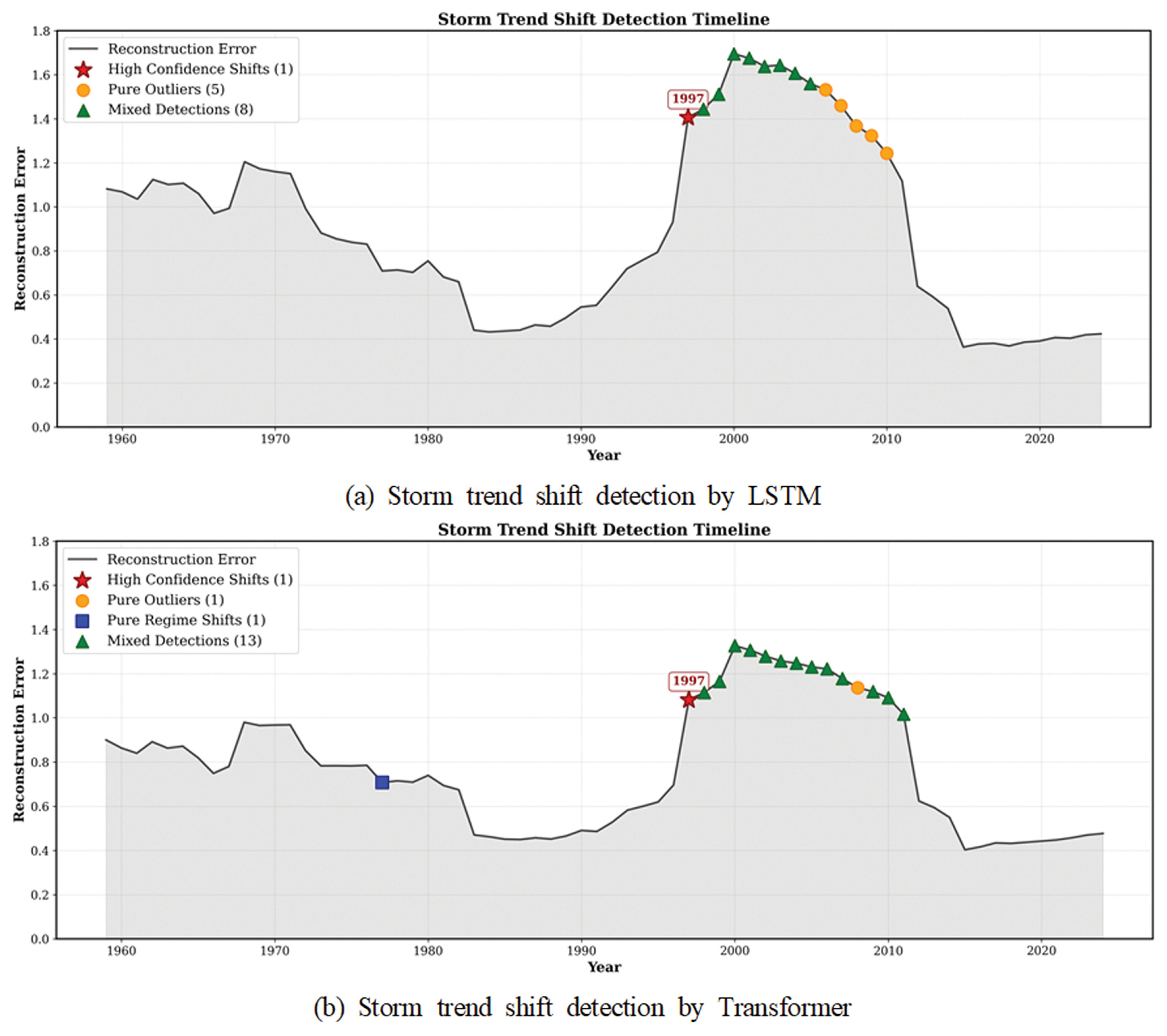
본 연구의 2장에서 설명한 것과 같이 열대저기압의 시계열 변화를 감지하기 위해 서로 독립된 3가지 방법을 사용하였으며, 각각의 방법은 outlier detection, statistical test, TL-AE shift(Time-Lagged autoencoder) 이다. 각각의 검출 방법을 사용하여 특성 변화로 검출된 시기를 Table 4에 정리하였다. 분석 결과 세 가지 방법의 검출 개수와 시기가 다소 차이가 있으며, 특히 TL-AE shift에서 큰 차이를 보여주었다. 이것은 LSTM과 Transformer 두 모델로부터 생성된 reconstruction error가 Fig. 4와 같이 전 구간에서 형상은 매우 유사하지만, 그 강도에서 차이가 있기 때문이다. 단기 변화에 민감한 LSTM과 장기 구조적 변화 포착 성능이 우수한 Transformer 두 모델의 연산 결과를 활용하여 획득한 최종 결과는 장기 추세 변화에 대한 강력한 신호라고 판단할 수 있다. 인공지능과 통계 기법이 연계된 다중 모델 연산의 결과로부터 Table 4와 같이 각 기법에 따른 추세 전환 검출 연도를 획득하였다. 최종적으로 이들 결과를 토대로 앞에서 설명한 Table 3과 같은 조합을 사용하여 Voting matrix를 구성한 후, 3가지 결과가 모두 합의된 최종 목표인 High confidence detection을 얻고자 하였다.
각각의 Voting matrix에서 합의된 결과를 Table 5에 나타내었으며, High confidence로 결정된 1997년을 북서태평양 열대저기압의 장기 추세 전환점으로 추정하였다(Fig. 4). 특히 주목할 점은 Pure regime shift는 모델에서 독립적으로 연산하며 이론적으로 장기 변화의 시작점을 보여주는데, 본 연구의 Transformer 모델 결과에서 High confidence가 발생하기 20년 전인 1977년이 변동 시점으로 검출되는 것을 확인할 수 있다. 1995년 이후 reconstruction error를 비롯한 대부분의 지표가 급격히 상승하여 High confidence 이후에도 일관적인 추세 변화 경보가 감지되는 것을 확인할 수 있다. 두 모델 모두에서 1997년 High confidence 이후 2000년에 reconstruction error가 최고 수치에 도달하였으며, 다수의 Mixed detection 이후에 Pure outliers가 연속되어 검출되었다. 2000년 이후 기간은 전체 시계열 기간에서 가장 두드러진 이상 현상을 나타낸다. 특히 1997년부터 2005년 구간에서 이상 검출이 집중되고 있음을 알 수 있다.
일반적으로 전환기의 시작을 의미하는 Pure regime은 1977년에 1회 발생하였으며, 열대저기압의 실질적이고 지속적인 변화의 시작을 의미한다. Pure outliers는 정점으로부터 하강하는 시계열의 마지막까지 탐지되었으며, 이러한 연속적인 변동성 증가는 향후 지속적이고 중대한 변화를 예고한다고 할 수 있다. Mixed detection은 reconstruction error 정점의 전후에서 관찰되었으며, High confidence와 Pure outliers의 중간 기간에 자리 잡고 있어 명확하게 드러난 현상은 아니지만, 중대한 변화를 암시하는 것으로 판단된다. Mixed detection과 Pure outliers 모두 급격한 변환인 outlier를 포함하고 있으며, 열대저기압 자료의 급하강 직전인 2010년까지 흐름이 이어지는 것을 고려할 때 시스템이 크게 전환하는 regime shift가 발생한 것으로 의심된다. 다만 모델의 특성상 장기간의 sequence length를 사용하는 구조적 한계로, 시계열의 끝부분에 있는 2015년 이후 발생한 재 상승 구간에 대해서는 전후 데이터를 충분히 고려할 수 없어, 현시점에서는 판정이 제한된 것으로 보인다. 하지만 1977년의 Pure regime shift 이후에 High confidence 및 연속적으로 강한 경보가 발생하는 것을 볼 때, 물리적으로 중대한 변화가 시스템 전반적으로 진행되고 있을 가능성이 높다.
참고로 1976-1977년은 북태평양 regime shift로 이미 잘 알려져 있다(Giamalaki et al., 2018; Hare and Mantua, 2000). 이 기간을 기준으로 해수면 온도의 급격한 상승이 관측되었으며, 해양과 대기의 결합 상태가 급변한 것으로 보고되며, PDO와 함께 언급되는 경우가 많다. PDO(Pacifice Decadal Oscillation)의 명칭과 같이 주기가 약 10년인 것을 고려할 때, 1997년의 High Confidence는 이러한 큰 변화의 흐름에 있음을 알 수 있다. 1997년은 또 다른 regime shift로 알려져 있다. 1977년 이후 계속되던 따뜻한 위상에서 차가운 위상으로 전환되었으며(Overland et al., 2008), 북태평양의 연평균 해수면 온도의 변화가 발생하였으며 관측 사상 가장 강한 엘리뇨가 관측된 것으로 알려져 있다(Vecchi and Harrison, 2006).
이러한 강한 변화 신호와 달리, 1980년 이전 기간에서 reconstruction error가 비교적 높음에도 불구하고 추세 전환 신호가 검출되지 않는 이유는, Voting matrix를 통해 여러 검출 알고리즘의 합의가 필요한데도 불구하고 과거의 결과는 단일 지표만 높았을 가능성이 높다. 더욱이 Transformer에 의해 1977년의 Pure regime shift 및 다수의 Mixed detection의 검출은 전 구간에 대해 미세한 변화도 검출하는 특성을 보여준다.
ENSO는 엘니뇨와 라니냐로 구성되며, 평균적으로 2~5년을 주기로 발생하는 전 지구적인 주요 기상현상이다. ENSO는 오랜 연구를 통해 열대저기압의 특성과 상관관계가 있다고 알려져 있기에, 위 Voting matrix 결과와 연관된 주요 이벤트를 조사하였다. 역사상 매우 강한 엘니뇨 발생 기간은 시간 순서로 1982~1983년, 1997~1998년, 2015~2016년이며, 반대로 강한 라니냐 발생은 1973~1974년, 1975~1976년, 1988~1989년, 1998~2000년, 2007~2008년, 2010~2011년이다. 본 연구 결과와 연관된 1997년은 매우 강한 엘니뇨 발생 기간이며, 1977년은 강한 라니냐 기간과 연결되며, 2000~2010년은 강한 라니냐 구간과 연관된다. High confidence인 1997년은 대표적인 강한 엘니뇨에 해당한다. 이를 다시 정리하면 High confidence는 강한 엘니뇨 기간에 위치하며 이후 강한 라니냐가 이어지는 것을 고려하면, 1997년은 엘니뇨와 라니냐의 추세 전환기로 추정된다. 최근 전 세계적인 초고온 현상에도 불구하고, 본 연구 결과는 2015년 이후를 정상 기간으로 기록하였다. ENSO가 열대저기압에 미치는 양상이 매우 다양하므로, 최근의 기상현상과 본 연구의 결과와의 직접적인 인과 관계를 단정하기는 어렵다. 다만 ENSO는 열대저기압의 발생 개수보다 발생 위치, 이동 경로, 최고 강도 등에 더 큰 영향을 미치는 것으로 알려져 있다(Yonekura and Hall, 2014).
3.3 SHAP의 주요 요인 분석
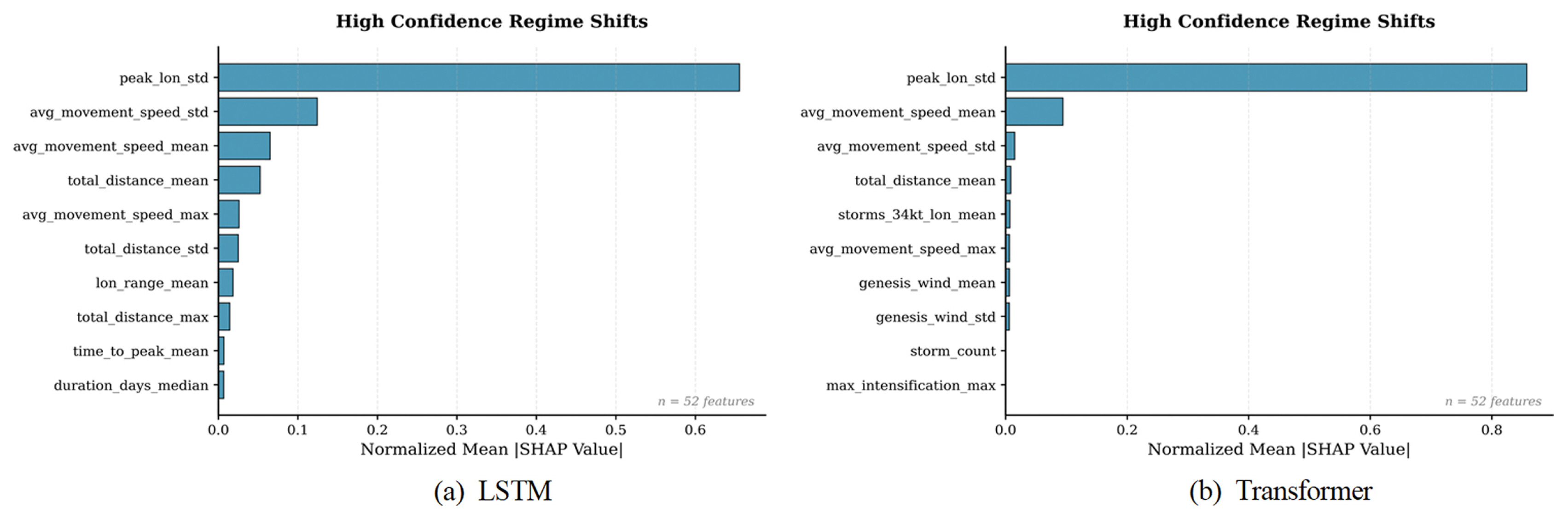
본 연구에서 SHAP 기법은 딥러닝 결과에 대한 열대저기압 장기 추세 전환의 주요 요인들을 분석하고자 사용되었다. 모델에 사용된 52개의 feature를 분석하여 가장 우선순위가 높은 10개의 feature에 대한 중요도를 Fig. 5와 같이 정량적으로 평가하였다. 두 모델 모두 최상위 순위만 동일하며, 그 이후 열대저기압의 이동 거리 및 이동 속도가 상위권에 자리잡고 있다. 하지만, 최상위 한가지 feature만 유의미한 기여도를 보였고 나머지 feature의 기여도는 매우 낮았기 때문에, 나머지 feature는 참고 자료로만 제시하였다. 참고로 최상위로 분석된 peak_lon_std는 열대저기압 최대 강도 시점의 경도 위치에 대한 분산을 의미하며, avg_movement_speed_std는 열대저기압의 평균 이동속도의 분산을 보여준다. 가장 비중이 높은 feature인 peak_lon_std는 열대저기압의 발달 위치 분포에 관한 내용으로, 열대저기압의 공간적 변동성이 가장 결정적인 지표인 것을 의미한다.
Fig. 5에서는 순위를 표시하기 위해 SHAP의 절댓값을 사용하였으며, 상위 feature의 물리적 의미를 설명하면 다음과 같다. peak_long_std은 열대저기압 최대 강도에서의 동서 분포를 의미하며, 이동속도 또한 주요 지표임을 의미한다. 즉 추세 전환점인 1997년 이후에 열대저기압은 최대 강도의 발현이 좀 더 서쪽으로 이동하고 있으며, 이동속도의 증가로 열대저기압의 강도가 더 강해지거나 좀 더 고위도에서 소멸하는 최근의 특성과 연관되었을 것으로 추정된다. 상위 feature들의 특성을 고려하면, 열대저기압의 장기 추세 변화는 단순히 최대 풍속과 같은 강도의 변화뿐 아니라 운동학적 특성 변화와 밀접하게 관계있음을 알 수 있다.
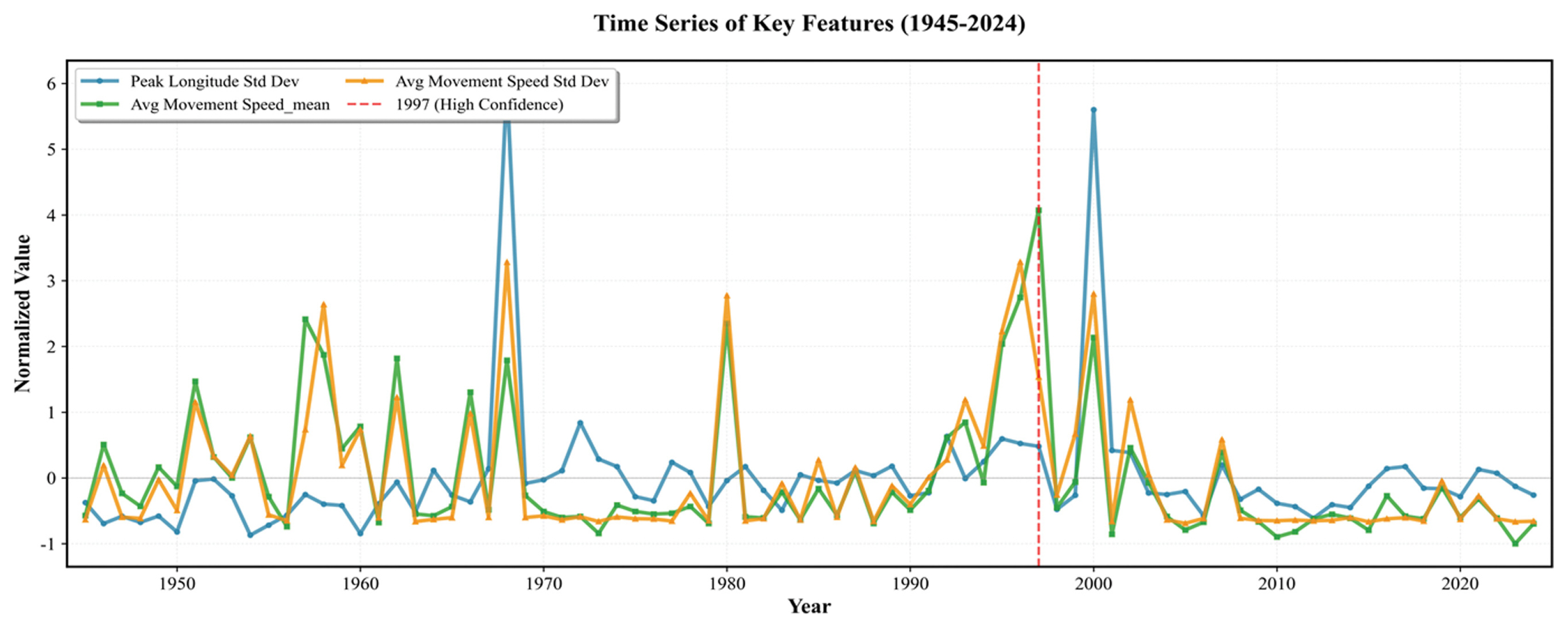
SHAP 분석으로부터 최고 기여도로 판정된 peak_lon_std, avg_movement_speed_std, avg_movement_speed_mean feature의 시계열 자료를 Fig. 6에 나타내었다. High confidence인 1997년을 제외한 다른 2개의 시점에서(1968, 2000년)도 주요 feature들이 집중되는 것을 확인할 수 있다. 이를 통해 또 다른 장기 추세 전환점을 기대할 수 있으나, 실제 1968년 전후는 북서태평양에서 특징적인 현상이 기록되지 않았다. 딥러닝 모델을 이용한 복잡한 시계열 분석에서는 단순한 선형 관계를 넘어 feature들 간의 복잡한 상호작용이 존재하기 때문에, 주요 feature가 동일 시점에 발현하더라도 반드시 시계열에서 변화를 의미하지는 않는다. 이것은 SHAP의 분석 결과는 특정 시점에 대한 feature의 분석과 기여도만을 의미하기 때문이다. 즉 본 연구에서 최상위로 분석된 feature가 열대저기압의 물리적 추세 변화를 발생하는 것은 아니라는 의미이다.
4. 결 론
본 연구에서는 딥러닝 기반 LSTM 오토인코더와 Transformer 오토인코더를 통합하고 통계적 기법을 함께 적용한 다중 아키텍처 방법론을 통해 북서태평양 열대저기압의 장기 추세 변화를 효과적으로 탐지하고자 하였다. 80년에 달하는 방대한 열대저기압 시계열 자료를 분석한 결과, 1997년을 전후하여 유의미한 장기 추세 전환점이 탐지된 것으로 확인되었다. 딥러닝 모델들은 열대저기압 feature의 비선형 상호 작용을 효과적으로 분석하였으며, 서로 다른 세 가지 변화 탐지 알고리즘(outlier 탐지, 통계적 검증, Time-Lagged 오토인코더)의 Voting을 통해 1997년을 모든 기법이 공통으로 지목하는 변환 시점으로 도출함으로써, 제안된 인공지능 모델이 열대저기압 장기 추세 변화 탐지에 높은 신뢰성과 정확성을 제공함을 확인하였다. 주요 연구 결과로는 1997년을 High confidence에 의한 주요 장기 추세 전환점으로 결정하였으며, 1977년에는 Pure regime shift가 선행하여 발생하였으며, High confidence 기간 이후에 Mixed detection, Pure outliers가 연속적으로 검출되어 1997년 이후 열대저기압 시스템의 근본적 변화가 진행 중임을 시사한다.
SHAP 기반 분석 결과 열대저기압의 장기 추세 변화에 가장 크게 기여한 요인은 peak_long_std으로 분석되었으며, 그 뒤를 이어 이동 속도 및 이동 거리가 중요 요인으로 분류되었다. 이는 열대저기압의 최대 풍속과 같은 강도의 변화뿐만 아니라, 공간에 대한 운동학적 특성 변화가 주요 요인이 될 수 있음을 의미한다. 이러한 변화는 전 지구적인 ENSO 현상과 밀접한 관계가 있음을 보여주며, 검출된 기간 전후로 발생한 기록적인 해수면 온도 상승과 급격한 강도 강화 증가 등 실제 자연현상과도 부합한다. 본 연구에서 제시한 딥러닝-통계 융합 방법론은 열대저기압 특성의 장기 변화를 정량적으로 추정할 수 있는 새로운 시도로써, 기존 통계 분석에 인공 지능을 접목함으로써 결과의 신뢰도를 향상시켰다. 연구를 수행한 2025년은 과거와 다른 열대저기압 활동의 이상 변화를 보여주고 있다. 아직 공인기관의 베스트 트랙이 제공되지 않아서 확정 지을 수 없지만, 매우 높은 연중 기온에도 불구하고 한반도에 영향을 준 열대저기압 활동이 없었으며 10월 이후 동남아시아 해역에는 이례적으로 매우 강한 등급을 가진 다수의 열대저기압이 연속적으로 발생하고 있다. 이러한 기후변화가 지속적으로 진행되고 있는 시점에서 본 연구는 장기 재현 빈도 분석의 재평가 필요성과 급격히 변화하는 기후 변화 시대에 해안 구조물의 위험 평가 기준과 방재 전략 수립에 중요한 과학적 근거를 제공할 것으로 기대된다. 향후 연구에서는 열대저기압의 급속 강화에 대한 지역별 세분화된 영향 평가를 수행하여, 시스템 전반에 대한 섬세한 기후 인자 분석을 수행할 필요가 있다.



 PDF Links
 PubReader
 ePub Link
 Full text via DOI
 Download Citation
  Print
Print